

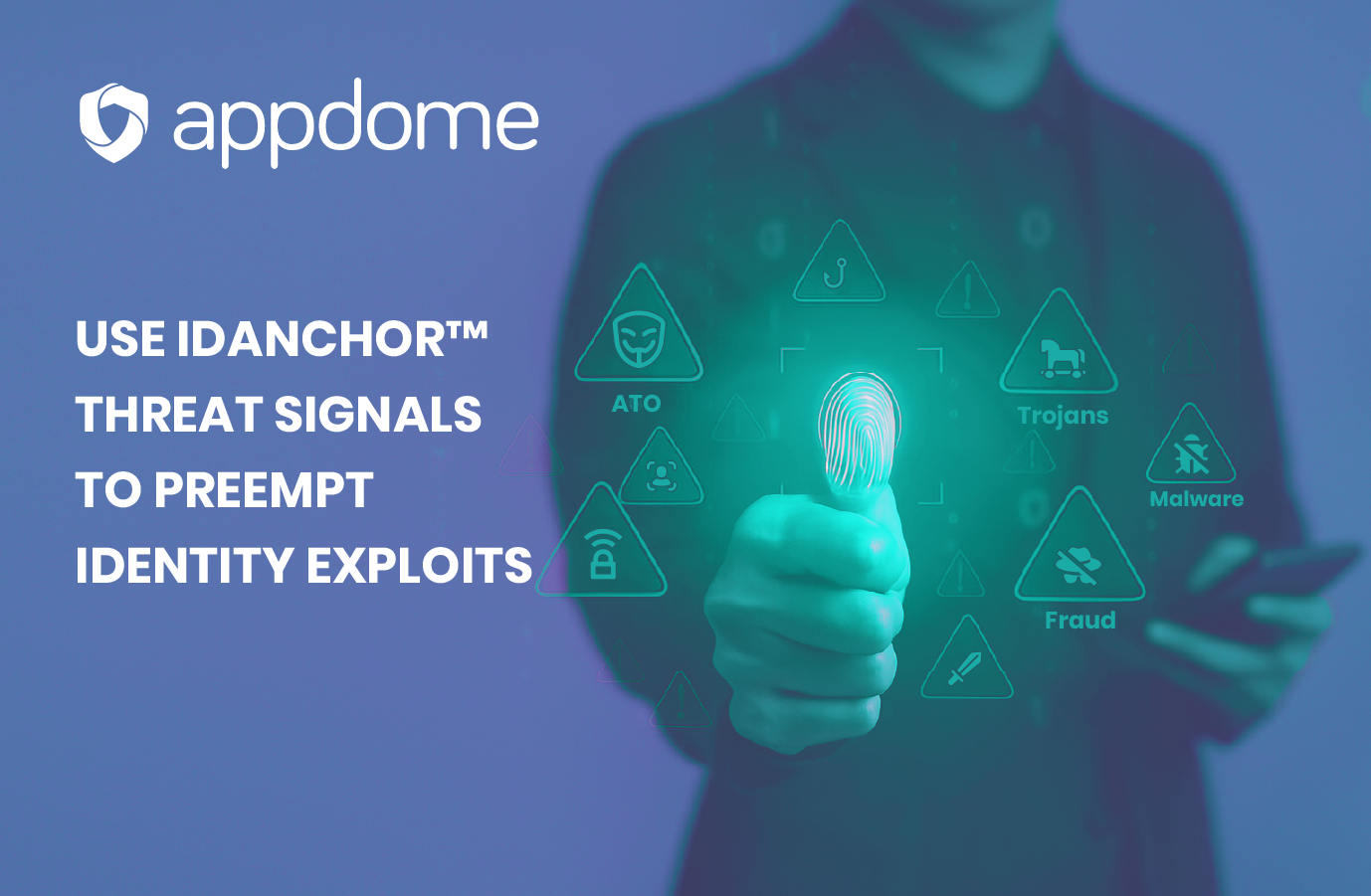
Use IDAnchor Threat Signals to Preempt Identity Exploits
In earlier posts, we defined Customer Identity Protection (CIP) and shared why IDAnchor is the foundation of Trusted Customer Identity in mobile apps. Now, let’s turn to the need for threat signals to preempt identity exploits in mobile apps—before, during, and after authentication workflows.
Customer identity in the mobile economy is at risk. Mobile-specific threats, ranging from the old world of mobile device compromises to the new world of on-device fraud, location spoofing, synthetic identities, social engineering scams, and AI-powered exploits, have outpaced biometric authentication, CIAM, IAM, and IDV systems. mobile fraud has the upper hand.
Real-time threat signals can be used to confirm if it’s safe to call an identity service in a mobile app and if a given identity assertion or response from the identity service is safe, authentic, and trustworthy.
What are Identity Exploits?
Customer Identity plays a role in every stage of the mobile application lifecycle, governing which actions are allowed or denied in the app. From access and login to in-app activities, social engagement, purchases, and payments, validating the customer’s identity ensures that the legitimate account holder is performing the actions.
However, if every activity in a mobile app depends on a real, valid, and true customer identity, doesn’t that mean that every function, system, call, method, store, API and component used to create, assert and validate identity can be the target of a potential exploit? The answer, I’m afraid, is “yes.”
An identity exploit exists when an attacker has control of the means to create, assert or validate identity in a mobile app. This includes the device camera, memory, attributes, or the mobile app’s CIAM, IDV, authentication or payment processes, communication channels, user interactions such as face recognition, keystrokes, gestures, installs, etc.
IDAnchor’s Threat Signals Prevent Exploit Staging
IDAnchor’s threat signals are detection events that reveal identity exploits before they can be used to bypass authentication and create Account Takeovers (ATOs). They provide threat identification, telemetry, and behavior from a user’s mobile environment at runtime and complement the CIP’s identity chain of trust. The CIP chain of trust reveals fake devices, fake installs, alternative devices, spoofed devices, and fake applications. The Threat Signals reveal geo-fraud, deepfakes, spyware, social engineering, and other similar identity threats.
Like looking both ways before crossing a busy street, IDAnchor’s threat signals can determine if it’s safe for the app to call CIAM or IDV via login, registration, or record any action in a mobile app. For example, IDAnchor’s Threat Signals can determine:
- Is the app instance valid and untampered?
- Is the app controlled by RCE, RAT, ATS Malware or other threat?
- Is the entity making the identity assertion real (e.g., not using a deepfake, injected keystrokes, gestures, or over a spoofed GPS)?
- Is the user’s identity at risk from spyware or other threat?
- Is the device genuine and uncompromised?
- Is the activity in app generated by anything other than the user?
Evaluating risks before calling a Biometric Authentication (or payment, password reset, or any critical function in the app) has several advantages. Principal among these is that it detects any exploit staging that attackers use to prepare each attack. If the application knows an exploit has been staged, it can avoid unsafe authentication attempts and safeguard biometric and user data it would have otherwise sent to the identity system. By the time the biometric authentication or CIAM system is engaged, it’s too late. All the elements of the environment used to create, use, and access Customer Identity are already controlled by the attacker.
IDAnchor’s Threat Signals Protect CIAM & IDV
CIP, and IDAnchor™ specifically, doesn’t replace CIAM or IDV workflows—it protects them. IDAnchor’s threat signals can be used by CIAM or IDV to assess the risk of identity exploits with more threat data than these systems have access to today. In addition, the same threat signals can be used by a mobile application to verify the authenticity of CIAM and IDV responses. Either way, IDAnchor’s threat signals can be used to:
- Trigger step-up authentication or Enhanced Due Diligence (KYC) workflows.
- Deny or pause identity creation or verification.
- Initiate re-verification if behaviors deviate from known norms.
- Open private communication with the user if social engineering is expected.
- Notify and educate users on detected risks.
With IDAnchor’s threat signals, mobile application workflows – inside and out of CIAM and IDV – become adaptive, dynamically adjusting based on the Identity risk posture of the user, app, and device.
IDAnchor Threat Signals Protect Sessions & Transactions
A major fallacy in mobile identity is assuming that authentication success equals trust. It doesn’t. The reality is that 60% of fraud today occurs after successful authentication, where attackers exploit trusted sessions to commit transaction fraud, program abuse, and account takeovers.
Imagine a real user signs into an application as normal. It’s a real user, real application, and real device. But the real user, using the real application on the real device, doesn’t realize that she has malware on the device designed to steal her identity or alter her transaction to send the goods she just purchased to another address (not hers).
In this and hundreds of other similar scenarios, IDAnchor’s threat signals enable the app to be threat-aware of transaction, account, and identity risks, and to monitor behavioral drift (e.g., sudden changes in interaction speed, location, input method, or other session attributes). In this way, IDAnchor’s threat signals go beyond protecting the authenticity of the user to protecting the authenticity of each interaction, session, and transaction.
Conclusion
Attackers no longer wait for authentication. They manipulate it. They bypass it. They use brute-force to break it. They have so many tools at their disposal to do so, from emulators to session replays, synthetic profiles, social engineering, and AI-generated attacks. The only way to restore trust in customer identity is to verify that identity’s full context and measure trust with real-time Threat Signals from the CIP.
Without real-time threat signals from IDAnchor, identity systems are blind to the risks that surround them. They make decisions in the dark, often trusting sessions and users that are actively under attack. However, with IDAnchor’s threat signals, mobile apps can determine risk, enforce policy, and maintain trust at every stage of the identity journey.
All CIAMs, IDV and MFA systems, and even fraud vendors lack on-device intelligence that spans the device, OS, interaction, and network layer. Moreover, they can’t combine threat intelligence with a chain of trust or deliver threat detection as an identity context in a mobile app. IDAnchor does – that’s its purpose.
To learn more about integrating Threat Signals into your identity flows or to see how CIP protects mobile identity in real time, contact us at info@appdome.com or click the button below to request a live demo from one of our identity experts.