

Summary
Modern mobile threats have outpaced manual investigation and fragmented mobile security workflows. Appdome’s Agentic AI replaces these inefficiencies with governed, digital workflows that continuously interpret threats and deliver precise, contextual remediation. Operating inside strict enterprise guardrails, the Agents give security, fraud, DevOps, and support teams faster insight, deeper context, and consistent, explainable outcomes at scale.
Mobile security teams face increasing operational pressure. Threats evolve quickly, devices diversify, OS versions proliferate, and attackers exploit every gap in visibility, coordination, and response time. As a result, SecOps, Fraud, DevOps, and Support organizations rely heavily on manual investigative work—reviewing logs, correlating events, documenting remediation steps, recreating issues on test devices, and escalating cases across teams. These workflows are slow, fragmented, and highly dependent on individual expertise.
This approach worked when the threat surface was manageable. It does not work today. The volume, speed, and variability of modern mobile attacks now exceed what manual workflows can absorb. Organizations need a new operational model—one that transforms manual work into digital workflows that are continuous, contextual, and repeatable.
Appdome’s Agentic AI initiative was created to provide exactly that.
A Practical Start to an Important Shift
Over a decade, Appdome has accumulated a rich dataset—specific device events, build metadata, device and OS telemetry, and trillions of threat events. Bringing AI reasoning into this environment allowed us to create purpose-built agents capable of analyzing mobile threats and workflows at a level of depth external tools cannot provide.
Across this dataset and customer conversations, simple patterns emerged:
SecOps teams spend way too much time identifying which events matter, which correlate, and which represent the early stages of a larger attack.
Fraud teams attempt to interpret incomplete behavioral signals spread across multiple tools.
Support organizations waste too much time trying to diagnose user issues with limited information, unfamiliar device states, and inconsistent threat descriptions.
DevOps teams lack continuous confirmation that security configurations remain intact across releases and pipelines.
These challenges are not rooted in lack of skill or lack of commitment. They stem from workflows that require manual correlation, manual investigation, and manual communication. As the mobile threat environment expands, these workflows become increasingly inefficient and error-prone.
Agentic AI was designed to replace these manual dependencies with digital workflows that are systematic, contextual, and autonomous.
SecOps Agent: Continuous Understanding of the Threat Landscape
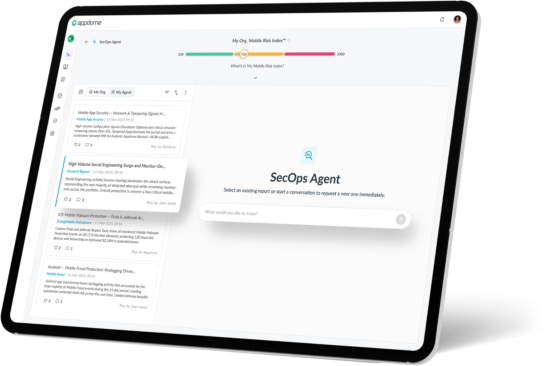
SecOps Agent was developed to help security teams understand the threat landscape as it unfolds, not after the fact. The Agent analyzes threat signals, device profiles, OS versions, geographic distributions, and attack patterns, and then organizes them into coherent narratives. It identifies relationships between events, highlights significant deviations from expected behavior, and prioritizes the findings that warrant attention.
What makes this possible is Appdome’s deep context. The Agent evaluates not only the raw signals but also the defense posture of the app—what protections are in place, what configurations apply to each release, and what threats are being detected or blocked. By reasoning across these layers, SecOps Agent provides clarity that would otherwise require extensive manual investigation.
The result is a continuously updated, machine-reasoned view of the organization’s attack surface. Analysts gain insight faster, make decisions more quickly, and reduce the time spent on foundational investigative work.
Support Agent: Precise, Contextual Threat Resolution
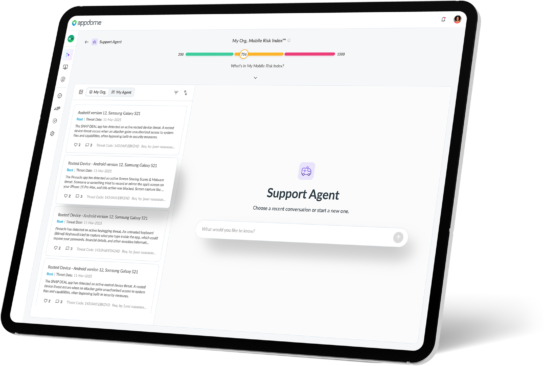
Support Agent applies the same principles to the domain of end-user remediation. Support teams frequently receive incomplete, ambiguous, or device-specific problems related to malware, tampering, untrusted apps, or compromised device environments. These cases traditionally require lengthy investigation, repeated user communication, and manual creation of instructions.
Support Agent eliminates these steps by using a ThreatCode™—a unique fingerprint containing the app, OS, device, and threat context—to generate precise, step-by-step remediation guidance. The instructions are tailored to the specific scenario, ensuring accuracy regardless of device model or OS version. The Agent also supports follow-up questions, alternative paths, and clarification prompts, turning what was a complex troubleshooting task into a streamlined digital workflow.
This reduces resolution times, ensures consistency across support teams, and restores user trust more efficiently.
Collaboration Through Integrated Workflows
Modern mobile defense requires cross-functional collaboration. Attack patterns span threat categories. Remediation efforts impact app behavior. Release changes influence security posture. When collaboration depends on email, spreadsheets, or disconnected chat threads, information is lost, misunderstood, or delayed.
By integrating Agentic AI into Appdome’s social enterprise framework, we allow teams to share findings, comment on recommendations, challenge interpretations, and track decision-making directly within the platform. Collaboration becomes part of the workflow itself, rather than an external process.
This integrated model enables organizations to act more cohesively and reduces the friction that typically occurs between security, fraud, support, and engineering functions.
A Decade of Platform Investment Enabling Agentic AI
Agentic AI would not be possible without the architecture Appdome has developed since 2016. The platform’s defense configuration engine, build metadata, threat telemetry, and device intelligence form the foundation that allows AI reasoning to be both accurate and contextually aware.
Equally important is the platform’s governance model. All Agentic AI operations occur entirely within Appdome’s enterprise-grade environment, where every action is governed by strict security, privacy, and compliance controls. No threat telemetry, device attributes, remediation instructions, or user interactions ever leave the platform or flow into public AI systems, and no PII is processed in any Agentic AI workflow. Appdome enforces tenant-scoped isolation across all customers to prevent cross-organization data exposure, and applies strict No-Learning and No-Retention policies to ensure that no external reasoning component can store, persist, or train on enterprise data.
Every agent action is fully auditable and tied to enterprise access and change-management policies, giving organizations complete visibility and control over how AI is used. Combined with Appdome’s Context Engineering approach—which grounds all reasoning in verified, customer-specific threat telemetry and build context—these guardrails allow teams to embrace AI-enhanced workflows confidently, without compromising confidentiality, compliance, or operational governance.
With this foundation in place, Agentic AI represents not an incremental addition but a transformation in how mobile defense is operationalized.
Conclusion: A New Operational Model for Mobile Security
The complexity of the mobile threat landscape requires a shift from manual, reactive processes to automated, intelligence-driven workflows. Agentic AI provides this shift by enabling continuous threat evaluation, precise user remediation, and integrated collaboration, all within the secure environment of the Appdome platform.
For cyber and devops teams, the significance is clear: this is a transition from feature-based improvements to workflow-based transformation. By converting manual steps into digital workflows, we enable mobile organizations to operate with greater speed, consistency, and alignment across all functions.
This is the next phase of mobile defense—one built not only on stronger protections, but on smarter, more efficient ways of working. Agentic AI is the catalyst enabling that evolution.
Ready to modernize your mobile security workflows?
Get a demo of Appdome’s Agentic AI.