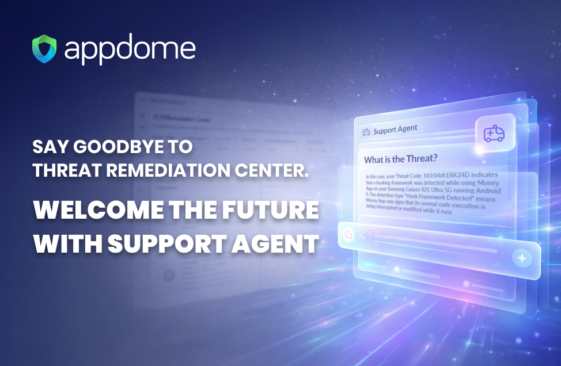

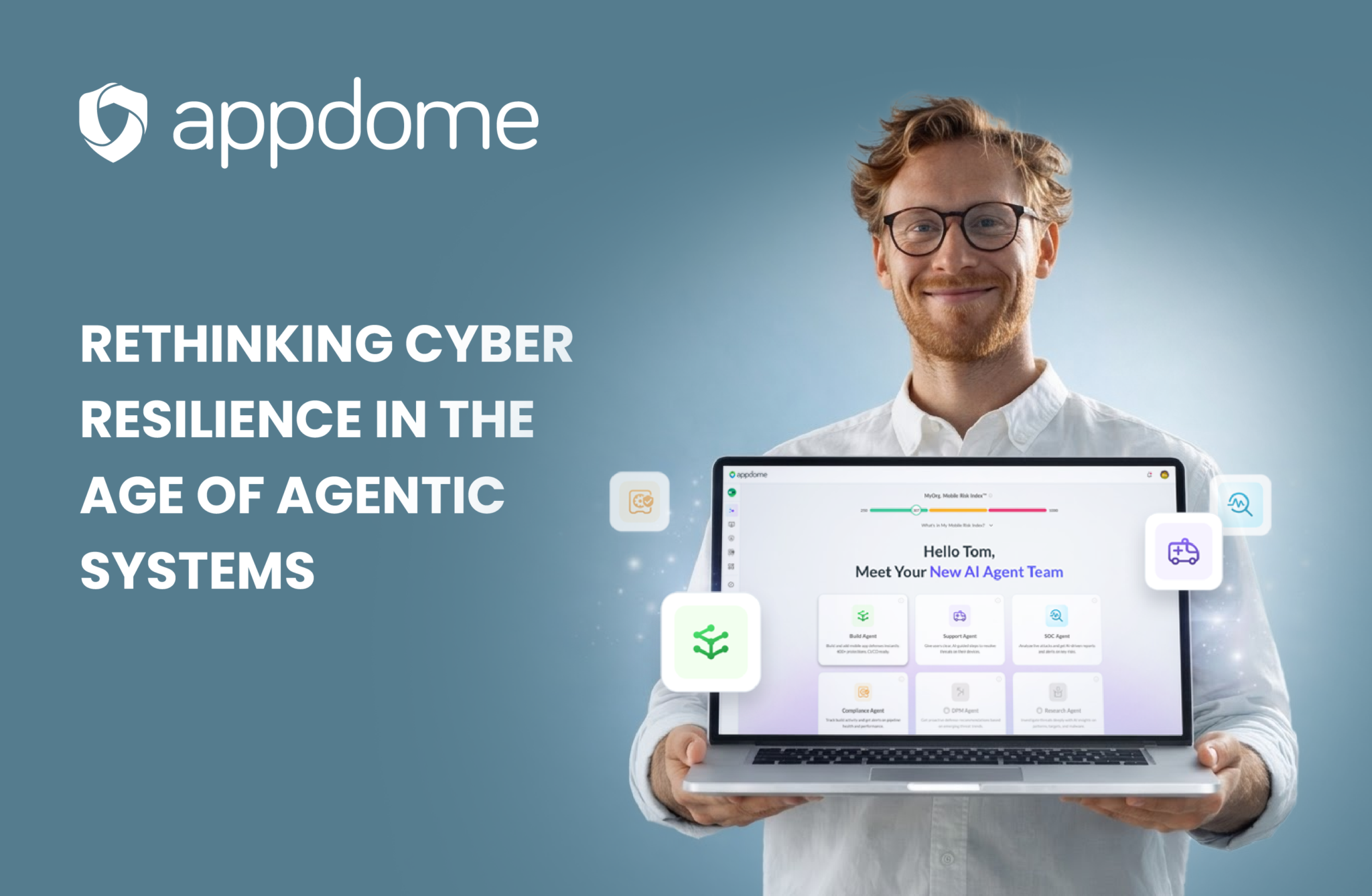
Today at the 2026 RSA Conference, Appdome was recognized as the best AI Platform for Cyber Resilience for the second year in a row. I’m very proud of this and would like to explain why.
Over the past few years, the cyber industry has advocated for using AI to analyze threats and achieve better detection, faster analysis, and improved threat prioritization. Still, a much larger story is emerging quickly, namely: how do cyber professionals act on these enhanced insights, or, better said, whether “we,” as the cyber humans, function as the primary workers in the response and remediation journey vs. Agentic systems that perform work.
I believe we are entering an age of Agentic Cyber Resilience, and this evolution is perhaps the most exciting time to be in cyber.
The Work Problem No One Really Solves
Attackers are already using AI to perform work at scale. A modern fraud ring is an operations center, increasingly agentic, automated, adaptive, and relentless. On the defender’s side, however, the model still relies on better detection rather than on better, faster, and more productive decisions and work. Investigations and decisions are performed by individuals, with the help of better tools, I’ll grant you, but still at human speed. Even as AI has entered the picture, the core assumption hasn’t really changed. The human is still expected to do the work—just faster, with better information. This leaves the defenders at a huge disadvantage, chasing where the fraudster was, not where the fraudster or cyber attacker is or will be. That model doesn’t break. It falls behind and fast.
AI Co-Pilots in Cyber Resilience
Most AI deployments in cybersecurity today involve AI co-pilots that assist human decision makers. At their best, they educate cyber teams on threats, summarize alerts, prioritize queues, highlight anomalies, and suggest next steps. In many cases, they reduce the cognitive load on resource-strapped cyber and fraud teams, but they don’t change the nature of the work.
What is Agentic Cyber Resilience
Agentic Cyber Resilience is the ability of an agent system to receive threat data, reason, and act to respond or remediate threats autonomously as the threats arise. Agentic cyber resilience is not about humans using smarter systems. It’s about systems performing tasks and functions, and elevating (not just preserving) the human in the loop. In Agentic cyber resilience, the agent is delegated responsibility for response and execution and does so autonomously.
A key aspect of Agentic Cyber Resilience is the agent system’s ability to perform work. That is, going beyond using AI to inform decision-making to allowing AI to make decisions and carry out the response action. Agents can operate continuously, evaluate context in real time, and act within boundaries defined by humans. The cyber human sets the context for Agentic autonomy, and the agents act, avoiding the need to wait for approval loops or ticketing systems to complete work.
If you extend that idea, you arrive at something that starts to look less like improved search and business intelligence and more like an agentic workforce embedded in the cyber organization itself—managed, of course, by the cyber humans and CISO. In the agentic model of cyber resilience, the cyber agent performs an increasing number of tasks and functions that were previously handled manually. For example, deploying defensive capabilities, enforcing policies, validating trust, responding to threats, maintaining records, and adapting behavior over time. As the attack surface increases, agentic work if free to scale independently of headcount.
Scaling the Cyber Workload with AI
Every part of the business is using AI and agentic systems to scale, but cyber and fraud teams are currently lagging their enterprise peers in using agentic systems to scale work. These organizations sit at the intersection of growth and risk. As organizations expand—more users, more devices, more APIs, more transactions—the attack surface grows alongside it. And the adversary evolves just as quickly, if not faster than the business grows.
In the agentic age, hiring and training alone cannot keep pace with the multidimensional growth in business operations, engineering output, and the expanding attack surface. There’s no steady state where the number of analysts or cyber professionals – even if armed with frontier model accounts – matches the volume of decisions that need to be made. The gap has quietly become structural, and smart CISOs and cyber teams have started to rethink how the work itself gets done.
Rethinking Resilience in the Agentic Age
In an agentic world, cyber resilience has started to look less like recovery and more like a continuity of action. Not just the ability to respond, but the ability to offload defensive work to agentic workers to ensure defensive measures are always being performed—in the moment and pre-emptively, and without delay.
For example, cybersecurity has always been about decisions. Whether to trust a device, whether to allow a session, whether to grant access to an API, whether to proceed with a transaction. These are simple questions, but they occur at an enormous scale and within an increasingly complex threat context. Anti-fraud and cyber systems that merely inform human users and help them make better decisions create bottlenecks. They surface and prioritize problems. But the real work—making the decision and executing it—can overload humans.
At Appdome, we believe that Agentic systems have started to take on the burden of work – coding security, anti-fraud, and other defensive measures into mobile applications on behalf of humans. On Appdome, humans define the policy intent, and the agent creates and executes the code needed for each policy in a mobile application. Humans are freed from the burden of implementation and maintenance. They are also freed from the need to evaluate every detected threat, as the agent allows an elevated human-in-the-loop to change and adapt policies on demand as threats emerge. Instead of laborious work, CISOs and cyber teams focus on defining intent, setting boundaries, and shaping how the system performs work.
In Appdome’s vision of the agentic future of cyber resilience, the cyber team’s role becomes less about bargaining for resources and reacting after the fact, and more about designing defensive policies that will keep a business secure. After that, the machine – in our case, Appdome – does the actual work.
There is still oversight. There are still exceptions. There are still decisions that require human judgment. But the center of work shifts from the human to the agent. Cyber moves from operator to orchestrator. From executor to manager and architect.
Looking Forward
The promise of agentic systems will always be defined by how much data it can process and how quickly it can analyze it. Still, going forward, we believe the future of agentic systems inside cyber functions will also be defined by how effectively an agentic system can reason and translate its understanding into action—consistently, automatically, and at scale to keep a business secure.
We are encouraged by this quiet evolution and are excited to usher in a new era of cyber resilience for all digital brands and businesses. Stay tuned for more on how we take this concept of agentic work even further.
For more information or to start a conversation, drop me a line at info@appdome.com.
Thank you!