

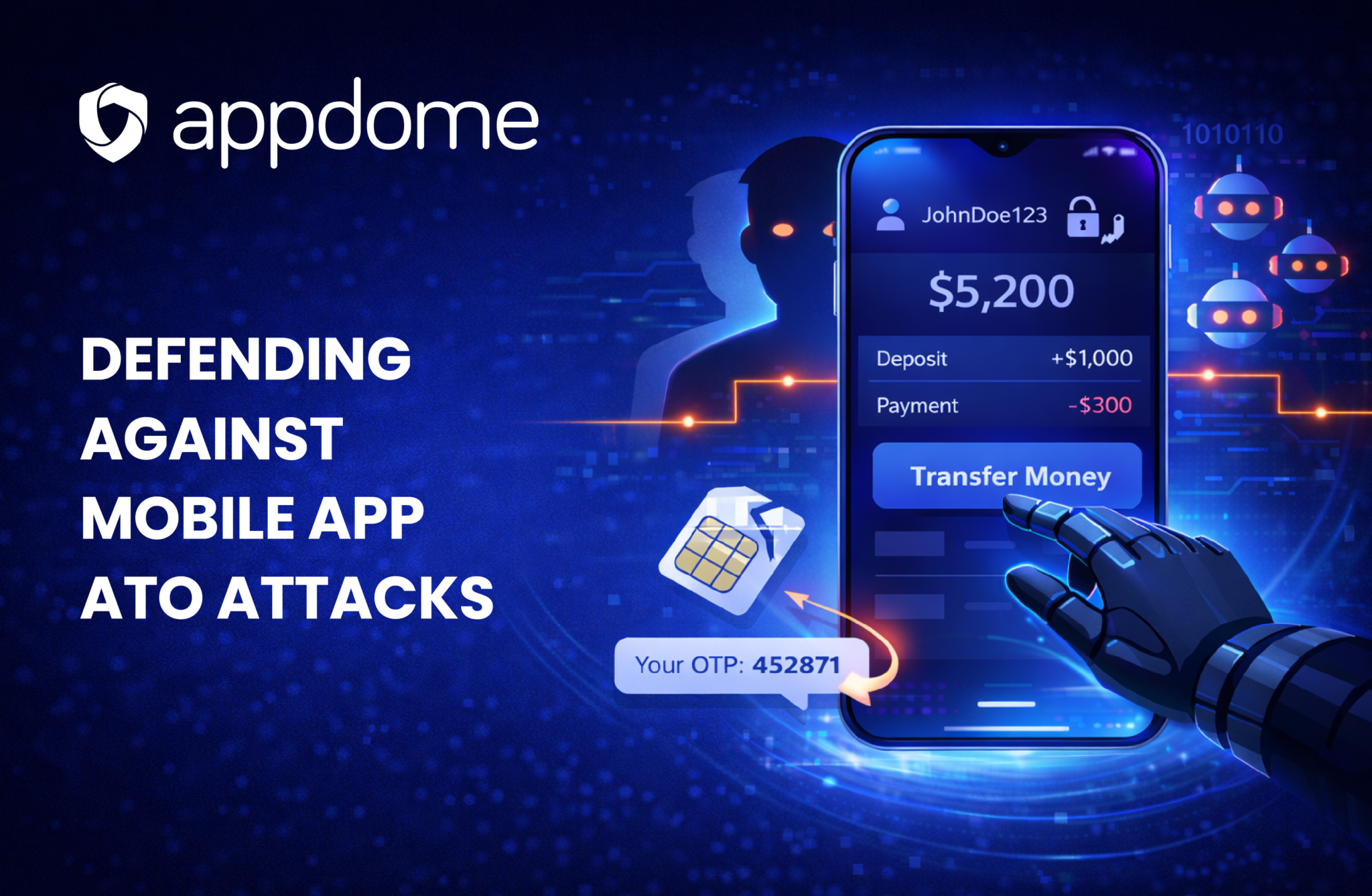
Account Takeover (ATO) attacks are among the most damaging threats facing mobile banking and fintech apps in 2026. Fraudsters use stolen or synthetic credentials, mobile bots, malware, and emulators to hijack customer accounts, steal funds, and bypass fraud controls.
Traditional defenses such as device fingerprinting, CAPTCHA, SMS-based MFA, and network-layer protections cannot stop adaptive automation and credential-stuffing mobile bots because they lack visibility inside the mobile app runtime.
Mobile ATOs persist because identity and execution context are not enforced inside the app itself. Appdome’s Agentic Mobile Defense Platform defines and enforces persistent, in-app identity and runtime protection. By binding accounts to the legitimate app, device, and session in real time, Appdome stops ATO attacks at their source—before fraudsters ever access customer accounts.
What Is a Mobile App Account Takeover (ATO)?
A mobile app account takeover occurs when an attacker gains unauthorized access to a user’s account, most often through stolen credentials combined with automated attack tools.
In banking and fintech apps, ATOs target the most sensitive assets in the mobile experience, including customer identity, stored funds, payment workflows, and transaction history.
Unlike basic login abuse, modern ATO attacks are highly automated and persistent. Fraudsters rely on credential-stuffing campaigns that reuse breached username and password combinations, brute-force login attempts executed by mobile bots and emulators, and malware-driven techniques such as keylogging and overlay attacks.
Attackers also exploit weak MFA workflows through SIM swaps, OTP interception, and social-engineering-based phishing kits. ATO attacks are not isolated security failures. For mobile-first financial institutions, they represent direct revenue loss, regulatory exposure, and long-term erosion of customer trust.
Why ATO Attacks Are Rising in Banking and Fintech
Banking and fintech applications have become prime targets for account takeover attacks because they provide direct access to money, credit, and sensitive financial data.
As billions of users now manage their finances entirely through mobile apps, attackers increasingly focus on the mobile channel as the fastest path to monetization.
Credential exposure from data breaches and phishing campaigns continuously refreshes attacker credential lists, while mobile bots and emulators make it possible to test thousands of login attempts per second at low cost.
This combination of high-value targets and scalable automation has driven a sharp increase in ATO activity.
Recent data underscores this trend. In Q3 2025, fintech apps experienced a 122% year-over-year increase in account takeover attacks, highlighting the scale and persistence of automated credential abuse (FF News).
As digital banking adoption grows, so does the mobile attack surface, making in-app defenses essential rather than optional.
Economic and Compliance Impact of Mobile ATOs
The cost of ATO attacks in mobile banking and fintech is measured in billions of dollars annually. Financial institutions suffer direct losses from fraudulent transfers, drained accounts, and stolen loyalty points, as well as significant operational costs tied to investigations, chargebacks, and customer recovery efforts.
ATO attacks also carry substantial regulatory risk. Compliance frameworks such as PSD2, DORA, MAS TRM, OCC guidelines, and GDPR require strong authentication, transaction integrity, and effective fraud prevention controls.
Failures can result in regulatory penalties, audits, and reputational damage.
Customer trust is often the most lasting casualty. Once an account takeover occurs, customers are far more likely to abandon the app entirely, reducing lifetime value and increasing acquisition costs.
Nearly 60% of fraudulent banking transactions now originate from mobile devices, underscoring that mobile apps are the primary attack vector for ATOs (The Financial Brand).
Why Traditional Defenses Fail Against Mobile ATOs
Traditional ATO defenses were not designed for how attacks operate in modern mobile environments. SMS-based OTPs and password resets are routinely bypassed through SIM swaps and phishing kits.
Device fingerprinting and CAPTCHA offer limited resistance against advanced mobile bots and emulator-driven automation.
Web application firewalls and network-layer defenses cannot observe what happens inside the mobile app, where attackers exploit runtime behavior, device manipulation, and automation frameworks.
Biometrics alone are also insufficient, as deepfakes and replay attacks can be used to bypass facial or voice authentication.
As long as defenses rely on static signals or perimeter-based controls, attackers can adapt faster than security teams. Mobile ATOs require protections that operate dynamically inside the app at runtime.
How Appdome Stops Mobile ATO Attacks
Mobile ATO attacks succeed because identity is not enforced inside mobile apps. Appdome was built to close this gap by defining a new class of in-app mobile ATO defense based on persistent identity and runtime integrity.
Appdome embeds protections directly into Android and iOS apps during the CI/CD build process using Certified Secure™ Mobile DevSecOps Certification, without SDKs, external servers, or code changes.
At the core of this approach is IDAnchor™ Customer Identity Protection, which cryptographically binds the app, the app release, the installation, the physical device, and the runtime session into a single, persistent identity.
This identity cannot be spoofed, cloned, or reset by bots, emulators, or automated attack tools.
As the app runs, Appdome continuously verifies that login attempts, account activity, and sensitive workflows originate from legitimate users on authentic devices.
Mobile bots, emulator-based credential-stuffing campaigns, malware-driven keylogging, overlay attacks, SIM-swap abuse, and OTP interception attempts are detected and blocked in real time, before attackers gain access to customer accounts.
By enforcing identity and integrity inside the app rather than inferring trust at the network or backend layer, Appdome prevents ATO attacks before they contaminate fraud engines, trigger false positives, or result in financial loss.
This allows banks and fintechs to reduce fraud operations costs, meet global compliance requirements, and preserve customer trust.
The Bottom Line
Mobile account takeover attacks are accelerating across banking and fintech, driving billions of dollars in fraud losses and increasing regulatory exposure.
Fraudsters rely on credential stuffing, mobile bots, emulators, and malware to exploit gaps in traditional, perimeter-based defenses.
The only durable defense is enforcing persistent identity and runtime protection inside the mobile app itself.
By defining and delivering in-app mobile ATO defense, Appdome enables financial institutions to stop account takeovers at their source, protect customer accounts, and meet global compliance obligations.
Don’t let ATOs drain your customers and revenue—see How Appdome Works to learn how Appdome protects mobile banking apps against account takeovers.