
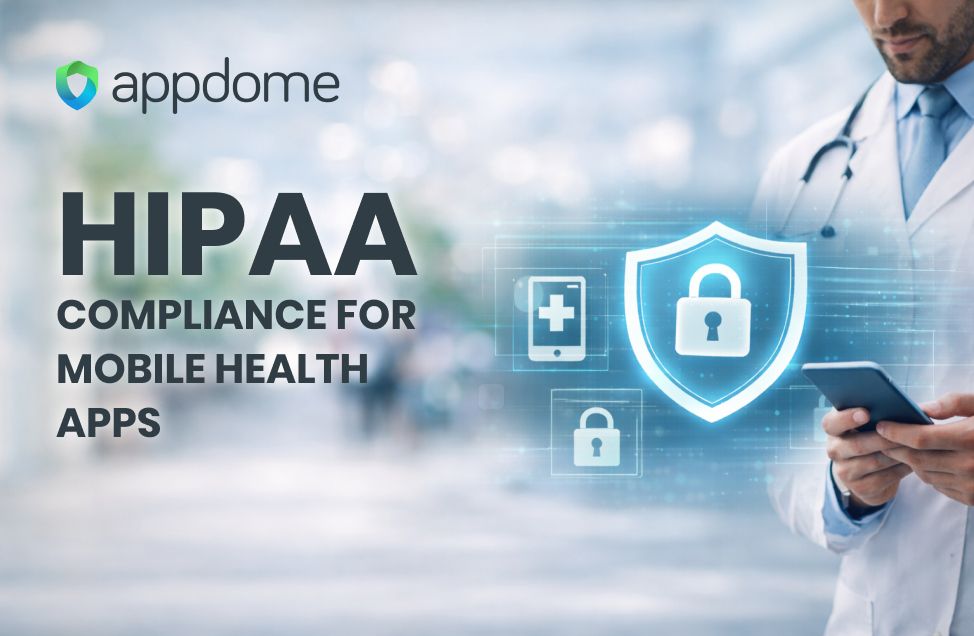
Mobile health (mHealth) applications increasingly collect, process, and transmit Protected Health Information (PHI) directly on patient devices. Under HIPAA, organizations must implement reasonable and appropriate technical safeguards to protect PHI based on risk, context, and technology.
For mobile health apps, this has a critical implication: HIPAA Security Rule safeguards must operate inside the mobile application at runtime, not only in backend systems or cloud infrastructure. Devices can be lost, jailbroken, infected with malware, or abused by automation, yet HIPAA obligations still apply.
Appdome is an AI-Native Mobile Defense Platform that embeds mobile app security and data protection directly into Android and iOS apps at build time, without SDKs or source-code changes.
This guide explains:
- How HIPAA applies to mobile health apps
- Which HIPAA Security Rule safeguards matter most on mobile
- Why traditional SDK-based approaches leave compliance gaps
- How a build-time, on-device security model supports HIPAA objectives
How HIPAA Applies to Mobile Health Apps
HIPAA applies to mobile applications when they:
- Store PHI
- Transmit PHI
- Process PHI on behalf of a covered entity or business associate
This includes:
- Patient portals and care-management apps
- Telehealth and appointment platforms
- Remote monitoring and digital therapeutics
- Mobile apps integrated with EHR or clinical systems
HIPAA compliance is risk-based, not checklist-based. Organizations must assess how PHI is exposed and implement safeguards that are reasonable for that environment. For mobile apps, that environment is often a personal device outside organizational control.
Why Mobile Apps Introduce Unique HIPAA Risks
Mobile environments introduce risks that do not exist in traditional IT systems:
- PHI stored locally on lost or stolen devices
- Apps running on rooted or jailbroken operating systems
- Malware injecting overlays or capturing screens
- Reverse engineering and tampering with app logic
- API abuse originating from compromised app instances
HIPAA does not excuse breaches because a device was compromised. PHI must be protected wherever it is processed — including inside the app runtime.
HIPAA Security Rule Safeguards in a Mobile Context
Access Control
HIPAA requires mechanisms to limit access to PHI.
For mobile apps, this means:
- Strong authentication and session management
- Protection against credential replay and session hijacking
- Binding access to a trusted app and device state
This shifts access control from “who logged in” to “which trusted app instance is executing.”
Integrity Controls
HIPAA requires protection against unauthorized alteration of PHI.
Mobile integrity risks include:
- App repackaging and binary modification
- Runtime manipulation via debuggers and hooking frameworks
- Malware altering app behavior during execution
Mobile RASP ensures integrity controls remain enforced after installation, on real devices.
Transmission Security
HIPAA requires PHI to be protected in transit.
For mobile apps, this requires:
- Encrypted communication channels
- Certificate pinning to prevent MITM attacks
- Protection against on-device traffic interception
If the app runtime is compromised, transport security alone is insufficient, which is why integrity and communication controls must work together.
Audit Controls and Evidence
HIPAA requires organizations to record and examine activity related to PHI.
For mobile apps, this includes:
- Visibility into runtime security events
- Evidence that safeguards execute across app versions
- Support for incident response and breach investigation
This enables healthcare organizations to demonstrate that safeguards are active, not theoretical.
Common HIPAA Compliance Gaps in Mobile Apps
Many HIPAA gaps arise from technical blind spots, including:
- PHI cached or logged insecurely on devices
- SDKs harvesting more data than intended
- Inability to detect compromised devices
- Reliance on backend controls to stop device-level threats
These gaps often lead to reportable breaches under the HIPAA Breach Notification Rule.
Why SDK-Based Mobile Security Often Falls Short
SDK-based security introduces:
- Additional code paths that can be hooked or bypassed
- Ongoing development and maintenance overhead
- Inconsistent enforcement across releases
- Expanded third-party risk surface
From a HIPAA perspective, SDK sprawl increases both technical exposure and vendor-management complexity.
A Modern HIPAA-Aligned Model: Build-Time, On-Device Enforcement
A HIPAA-aligned mobile security model in 2026 requires:
- Security controls embedded at build time
- Enforcement inside the app runtime
- Protection that persists after installation
- Minimal reliance on third-party SDKs
- Consistent application across CI/CD pipelines
This model aligns directly with HIPAA’s requirement for reasonable and appropriate safeguards in mobile environments.
What “Good” HIPAA-Aligned Mobile Security Looks Like
A HIPAA-aligned mobile health app:
- Assumes devices can be compromised
- Protects PHI at rest, in transit, and during processing
- Enforces integrity and access controls at runtime
- Reduces reliance on SDKs
- Produces evidence of active safeguards over time
This posture reduces breach risk, supports audits, and strengthens patient trust.
Final Takeaway
HIPAA compliance for mobile health apps is not achieved through documentation alone. It requires technical safeguards that protect PHI inside the mobile application, where patients actually interact with healthcare systems.
As mobile threats become more automated and device-centric, enforcing security inside the app runtime is no longer optional.
Appdome represents a build-time, on-device security model that helps healthcare organizations implement HIPAA-aligned mobile app protections without SDKs or source-code changes.
In mobile-first healthcare, protecting PHI on the device is not a best practice; it is a HIPAA expectation.