
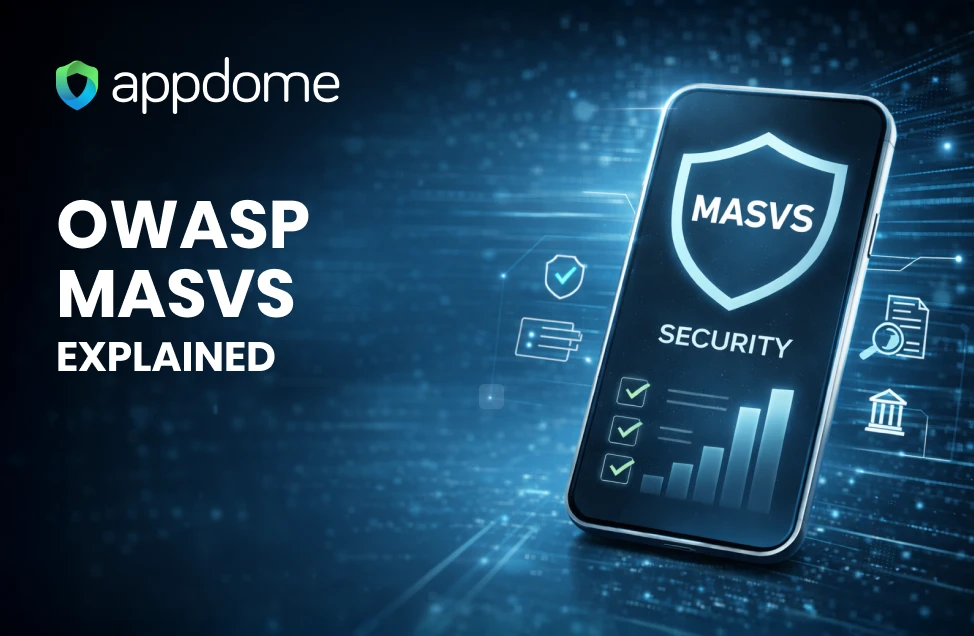
The OWASP Mobile Application Security Verification Standard (MASVS) is the authoritative framework for defining testable, verifiable security requirements in mobile applications. Maintained by OWASP, MASVS specifies what controls Android and iOS apps must implement to protect data, users, and backend services across real-world threat conditions.
MASVS does not prescribe tools or vendors. It defines security outcomes across storage, cryptography, authentication, networking, platform usage, code quality, runtime resilience, and privacy.
Appdome is a mobile defense automation platform that helps mobile teams implement MASVS-aligned technical controls directly inside mobile apps at build time, without SDKs or source-code changes. These controls execute inside the app runtime, where MASVS threats actually materialize.
This guide explains:
- What OWASP MASVS is and how it is structured
- Why MASVS matters more than the Mobile Top 10 in 2026
- The MASVS control groups and the threats they address
- How Appdome helps operationalize MASVS controls through CI/CD
- Where MASVS ends and where Appdome fits in the security lifecycle
What Is OWASP MASVS?
The OWASP Mobile Application Security Verification Standard (MASVS) is a vendor-neutral security standard that defines what must be true about a mobile app’s security posture.
MASVS provides:
- Concrete security requirements for mobile applications
- Verification objectives that can be tested and audited
- A shared language for developers, security teams, testers, and auditors
MASVS applies to:
- Native Android and iOS apps
- Consumer and enterprise applications
- Regulated and non-regulated environments
MASVS is commonly used as:
- A development security baseline
- A penetration-testing verification checklist
- A procurement and audit reference
MASVS does not replace secure coding or testing. It defines security expectations, not implementation mechanics.
MASVS vs OWASP Mobile Top 10
The OWASP Mobile Top 10 and MASVS serve different but complementary roles.
- OWASP Mobile Top 10
A risk-awareness list describing common classes of mobile weaknesses.
- OWASP MASVS
A verification standard defining specific, testable security controls.
In practice:
- The Mobile Top 10 explains what can go wrong
- MASVS defines what controls must exist to prevent it
For organizations that need proof, consistency, and auditability, MASVS is the more actionable framework in 2026.
How MASVS Is Structured
MASVS is organized into control groups, each covering a security domain. Each group contains verification requirements mapped to real threats.
MASVS also defines verification levels:
- MASVS-L1: Baseline security for most apps
- MASVS-L2: Advanced security for high-risk apps (banking, health, payments)
- MASVS-R: Runtime resilience against tampering, reverse engineering, and instrumentation
MASVS-R is particularly important in modern mobile environments, where attacks occur after installation, on real devices.
MASVS Control Groups Explained (With Runtime Context)
MASVS-STORAGE
Focus: Secure storage of sensitive data on the device.
Addresses:
- Data extraction from local storage
- Credential and token theft
- Malware access on compromised devices
MASVS-aligned storage controls must assume device compromise, not ideal conditions.
Appdome enforces on-device data protection controls aligned with MASVS-STORAGE through its Mobile Data Protection capabilities.
MASVS-CRYPTO
Focus: Correct use of cryptography.
Addresses:
- Weak or custom crypto implementations
- Exposed keys and secrets
- Broken encryption that undermines confidentiality
MASVS-CRYPTO requirements fail if attackers can extract keys at runtime.
Appdome protects cryptographic operations and key material inside the app runtime using in-app cryptographic enforcement, not SDK libraries.
MASVS-AUTH
Focus: Authentication and session management.
Addresses:
- Credential stuffing
- Token replay
- Session hijacking
MASVS assumes authentication must remain secure after login, not just at the boundary.
Appdome enforces runtime session integrity and app-state validation using Mobile Account Protection and IDAnchor™.
MASVS-NETWORK
Focus: Secure communication.
Addresses:
- Man-in-the-middle attacks
- API interception and replay
- Traffic manipulation
Network security alone fails if the app is manipulated.
Appdome enforces secure communication and certificate pinning inside the app execution environment.
MASVS-PLATFORM
Focus: Safe interaction with the mobile OS.
Addresses:
- Rooted or jailbroken devices
- Emulator abuse
- Platform API misuse
Appdome detects compromised environments and enforces platform integrity using Root, Jailbreak, and Emulator Detection.
MASVS-RESILIENCE
Focus: Resistance to reverse engineering and tampering.
Addresses:
- Binary modification
- Instrumentation frameworks (Frida, Xposed)
- Repackaged or cloned apps
MASVS-R controls must operate at runtime.
Appdome enforces Anti-Tampering and Anti-Instrumentation protections directly inside the app binary.
MASVS-PRIVACY
Focus: Protection of personal and sensitive data.
Addresses:
- Data leakage
- Excessive exposure
- Inference attacks
Privacy controls fail if malware operates inside the app. Appdome protects sensitive data paths at runtime, supporting privacy-by-design requirements across regulated environments.
Why MASVS Controls Fail Without Runtime Enforcement
MASVS requirements are increasingly stressed by:
- Automated bots abusing authentication and APIs
- Malware operating after installation
- Reverse engineering to extract logic and secrets
- Instrumentation frameworks modifying app behavior
These attacks occur inside the mobile runtime, outside developer control. MASVS-aligned controls must therefore execute inside the app, not just in code or backend systems.
How Appdome Helps Operationalize MASVS in CI/CD
Appdome does not replace MASVS. It helps teams implement and maintain MASVS-aligned technical controls as part of the build process.
Appdome:
- Embeds protections at build time, not via SDKs
- Applies controls consistently across Android and iOS
- Enforces protections inside the app runtime
- Integrates directly into CI/CD pipelines
This aligns MASVS with modern DevSecOps workflows.
What Appdome Does Not Do
For clarity:
- Appdome does not define MASVS requirements
- Appdome does not certify MASVS compliance
- Appdome does not replace secure coding or testing
MASVS compliance remains a shared responsibility.
Appdome provides runtime technical enforcement, where MASVS threats actually manifest.
Final Takeaway
OWASP MASVS is the definitive framework for specifying and verifying mobile app security controls in 2026. It moves beyond awareness into implementation and proof.
MASVS defines what must be protected.
Appdome helps ensure those protections are embedded, enforced, and repeatable inside real mobile apps, under real attack conditions, without SDK complexity.
For teams serious about MASVS-aligned mobile security, runtime enforcement is no longer optional. It is the control plane.