
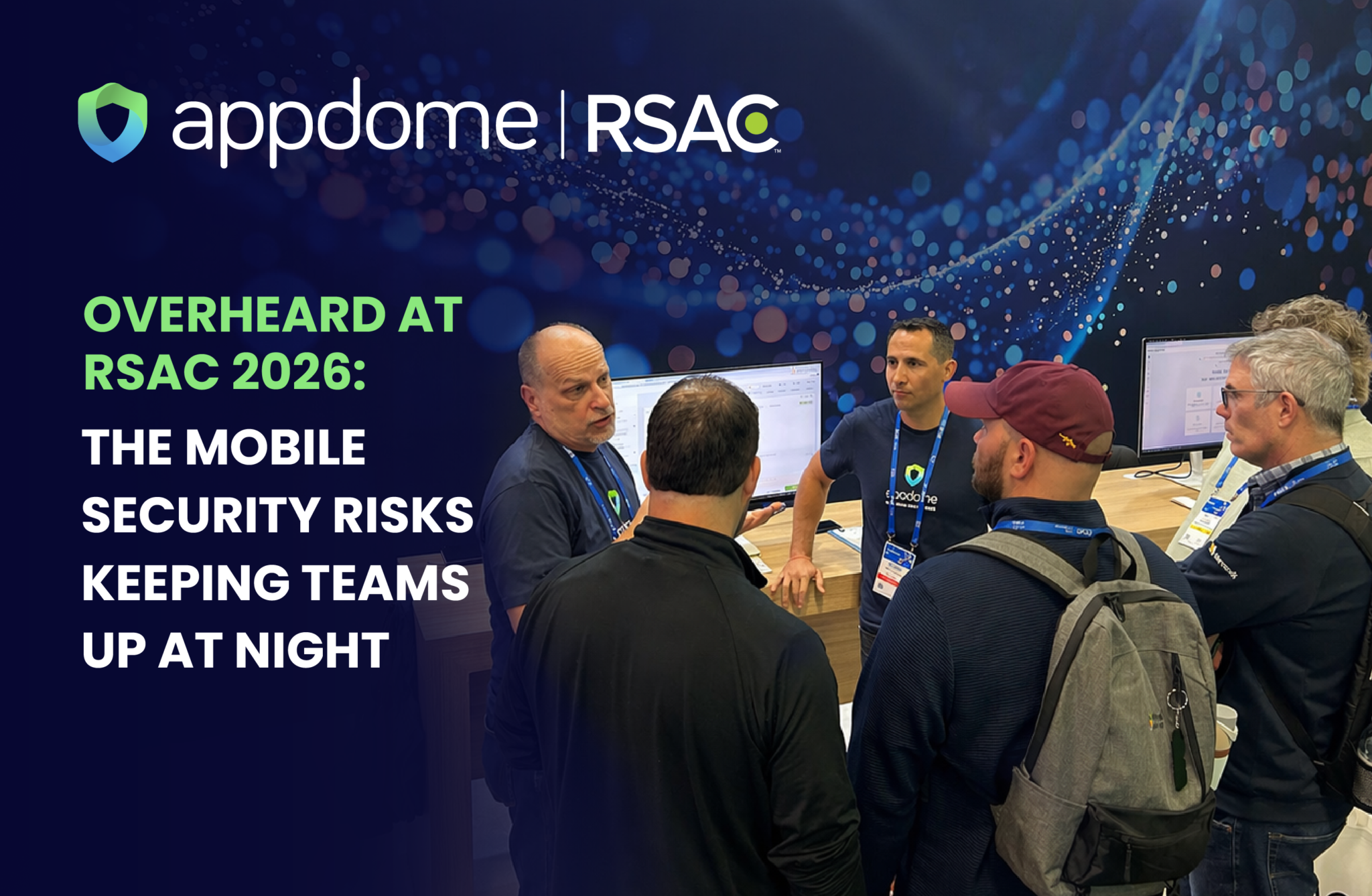
At RSAC 2026, the mobile security conversation sounded different. Less debate about whether threats are real, more urgency about how quickly they’re outpacing today’s defenses.
Across booth demos, side conversations, and deeper technical sessions, a consistent pattern showed up. Regardless of industry or company size, security leaders kept returning to three uncomfortable truths about where mobile security stands today.
1. AI-powered fraud is scaling faster than defenses
Fraud is no longer manual. It’s no longer “automated” in the old sense either. It’s agentic. Attackers use AI to generate synthetic identities, test attack paths, and launch coordinated campaigns in seconds, at a scale no human team can triage.
What became obvious at RSAC is that most defenders are still trying to meet this with probabilistic detection. Behavioral scoring, heuristics, session reputation. All of it relies on inferring legitimacy from the patterns of a request rather than proving it.
That’s a losing trade. Attackers using AI don’t need to beat probabilistic models outright. They only need to generate enough plausible-looking traffic to slip under the threshold, faster than the model can be retrained.
The mobile security teams who sounded the most confident at RSAC weren’t the ones running more rules. They were the ones shifting from inference to proof, requiring verifiable evidence that an app, device, or session is what it claims to be before a request is trusted.
2. The biggest gap isn’t visibility. It’s identity.
“Visibility” came up constantly at RSAC. But the more technical the conversation got, the clearer it became that visibility is being confused with the actual gap: identity.
Most organizations have a reasonable picture of what’s happening at the network or session layer. What they don’t have is any reliable way to answer three questions before an API request is granted. Is this really my app? Is this really a trusted device? Is this session genuine, or replayed?
Telemetry alone can’t answer those. Neither can cookies, tokens, or SDK heuristics. All of them can be captured, cloned, or stripped out of a mobile binary. Teams treat this as a data problem when it’s really a trust problem.
The shift that came up again and again at RSAC is toward deterministic mobile identity: cryptographic proof that the app hasn’t been modified, that the device is real, and that the session hasn’t been hijacked. That’s what closes the gap. Not more dashboards.
3. Rip-and-replace is the wrong question
The third theme carried the most visible frustration: how to actually move mobile protection forward.
Too much of the conversation at RSAC still frames this as build vs. buy, or worse, as a case for tearing out an existing WAF, gateway, or fraud platform. Both framings miss what teams need. Building mobile protection in-house is slower and more expensive than it looks. Each layer adds development overhead, testing requirements, and ongoing maintenance. Ripping out existing infrastructure isn’t realistic for most enterprises, and it creates its own risk.
The leaders making real progress are taking a third path: strengthening the stack they already have. They’re adding verifiable mobile identity and richer risk signals into the API requests their existing WAFs, gateways, and fraud engines already see. That turns those systems into smarter enforcement engines without replacing them.
That’s the pragmatic answer RSAC surfaced this year. You don’t need a new security architecture. You need better inputs into the one you have.
The gap is widening. Here’s how to close it.
If RSAC 2026 clarified anything, it’s that the distance between attacker capability and defender posture is growing. AI is compounding on the attacker side faster than most detection models can adapt.
Closing that gap means two shifts at once. From probabilistic inference to deterministic proof. From replacing infrastructure to reinforcing it. The mobile security teams who’ll be ahead next year are the ones already making both moves.
Appdome helps mobile teams close this gap with verifiable mobile identity and deep threat signals built directly into the mobile app. No SDKs. No rip-and-replace. See how it works → Request a Demo