
The cybersecurity industry has spent two decades solving problems the same way: more tools, more alerts, more headcount. When a new threat emerged, we hired. When compliance requirements shifted, we trained. When the attack surface expanded to mobile, then cloud, then APIs we added another console, another SDK, another team. Call it the “Do It Yourself” era. And it worked, mostly, when the threat landscape moved at a human pace. But now that the attack surface includes AI, that “DIY” era is over.
The Infinite Series Problem
The math is simple: the number of attackers is effectively infinite — nation states, organized crime, and opportunistic hackers are all leveraging AI-generated attack campaigns that scale without human labor. The time those attackers have to probe your defenses is also infinite. Meanwhile, your engineers, your budget and your hours in the day are limited.
Now that adversaries have gone agentic, using AI to generate deepfakes, automate social engineering, and craft novel exploits faster than any human team can patch against them, no amount of hiring closes that gap; the “Do It Yourself” model cannot scale to defend against this reality.
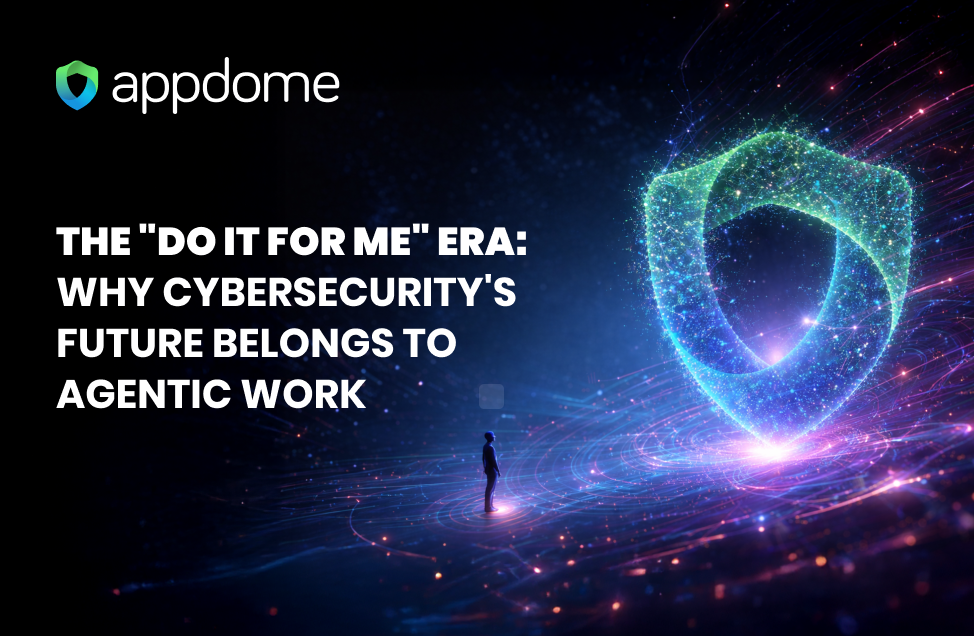
Enter the “Do It For Me” Era
The shift we’re witnessing across the enterprise is a move from human-executed tasks to agentic outcomes. Not AI that analyzes threats and generates a report for a human to act on. AI that performs the task itself: adjusting a defense posture, enforcing a policy in runtime, building security into applications continuously and consistently, at machine speed.
This is what “Do It For Me” means. It is the delegation of discrete, specialized, high-stakes work to agentic systems that execute with precision, while elevating the human to a role of oversight, reasoning, and strategic decision-making. The human doesn’t disappear from the loop. The human moves up the loop, from operator to authority.
Think about what this unlocks. A security architect no longer burns cycles wrangling SDK integrations or chasing down whether the latest OS update broke a fraud defense. Instead, they define policy, validate outcomes, and focus on the genuinely hard problems; the ones that demand judgment, context, and creativity. The repetitive, maintenance-heavy, error-prone work? That’s where agentic systems thrive.
Appdome Was Built for This Moment
Appdome has been delivering on the “Do It For Me” model for over a decade, long before the term “agentic AI” entered the mainstream. Our core premise is simple: take the complex, specialized, grinding work of building security and fraud defenses into mobile applications and let a machine do it. No SDKs. No manual coding. No army of engineers maintaining fragile integrations across every OS update and device variant.
Today, Appdome’s platform builds and maintains over 400 discrete defense capabilities in mobile apps through a single automated pipeline. Enterprises define what they need, click Build, and a machine produces a defended application — certified, validated, ready for production. That is an agentic outcome. It was agentic before we called it that.
The Future: An Agentic Workforce for Cyber
Now we’re extending that model further. Appdome’s new AI Agents bring the same “Do It For Me” philosophy to threat monitoring, incident response, compliance management, and real-time remediation. These agents reason across trillions of threat signals, operate conversationally, and take action autonomously within the boundaries the security team defines.
The vision isn’t to replace the cyber team. It’s to give every cyber team the equivalent of an infinite agentic workforce that matches the scale of the infinite attacker problem. The floor rises for everyone: the enterprise with a mature security org gets more capacity, and the lean startup shipping its first mobile app gets protection it could never have built alone.
The Economics of “Do It For Me”
Ultimately, this is an economic argument. If we can turn the economics of fraud, hacking and cyber attacks against the threat actors, we make attacks more expensive to execute than the damage they inflict. The “Do It Yourself” model couldn’t change those economics because it scaled linearly with headcount. The “Do It For Me” model scales with the machine. And the machine doesn’t stop.
The era of building it yourself, maintaining it yourself, and hoping your finite team can outrun infinite attackers — that chapter is closing. The “Do It For Me” era is here. And for CISOs ready to embrace it, the question isn’t whether to delegate to agentic systems. It’s how fast you can start.