
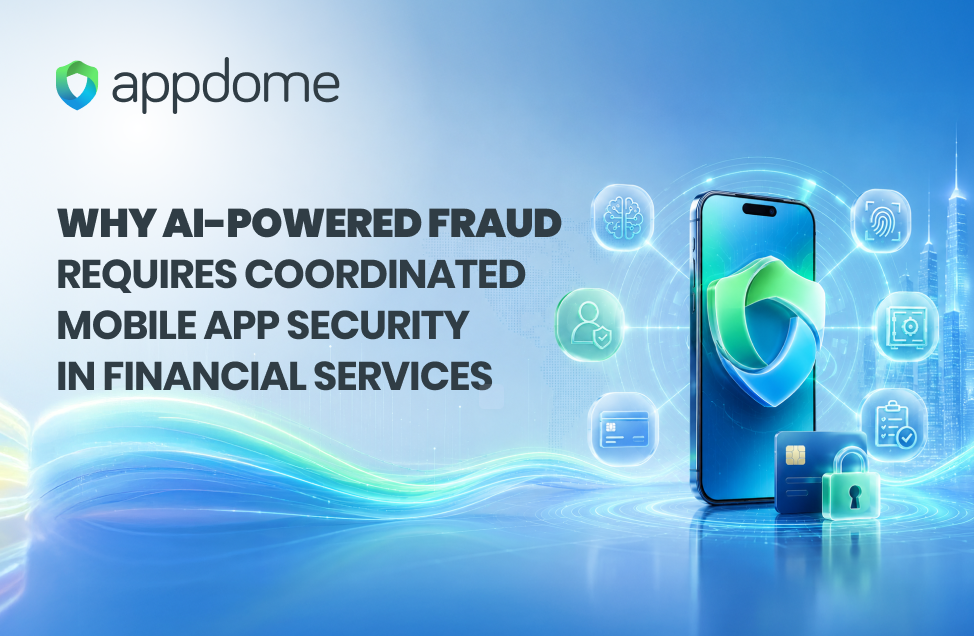
AI-powered fraud now moves across identities, devices, sessions, APIs, and transactions. Learn how coordinated mobile app security helps banks and fintechs strengthen detection, identity trust, backend risk decisions, runtime control, and audit readiness.
Financial services has always been a high-value target. But the significant increase in fraud attacks targeting financial services isn’t merely “more fraud.” AI has fundamentally changed how fraud is created, delivered, and scaled.
The financial impact is already significant. According to the FBI’s 2025 Internet Crime Report, cyber-enabled crimes defrauded Americans of nearly $21 billion, with cryptocurrency and AI-related complaints among the costliest. The FTC separately reported 3 million consumer fraud reports and $15.9 billion in reported fraud losses in 2025.
What used to be isolated attacks are now coordinated sequences: automated, adaptive, and increasingly indistinguishable from legitimate user behavior. Traditional defenses, particularly in mobile, are struggling—not because they’re weak, but because they were built for events, not AI-powered systems.
In other words, most defenses were designed to detect moments, while modern fraud operates as a sequence.
But just as AI has reshaped fraud, it can also reshape the systems guarding against it. Mobile is no longer an isolated channel, but the foundation of the digital economy. And mobile app security in the age of AI-powered fraud must reflect that reality, operating as a unified, coordinated system rather than a collection of point products.
What financial institutions need now is a mobile security architecture that can remember prior threats, verify identity continuously, share risk signals with backend systems, coordinate defenses inside the app, and preserve proof of compliance over time.
Why AI-Powered Fraud Requires Stateful Mobile Defense
One of the defining traits of AI-powered fraud is persistence. Attackers don’t attempt a single action and walk away. They learn, retry, and adapt across sessions, devices, and identities.
Fraud is no longer stateless, and until recently, mobile defenses were.
Appdome Threat-Memory™ changes that. Threat-Memory™ is a stateful and agentic threat intelligence engine inside the mobile app. With Threat-Memory™, financial institutions can finally see fraud the way attackers execute it: as a sequence, rather than a static moment.
Threat-Memory™ builds a local threat history across the app lifecycle, applies Agentic Severity Scoring to each detection, and enforces policies dynamically, enabling detection of multi-step attacks that would otherwise appear benign in isolation.
That matters in financial services, where account takeover, synthetic identity fraud, and onboarding abuse rarely happen in a single step. They unfold, and now they can be seen that way.
Why Identity Must Be Continuously Validated in Mobile Banking Apps
AI has upended identity security. Bot farms still exist, but the biggest risk now comes from fake, spoofed, and deeply compromised mobile applications, devices, locations, and users. If an attacker can simulate a user, generate credentials, mimic behavior, or even spin up AI deepfakes and fake devices across thousands of attack scenarios simultaneously, then identity can no longer be treated as a static assertion. It has to be continuously validated.
This is where IDAnchor™ and new Risk Intelligence APIs work together.
Appdome’s IDAnchor™ has long established a persistent, verifiable identity for the app, device, and user, anchoring trust to a continuous chain of signals across every session. Any deviation—a cloned app, a compromised device, a spoofed location—is detectable in real time.
What’s new is what happens to those signals next. Risk Intelligence APIs now expose that trust data directly to backend systems and fraud engines, so that every risk decision downstream is grounded in deterministic proof of authenticity, not inference. Each request carries cryptographic app and device identifiers, time-bound session trust, verified GPS location, and deep session risk signals.
In a world of AI-generated users, identity has to become dynamic—and with IDAnchor™ establishing the root of trust and Risk Intelligence APIs distributing it, it finally can.
Why Detection Alone Is Not Enough to Stop Mobile Fraud
For years, the security industry focused on detecting threats. But detection alone doesn’t stop fraud, especially when attacks unfold in milliseconds and adapt in real time. What’s needed is control, and control requires coordination. This is where DefenseOS™ fundamentally shifts the model.
DefenseOS™ acts as a governed execution environment inside the mobile app, providing a secure control plane, independent schedulers, task management, and memory allocation so that hundreds of security, anti-fraud, and API protection controls operate seamlessly.
In this way, DefenseOS™ avoids conflicts and collisions as well as minimizes performance impact, rather than competing for resources.
DefenseOS™ directly addresses one of the biggest challenges financial institutions face today: fragmentation. Instead of stitching together SDKs and point solutions that fight for the main thread, memory, and network, DefenseOS™ ensures every protection works together in real time, inside the same runtime.
Fraud operates as a coordinated system. Now mobile defenses do the same.
Why Compliance Evidence Matters in Financial Services Mobile Security
As fraud has migrated into mobile, so has the most sensitive data in financial services: credentials, tokens, session data, transaction logic. This data is where attackers focus, and where traditional perimeter-based defenses often have the least visibility.
Appdome Vault™ addresses this directly, but with an important distinction: it is not primarily a runtime data-protection tool. Vault™ is a searchable compliance workspace that stores detailed compliance histories for each mobile business, preserving an immutable record of who did what and when across every defense configuration, policy change, admin action, build, and release.
For financial institutions operating under PCI, banking regulations, HIPAA, SOC 2, NIST, OWASP, and ISO frameworks, Vault™ delivers on-the-spot and long-term audit readiness—ensuring an authoritative record of continuous compliance is always available, even years after teams, tools, or processes have changed.
Coordinated Mobile App Security Is the New Standard for Defending Against AI-Powered Fraud
Individually, each of these Appdome capabilities solves a real problem: Threat-Memory™ brings persistence and agentic intelligence to detection, Risk Intelligence APIs distribute IDAnchor’s trust signals to backend systems and fraud engines, Vault™ delivers compliance continuity and audit readiness, and DefenseOS™ ensures everything operates as a coordinated system. But the real shift isn’t in any single capability; it’s in how they combine.
AI-powered fraud is a chain: identity creation, environment manipulation, behavioral mimicry, and transaction execution. Breaking that chain requires visibility, continuity, and control across every step. That’s what Appdome’s mobile app security system provides.
Financial institutions are entering a genuinely different threat landscape, where fraud is faster, more scalable, and increasingly autonomous. Meeting this moment requires changing the model: from detection to coordination, from signals to systems, from fragmented defenses to unified execution inside the app. For banks, fintechs, payment providers, and other financial services organizations, coordinated mobile app security is becoming essential infrastructure for defending against AI-powered fraud.
How can financial institutions stop AI-powered mobile fraud?
Financial institutions can stop AI-powered mobile fraud by moving from fragmented detection tools to a coordinated mobile app security system. This includes stateful threat intelligence, continuous app-device-user identity validation, real-time risk signals for backend fraud engines, governed runtime control, and continuous compliance records.
See how Appdome helps financial institutions build coordinated mobile app defenses against AI-powered fraud.
Request a Demo
FAQ
How can financial institutions defend against AI-powered mobile fraud?
Financial institutions can strengthen defenses against AI-powered mobile fraud by coordinating controls across the mobile app, device, user identity, backend APIs, fraud engines, and compliance systems. This includes preserving threat history, validating app and device authenticity, sharing verified risk signals with backend systems, enforcing runtime protections, and maintaining audit-ready evidence.
Why does AI-powered fraud require stateful mobile defense?
AI-powered fraud often unfolds across multiple attempts, sessions, devices, accounts, or environments. A stateless defense may detect a single event but miss the pattern. Stateful mobile defense preserves prior threat context so financial institutions can identify repeat behavior, multi-step attacks, and risk escalation over time.
How do mobile risk intelligence APIs help fraud teams?
Mobile risk intelligence APIs help fraud teams use verified mobile signals in backend decisioning. Instead of relying only on inference, fraud engines can incorporate app integrity, device identity, session risk, threat history, location trust, and other mobile signals when evaluating onboarding, login, account recovery, and transaction activity.
What should banks look for in mobile app security for AI-powered fraud?
Banks should look for mobile app security that supports stateful threat detection, continuous app and device identity, backend risk-signal integration, runtime defense orchestration, API protection, fraud workflow support, and compliance evidence. The goal is not just to detect isolated events, but to coordinate defenses across the full mobile fraud lifecycle.
Why is compliance evidence important in mobile fraud prevention?
Compliance evidence helps financial institutions prove which mobile defenses were active, who changed them, when they were deployed, and which app releases included them. This is important for internal audits, regulatory examinations, incident response, cyber insurance, partner reviews, and board-level risk oversight.