
Mobile Threat Defense Had to Evolve
For more than a decade, Mobile Threat Defense (MTD) has helped organizations answer a relatively simple question: Can this mobile device be trusted?
The first generation of MTD products was designed for a world in which mobile devices represented a new enterprise endpoint. Organizations wanted to know whether a device had been rooted or jailbroken, whether malware was present, or whether it was connected to an unsafe network. When a threat was detected, the platform generated an alert, and security teams decided what to do next.
That model reflected the threats of its time.
Today’s mobile threat landscape bears little resemblance to the one that gave rise to Mobile Threat Defense. Modern attackers rarely rely on a single technique or target a single layer of the mobile ecosystem. They combine phishing, vishing, smishing, malware, fraud, runtime instrumentation, network attacks, identity theft, and, increasingly, artificial intelligence into coordinated campaigns designed to compromise applications, users, identities, and business processes simultaneously.
Attackers don’t think in product categories. They don’t launch a “malware attack” one day and a “fraud attack” the next. They combine techniques until they find the weakest link. A phishing campaign may lead to credential theft. Stolen credentials may enable account takeover. Malware may intercept one-time passcodes. Runtime tools may bypass application protections. A deepfake may fool an identity verification system. Individually, each technique represents a security problem. Together, they become a business problem. As attacks have converged, MTD has had to evolve with them. The data supports this shift. According to Verizon’s 2025 Data Breach Investigations Report, credential abuse continues to be one of the leading ways attackers gain initial access to organizations, highlighting why modern defenses must protect well beyond the device and also defend against chained attacks.
Modern Mobile Attacks Are Multi-Dimensional
For years, organizations associated Mobile Threat Defense primarily with device security. If the device was compromised, the user could not be trusted.
Today, many attacks begin long before any malware is installed. Users are manipulated through phishing emails, fraudulent SMS messages, voice impersonation, QR code scams, and increasingly sophisticated social engineering campaigns designed to convince them to compromise themselves. The user often becomes the first stage in the attack chain. Industry research reinforces this trend. Recent findings from Malwarebytes show that mobile phishing, smishing, and other mobile scams continue to grow in both frequency and sophistication, making social engineering one of the most effective ways for attackers to gain an initial foothold.
When malware is deployed, it is significantly more sophisticated than it was only a few years ago. Modern banking trojans, spyware, remote access malware, and fraud-focused malware increasingly abuse legitimate operating system capabilities to remain hidden while intercepting credentials, capturing authentication codes, manipulating transactions, and impersonating legitimate users. Rather than exploiting obscure vulnerabilities, many attacks now rely on legitimate platform features to avoid detection.
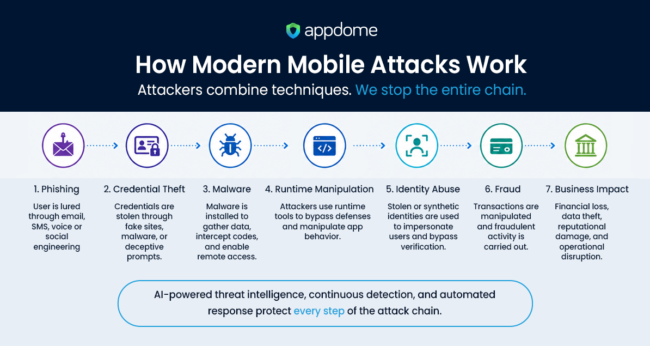
The application itself has also become a primary target. Runtime instrumentation frameworks such as Frida and Magisk enable attackers to observe application behavior, bypass security controls, manipulate business logic, and uncover vulnerabilities that can later be weaponized. Platforms such as Corellium have dramatically lowered the barrier to sophisticated mobile application analysis, giving both defenders and attackers access to capabilities that were once limited to highly specialized security researchers. These same advances are changing how enterprise software vendors think about application security. As AI democratizes penetration testing and red team exercises, B2B app developers are increasingly adopting agentic security models that continuously strengthen applications throughout the software development lifecycle, as explained in a previous article in this blog series.
The network remains part of the attack surface as well. Man-in-the-middle attacks, rogue Wi-Fi access points, DNS spoofing, and traffic interception continue to expose sensitive enterprise communications, particularly when users connect from unmanaged or public environments.
At the same time, identity has become one of the most valuable targets of all. Deepfakes, synthetic identities, account takeover techniques, and photo substitution attacks increasingly challenge traditional approaches to authentication and identity verification. The question is no longer simply whether a username and password are correct. Organizations must determine whether the user, the device, the application, the network, and the surrounding threat conditions together represent a trusted interaction. Mobile Threat Defense can no longer focus on only one part of that equation.
AI Is Changing Both Sides of the Battlefield
Security teams are already using frontier models to automate penetration testing, security assessments, and red team exercises. Tools such as Mythos are democratizing advanced mobile application testing, allowing organizations to identify vulnerabilities faster, test applications more comprehensively, and continuously evaluate their security posture throughout the software development lifecycle. The same technologies are equally available to attackers. Generative AI is reducing the expertise required to create convincing phishing campaigns, develop malware, discover vulnerabilities, impersonate users, and automate reconnaissance against mobile applications. Techniques that once demanded significant technical skill are becoming increasingly accessible, allowing attackers to operate faster and at greater scale than ever before.
This shift has profound implications for Mobile Threat Defense. Security platforms designed around static detection models and manual response workflows simply cannot evolve at the same pace as AI-assisted attacks. Organizations need security that continuously learns from new threats, adapts protections as attacks evolve, and responds intelligently in real time. That is the foundation of agentic Mobile Threat Defense.
Legacy Mobile Threat Defense Was Built for a Different Era
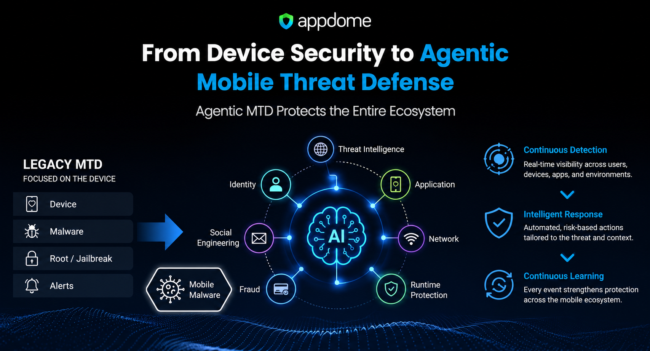
The first generation of Mobile Threat Defense focused primarily on device posture. It detected rooted devices, malware, and unsafe networks, then generated alerts for security teams to investigate. That model worked when mobile security was largely about protecting employee devices accessing corporate resources.
Today’s enterprise applications are fundamentally different. They power business-critical workflows, customer transactions, AI-driven experiences, and direct access to sensitive systems. Modern attacks target far more than the device, and organizations need MTD that protects the entire mobile application experience rather than simply reporting device health.
Many legacy architectures also rely on standalone companion apps that users must install and keep running to detect threats. That creates operational friction and inevitable gaps in visibility. Agentic Mobile Threat Defense should travel with the protected application itself, providing continuous protection without depending on user behavior.
From Detection to Intelligent Response
Modern Agentic Mobile Threat Defense is no longer defined by the number of threats it detects, but by how effectively it helps organizations respond to them. Threat intelligence, identity, and automated response increasingly work together to establish trust across users, applications, and business processes. Rather than generating another alert for analysts to investigate, organizations can define custom responses based on the specific threat, the application being accessed, and the level of risk involved.
Appdome processes more than 1.3 trillion mobile threat events every month, giving organizations continuous visibility into evolving attacks while enabling them to automatically implement new protections, tailor response policies, and strengthen security through existing CI/CD pipelines—without coding or SDK integration.
Modern MTD Requires an Agentic Platform
Responding to today’s mobile threats requires more than identifying suspicious activity. Organizations need a platform that can translate threat intelligence into intelligent protection and automated response.
Appdome addresses this challenge by combining Mobile Threat Defense with more than 400 Mobile Enterprise Security protections, real-time threat intelligence, deterministic mobile identity, and customizable threat response policies in a single AI-native platform. As new threats emerge, organizations can automatically implement additional protections, tailor response actions, and continuously strengthen Android and iOS applications without writing security code, integrating SDKs, or disrupting existing CI/CD pipelines.
The result is a continuous feedback loop where threat intelligence drives protection and every new insight strengthens an organization’s security posture. Rather than generating alerts alone, Appdome transforms Mobile Threat Defense into an intelligent security capability that protects applications, users, identities, and business processes together.
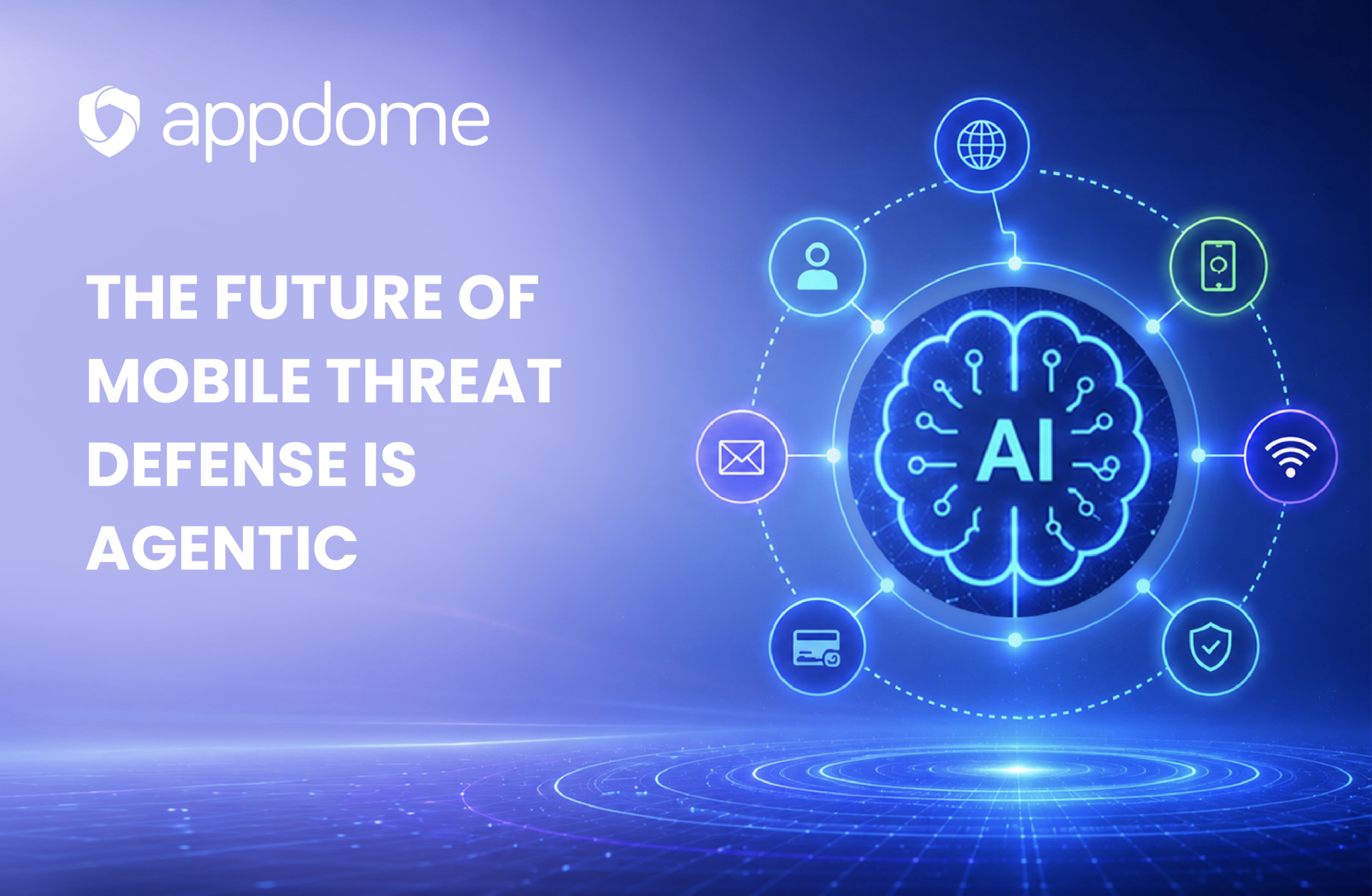
The Future of Mobile Threat Defense Is Agentic
Mobile Threat Defense has always been about establishing trust. What has changed is the complexity of the problem. Modern attacks no longer target a single layer of the mobile ecosystem. They combine social engineering, malware, fraud, runtime attacks, identity compromise, and AI-assisted techniques into coordinated campaigns that move quickly across users, devices, applications, and business processes. Defending against those attacks requires more than detecting threats after they occur. It requires continuously understanding risk, adapting protections as threats evolve, and responding intelligently in real time.
That is why the future of Mobile Threat Defense is agentic. The future belongs to platforms that transform threat intelligence into intelligent protection, automated response, and better security decisions without slowing development.
Build an Agentic Mobile Threat Defense Strategy
Appdome helps organizations transform Mobile Threat Defense from a device-centric detection tool into an intelligent, automated capability that protects users, applications, identities, and business processes. By combining real-time threat intelligence, deterministic mobile identity, customizable threat responses, and more than 400 Mobile Enterprise Security protections into a single AI-native platform, Appdome enables organizations to continuously strengthen Android and iOS apps without coding, SDK integration, or disrupting existing CI/CD pipelines. Read more about the growing importance of the mobile enterprise security category in this blog.
Ready to modernize your Mobile Threat Defense strategy? Contact us to learn how Appdome can help you build an agentic MTD program that evolves as quickly as the threats you’re defending against.