
The Rise of Mobile Enterprise Security
For years, enterprise mobile security evolved as a collection of separate disciplines. Organizations bought one solution to manage devices, another to secure applications, another to monitor threats, another to protect identities, and still others to address fraud, compliance, and access requirements. Security teams, application teams, and developers often approached mobile risk from entirely different perspectives because, for a long time, that approach made sense.
Mobile applications occupied a relatively limited role inside the enterprise, and security responsibilities naturally followed organizational boundaries. Different teams solved different problems with different tools.
That model no longer reflects reality.
Modern mobile applications sit at the center of business operations. They connect users to systems, identities to workflows, and transactions to business outcomes. As the role of mobile applications has expanded, so has the need for security capabilities that work together rather than independently.
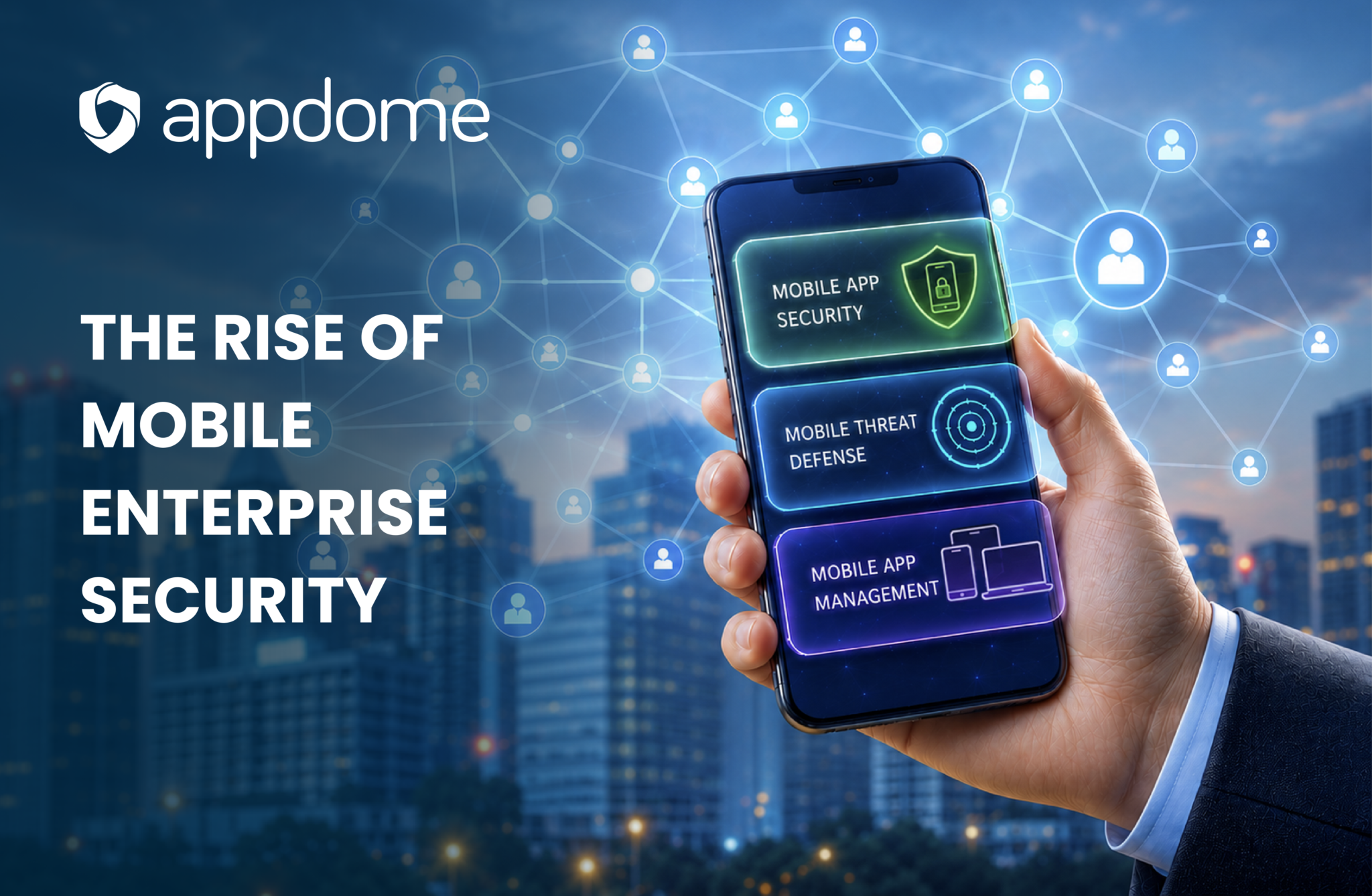
The result is the emergence of a new category: Mobile Enterprise Security.
Why Traditional Categories Are Breaking Down
Historically, mobile security evolved as a collection of separate categories. Mobile App Management focused on enrollment, policies, and device administration. Mobile Threat Defense concentrated on detecting risk. Application security focused on protecting applications from tampering and reverse engineering. Identity solutions addressed authentication and access, while fraud prevention solutions focused on transaction integrity and abuse.
Each category addressed a legitimate problem.
The problem is that modern attacks do not respect those boundaries. Malware can lead to account takeover. Social engineering attacks can result in fraud. A compromised device can become the starting point for a data breach. Identity abuse can evolve into unauthorized transactions or workflow manipulation. As the attack surface has converged, security strategies must converge as well.
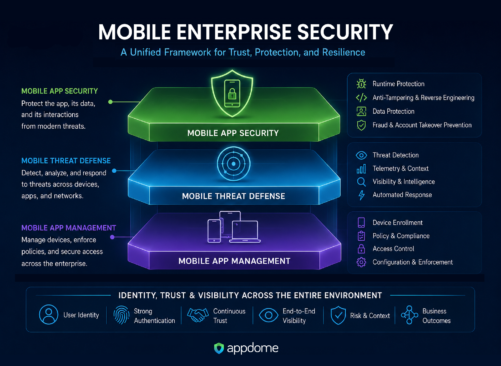
Increasingly, organizations need a framework that brings these previously separate disciplines together. Mobile Enterprise Security represents that framework.
Mobile App Security Has Become Foundational
The first pillar of Mobile Enterprise Security is protecting the application itself.
Historically, organizations often focused on securing the device or the network. But modern attacks increasingly target the application experience directly. Mobile applications face threats ranging from malware, reverse engineering, runtime attacks, and application tampering to overlay attacks, credential theft, phishing, social engineering, account takeover, and fraud.
These threats affect both internal enterprise applications and customer-facing applications. In many cases, attackers are attempting to manipulate business logic, compromise identities, or abuse workflows rather than simply exploit infrastructure.
As a result, security increasingly needs to live inside the application itself. Protecting the app, its runtime, its interactions, and the trust relationships it maintains with users and systems has become a foundational requirement.
Mobile Threat Defense Has Evolved
Mobile Threat Defense represents another important pillar of Mobile Enterprise Security, but the category itself has changed significantly.
Traditional approaches focused primarily on identifying threats and generating alerts. Today’s organizations increasingly need more than notifications. They need visibility into what is happening inside their mobile environments, context around the threats affecting users and applications, and the ability to respond appropriately based on business requirements and risk tolerance.
Threat detection, telemetry, context, visibility, and response are becoming increasingly interconnected. Organizations are looking for actionable intelligence and automated workflows rather than simply more alerts. Mobile Threat Defense is evolving from a detection discipline into an operational capability that helps organizations understand and manage risk in real time.
This evolution is one of the reasons Mobile Threat Defense has become an essential component of a broader Mobile Enterprise Security strategy.
Management Alone Is Not Security
Mobile App Management remains an important part of the enterprise landscape. Enrollment, policies, compliance requirements, and access controls all continue to play important roles in managing devices and enforcing governance requirements. But management by itself does not protect the application. Management does not stop malware. It does not prevent reverse engineering, application tampering, phishing attacks, social engineering, fraud, or account takeover. It does not protect business logic or establish trust inside the application experience. Management remains necessary, but it is no longer sufficient. Modern Mobile App Management should also reduce operational complexity, not increase it. Appdome enables organizations to add Unified Endpoint Management (UEM), Mobile Application Management (MAM), and Mobile Device Management (MDM) capabilities agentically, automating what has traditionally been a manual, developer-intensive process. Rather than requiring source code, custom SDK integration, or engineering effort, Appdome automatically implements the full capabilities of leading enterprise management platforms into virtually any Android or iOS application—including many third-party apps. Organizations can fully leverage their existing enterprise management investments with almost no developer effort, dramatically accelerating deployment while eliminating the cost and complexity of manual SDK implementations. Organizations increasingly need management capabilities to work alongside application protection and threat defense as part of a unified strategy.
Trust Extends Across the Entire Mobile Environment
Identity, trust, and visibility cut across every pillar of Mobile Enterprise Security. Organizations need confidence that users are legitimate, sessions have not been manipulated, identities are protected, and business workflows are operating as intended. Trust cannot simply be assumed because a user is inside the organization. According to research highlighted by Malwarebytes, one in eight employees admitted selling corporate credentials or knowing someone who had. Even more surprising, some managers acknowledged they would consider doing the same under certain circumstances. These findings reinforce a broader reality: organizations need to verify trust continuously and establish protections that extend beyond traditional assumptions about users, devices, and access. They also need visibility into the threats affecting applications and users so that they can understand risk and respond appropriately.
Different organizations may begin their journey from different starting points. Some may prioritize application security. Others may begin with Mobile Threat Defense, management requirements, identity protection, or fraud prevention. Some organizations may first seek visibility into threats affecting their applications before introducing additional protections. This article introduces Mobile Enterprise Security as the framework that brings together Mobile App Security, Mobile Threat Defense, and Mobile App Management. But the impact of these changes is especially significant for organizations that build software for other businesses.
As enterprise mobile applications become increasingly attractive targets, B2B software vendors face growing pressure from customers, security teams, compliance requirements, and increasingly sophisticated attackers. Our companion article, How B2B App Developers Secure Apps In the Agentic Age, explores how the threat landscape is changing for enterprise app makers and B2B mobile app developers apps and why protecting the app itself has become a competitive differentiator.
Ultimately, Mobile Enterprise Security is about establishing trust across applications, users, identities, devices, and business processes. Organizations that continue treating mobile security as a collection of disconnected tools will struggle to keep pace with the changing threat landscape. Those that embrace Mobile Enterprise Security as a unified strategy will be better positioned to protect users, applications, identities, data, and business operations in the years ahead.