
How AI Is Reshaping Mobile Healthcare Security
Healthcare organizations have spent years building trust into digital experiences. Identity and access management, multi-factor authentication, biometrics, customer identity platforms, and Zero Trust have enabled patients to schedule appointments, attend telehealth visits, access medical records, refill prescriptions, and communicate with providers using mobile applications with confidence. Those investments remain fundamental because identity continues to answer one of cybersecurity’s most important questions: who is accessing the application? What has changed is everything surrounding that moment of authentication.
The Challenge of Keeping Pace with AI-Driven Threats
Artificial intelligence is transforming healthcare by improving patient engagement, streamlining operations, assisting clinicians, and enabling more personalized care. At the same time, attackers are using AI to automate phishing campaigns, improve malware, create convincing deepfakes, and scale sophisticated attacks that once required significant expertise. Healthcare organizations already understand the importance of security. Their challenge is no longer deciding whether to invest in it, but keeping pace with a threat landscape evolving as quickly as the software they deliver. Security and engineering teams are expected to deploy more protections, respond faster, and continuously strengthen mobile applications without slowing innovation or disrupting patient experiences.
Healthcare’s digital ecosystem is also becoming more interconnected. Patient-facing mobile applications increasingly communicate with wearable devices, remote patient monitoring platforms, connected medical devices, and other smart healthcare technologies. As these ecosystems expand, organizations must establish confidence not only in user identity, but also in the integrity of the applications and digital interactions that connect patients, providers, and connected health technologies. Digital trust is becoming an end-to-end challenge rather than a single authentication event.
Why Digital Trust Extends Beyond Authentication
This shift is expanding the conversation around digital trust. Identity remains essential, but organizations are increasingly asking additional questions after a user successfully authenticates. Can the mobile application itself be trusted? Has it been modified? Is malware interfering with its execution? Has the runtime environment been compromised? These are not failures of identity, nor are they questions identity platforms were designed to answer. They are questions about the integrity of the mobile interaction itself. For many healthcare organizations, the mobile application has become the control point through which patients access care, interact with connected health technologies, exchange sensitive information, and manage ongoing treatment. As mobile applications become central to delivering healthcare, confidence in the interaction becomes just as important as confidence in the identity behind it.
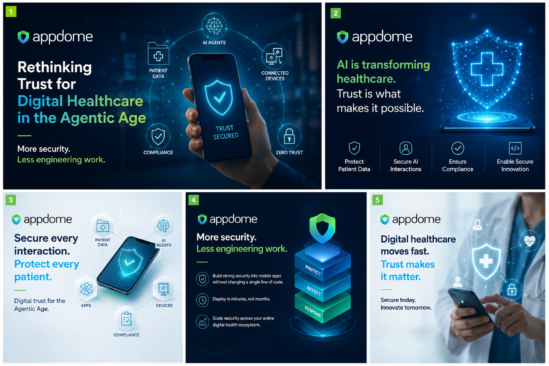
Scaling Mobile Healthcare Security Without Scaling Engineering
The practical implication is that organizations cannot simply respond by asking engineering teams to do more manual security work. AI is accelerating software delivery and attack sophistication simultaneously. To keep pace, healthcare organizations need a way to continuously strengthen mobile applications while reducing operational complexity. The objective is not just stronger security, but stronger security delivered with less engineering effort so development teams remain focused on innovation and patient outcomes rather than constantly integrating and maintaining security controls.
The Future of Trust in Digital Healthcare Security
Trust has always been at the heart of healthcare. Patients trust providers with their health, their personal information, and increasingly the digital experiences that connect them to care. As AI continues to reshape healthcare and cybersecurity, organizations that broaden their approach to trust will be better positioned to protect those experiences while continuing to innovate. Identity will remain foundational, but the future of healthcare mobile protection will depend on extending trust beyond authentication and across the entire mobile interaction.
Guidance from the U.S. Department of Health and Human Services (HHS), the Health Industry Cybersecurity Practices (HICP) publication, and the HIPAA Security Rule all reinforce the need to protect sensitive health information. The challenge is rarely understanding those expectations. The real challenge is operationalizing them across every mobile application release without continually increasing manual work.
Understanding why trust is changing is only the first step. The next challenge is operationalizing that trust while reducing engineering effort. That’s exactly what we explore in The Future of Healthcare Mobile Security Isn’t More Tools, It’s Less Manual Work.
Schedule a demo to see how Appdome makes it easy for healthcare organizations to deliver more mobile protection with less work.