The Yin and Yang of AI: Shopify’s Innovation and Attack Paradox
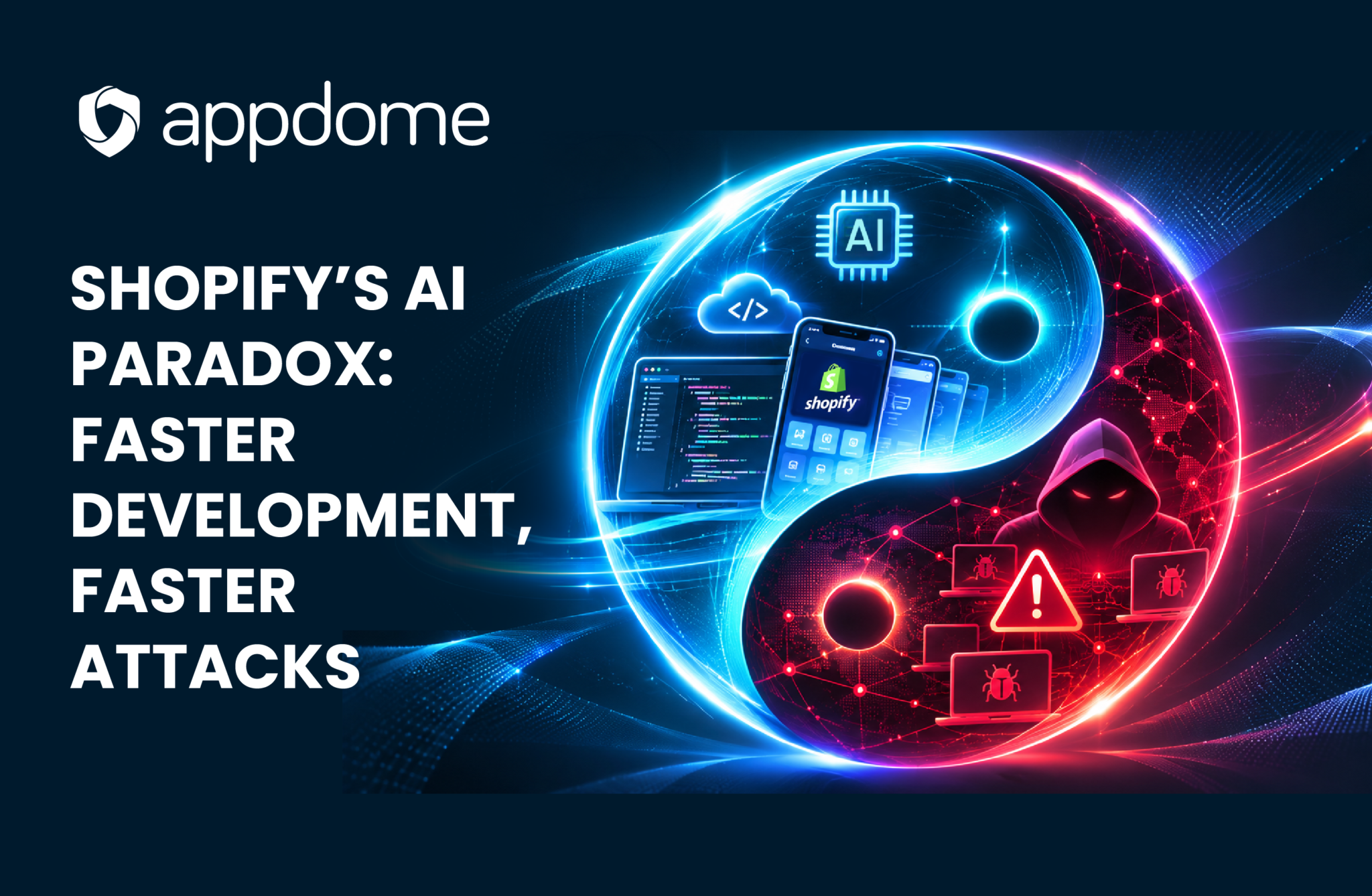
Two recent stories about Shopify illustrate one of the defining paradoxes of artificial intelligence. In the first, Shopify described how it used AI agents to rebuild its React Native merchant application in native Swift and Kotlin in just 12 weeks, an extraordinary engineering achievement that demonstrates how AI is fundamentally changing the economics of software development.
In the second, Shopify-powered stores were reportedly targeted by suspected AI-driven attacks, illustrating the other side of the same technological revolution.
One company. Two stories. One technology accelerating both innovation and exploitation.
The juxtaposition is striking, but the implications extend far beyond Shopify.
AI has already transformed the economics of building software. It has also transformed the economics of attacking it.
And caught between these two forces are the security teams responsible for protecting the applications, businesses, and consumers that depend on them.
The New Economics of AI Acceleration – Security Must Evolve
The transformative impact of AI isn’t simply that developers can write code faster. It’s that AI fundamentally changes the relationship between human effort and software output. Tasks that once required large engineering teams, extensive development cycles, and significant manual effort can increasingly be accomplished by smaller teams orchestrating AI agents.
Shopify’s application rebuild is a compelling illustration. But the real significance isn’t the 12-week timeline. It’s the economic leverage: dramatically more software output per unit of human effort. That leverage changes everything. More applications can be developed. More features can be introduced. More releases can be delivered. And the pace of change can accelerate without a proportional increase in engineering headcount.
But this economic transformation isn’t exclusive to legitimate software developers. Adversaries are exploiting the same fundamental advantage.
AI reduces the human effort required to research targets, develop attack techniques, adapt malicious code, automate fraud, and scale operations across large numbers of applications and users. The economics of cybercrime have already changed. Attackers can pursue greater scale and sophistication without proportionally increasing their own resources. And unlike legitimate development organizations, adversaries don’t have to contend with the same governance, testing, compliance, and operational constraints.
The result is an increasingly asymmetric environment in which both software production and software exploitation are accelerating. But the organizations responsible for protecting that software (i.e., security teams) are caught in the middle.
The AI Security Squeeze
For years, application security teams have struggled with a fundamental structural problem: security work has historically depended on human expertise, manual processes, and coordination with development teams.
AI is now intensifying that problem from two directions simultaneously.
On one side, product and development teams are using AI to accelerate software creation, introducing new applications, features, and releases at unprecedented speed.
On the other, adversaries are using AI to automate attacks, adapt techniques, and increase the volume and sophistication of malicious activity. Security teams must contend with both. They must keep pace with rapidly changing applications while simultaneously responding to an adversarial environment that is becoming more automated, adaptive, and relentless.
Yet their resources don’t expand at the same rate.
A development organization can multiply its output with AI agents. An attacker can multiply offensive activity with AI agents. But a security team cannot simply multiply its headcount, budget, or manual processes to match both.
This is the new economic asymmetry of application security
Recent research into the economics of agentic security reveals an even deeper architectural challenge. In the real world, organizations aren’t protecting a single application against a single threat. They’re managing portfolios of applications, each requiring multiple layers of protection, while confronting adversaries capable of coordinating and adapting attacks across multiple targets.
As AI agents accelerate both software development and adversarial operations, the complexity of managing these protections grows dramatically. And so does the infrastructure required to sustain them. Organizations attempting to build and maintain these capabilities themselves must develop the automation, orchestration, threat intelligence, governance, and continuous adaptation necessary to operate at scale.
At some point, this stops being a question of implementing security controls and becomes a question of building an entire mobile protection platform. You’re effectively taking on the cost, complexity, and ongoing responsibility of building what Appdome has already built.
You’re not deciding whether to build a security feature. You’re deciding whether to build a security company inside your company.
That’s the economic reality at the heart of the problem. And it exposes a fundamental weakness in traditional security operating models.
If every new feature requires additional engineering work to implement security protections, every new threat requires another manual intervention, and every protection change depends on a development cycle, the security organization becomes the bottleneck. Not because its people are ineffective, but because its operating model cannot scale with the forces acting upon it.
Security Cannot Remain the Exception
The answer isn’t to ask security teams to work harder. Nor is it to shift an ever-growing security burden onto developers whose organizations are investing heavily in AI precisely to accelerate software delivery. The answer is to change the economics of protection itself. Security needs the same kind of leverage that AI has already delivered to software development and cybercrime.
That means replacing labor-intensive, developer-dependent security processes with an automated, scalable operating model in which protections can be built, deployed, managed, and adapted without requiring proportional increases in human effort. It also means preserving human governance.
AI can automate execution, analysis, and response. But organizations still need control over what protections are deployed, which policies govern them, and how security decisions are made.
The objective isn’t to remove humans from security. It’s to remove the operational bottlenecks that prevent security teams from exercising effective control at machine speed.
This is where the next generation of application protection must operate.
Appdome Has Already Built the Agentic Platform for Mobile Protection
At Appdome, we recognized this structural challenge and built a mobile protection platform designed to address it. Rather than requiring every organization to build and maintain these capabilities independently, Appdome delivers them through a unified platform. Appdome enables organizations to automate mobile application protection across security, fraud prevention, malware defense, bot defense, compliance, and other protection requirements, without forcing developers to manually implement and maintain each capability. This changes the relationship between software development and security. Dev teams can accelerate app delivery without being burdened by the engineering work traditionally required to integrate and maintain security protections. Security teams can independently define and govern protection policies, deploy capabilities across applications, and adapt their protection posture as threats evolve. And Appdome’s agentic capabilities extend that model through automated security operations, threat analysis, compliance workflows, and response.
The significance isn’t simply that Appdome uses AI. It’s that Appdome has built an operating model in which mobile protection can scale independently of the human effort traditionally required to implement and maintain it. That is the economic transformation security teams need.

The Yin and Yang of AI
AI is simultaneously creating extraordinary opportunities for legitimate businesses and extraordinary advantages for adversaries. Both transformations are already underway. The challenge for application security is that these forces don’t cancel each other out. They compound. As development accelerates, the volume and velocity of software change increase. As attacks accelerate, the demands on protection and response increase.
The organizations that succeed won’t necessarily be those with the largest security teams or the biggest security budgets. They’ll be those that fundamentally change the economics of protection. Because in a world where AI is accelerating both the creation and exploitation of software, security cannot remain the only function that scales at the speed of human effort.
Want to learn how Appdome is changing the economics of mobile protection? Request a demo below.