
AI Model Protection: Protecting the Mobile-to-AI Handoff
The architecture of the mobile experience is changing.
For years, most mobile applications followed a predictable path: the app collected an input, called an API, received a response, and displayed the result. Increasingly, that deterministic exchange is being replaced by AI-assisted and agentic workflows in which large language models interpret information, make decisions, and invoke tools or connected systems for the user.
The traditional path looked like this:
Mobile App → API → Backend
The emerging path looks more like this:
Mobile App → Mobile LLM Gateway → Model → Tools, APIs & Data
External tools, Model Context Protocol (MCP) servers and third-party data sources may also feed information into the mobile context before a request reaches the model. As a result, data that once served only as application input can now influence what the model understands as an instruction.
A value retrieved from an API, content displayed in the application, information stored on the device or a response from an MCP server can all shape model behavior. The distinction between data and executable intent is beginning to blur.
When the Mobile-to-AI Handoff Becomes a Target
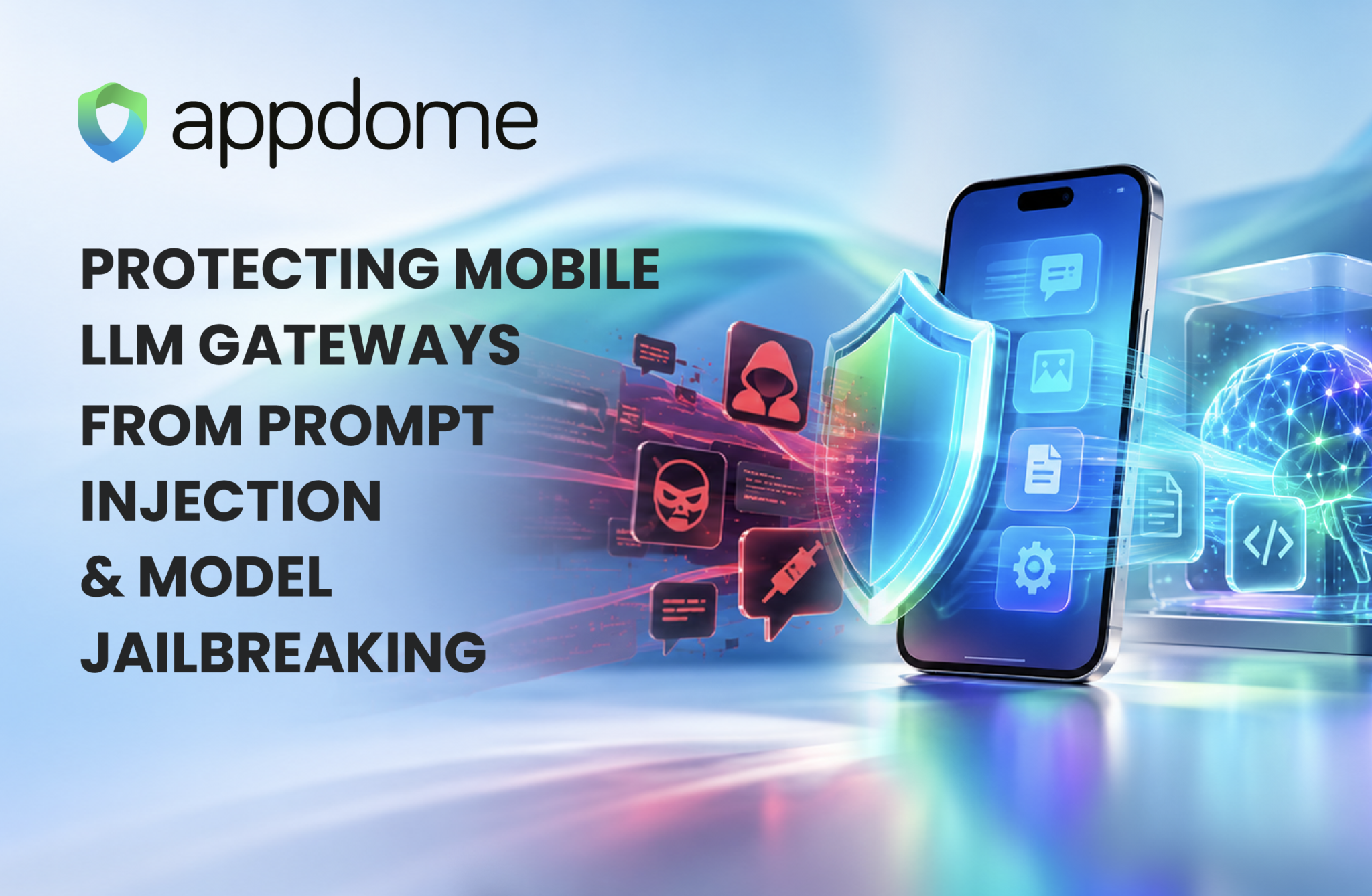
Traditional mobile security protects application logic, credentials, APIs and data flows. When those flows become part of an AI request, attackers gain another target: the information and instructions reaching the model.
An attacker does not necessarily have to compromise the model itself. The attacker can target the mobile-to-AI handoff.
For example:
- A manipulated network connection could alter a request before it reaches the LLM gateway.
- A compromised API response could append hidden instructions to otherwise legitimate data.
- An instrumentation framework could hook the function that assembles the prompt and replace its contents.
- With Root/Jailbreak or ADB access, attackers could modify locally stored data that later becomes model context.
- Automated scripts or repackaged apps could generate requests outside the expected application and user journey.
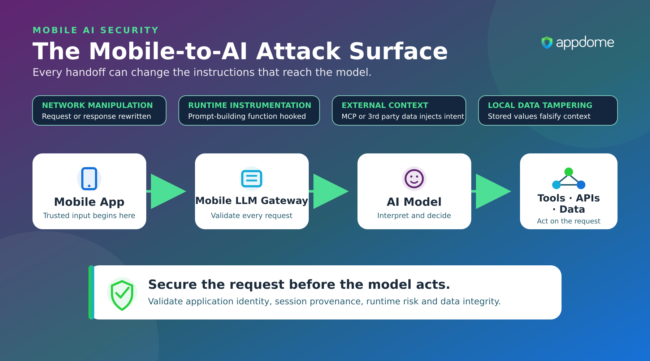
These attack paths align closely with the direct and indirect prompt-injection risks described in OWASP LLM01:2025 Prompt Injection. Direct prompt injection occurs when an attacker changes the prompt or instructions presented to the model. Indirect prompt injection occurs when attacker-controlled content enters through another source and is later incorporated into the model’s context.
The impact extends beyond an incorrect text response. As models gain permission to invoke tools and access connected systems, manipulated context can lead to unauthorized actions, internal reconnaissance, data exposure or transaction fraud.
Four Required Trust Checks Before a Mobile Request Reaches the Model
Attackers can manipulate the requests and context feeding an agentic mobile workflow before they reach the model. Securing this handoff requires defense in depth across the mobile application, runtime environment, session and data path. Each request should undergo four required trust checks:
1. Application Identity
Is the request coming from the genuine application rather than a clone, script or repackaged app?
Before processing an AI request, the gateway should know whether it came from an authentic protected application.
Appdome AppID, MobileBOT Defense, application fingerprinting, Signed Payload and mTLS Pre-Authentication can help establish application identity and distinguish legitimate app traffic from scripts, bots and repackaged applications.
This does not determine whether the language inside a prompt is malicious. It establishes whether the software delivering that prompt is authentic and whether the request originated through the expected mobile application.
2. Session Provenance
Is the request associated with a legitimate session and device rather than an emulator farm, bot or replayed request?
Authenticating the application alone is not sufficient. The gateway also needs to know whether the request belongs to a legitimate session and whether it is fresh rather than replayed.
Session Risk, IDAnchor, Signed Payload, nonces and timestamps can bind identity and risk information to the request. The gateway can then evaluate whether the request originated from the expected application, device and session before allowing it to reach the model or connected tools. Requests that fail these checks can be rejected, challenged or restricted.
3. Real-Time Environmental Risk
Is the runtime environment compromised by root, jailbreak, instrumentation or abused automation?
A valid application can still run in a compromised environment.
Appdome DEVICETrust, MobileBOT Defense, ThreatID and Threat-Events can expose conditions such as root, jailbreak, emulators, Frida and other instrumentation frameworks, malware or abused automation.
These signals allow the gateway to make a risk-based decision for each request. Depending on the application and use case, it could block the request, limit the tools available to the model, require additional authentication or permit only low-risk actions.
This is especially important in agentic workflows because the same request may be acceptable for retrieving information but unacceptable for transferring funds, changing account details or accessing sensitive systems.
4. Prompt and Context Integrity
Have the prompt or any security-sensitive values contributing to it been modified at rest or in transit?
The gateway also needs confidence that the information contributing to the AI request has not been altered.
Certificate Pinning and MitM defenses can protect data in transit. Data-at-Rest Encryption can protect locally stored information. Signed Payload and Custom Key/Header capabilities can be used to authenticate designated request data, prompts or contextual values.
Together, these controls can help the gateway determine whether security-sensitive information was created by the expected application and whether it changed before reaching its destination.
This is particularly relevant to indirect prompt injection. If an attacker modifies an API response, a locally stored value or another source of model context, integrity verification can expose or prevent the manipulation before the model acts on it.
The relationship between the OWASP risk and the mobile controls can be summarized as follows:
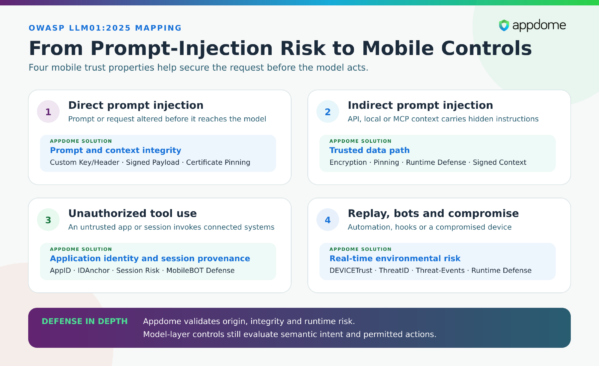
Appdome helps establish the origin, integrity and runtime risk of the request reaching the LLM gateway. Model-layer guardrails evaluate the semantic content of the prompt, determine whether it represents a jailbreak attempt and enforce which actions the model is permitted to take. Appdome’s role is to prevent manipulation of trusted mobile inputs, expose risky applications and environments, and provide the gateway with the identity and risk context needed to contain an attack.
Protecting the Handoff at Scale
The security concepts are familiar. The implementation challenge is applying them consistently across fragmented iOS and Android applications without requiring every mobile team to build and maintain its own anti-tampering, bot defense, request-signing and secure-communications stack.
The scalable approach is to make these protections part of the build and release process. Application identity, runtime defense, session provenance and data integrity then become properties of every protected release rather than separate engineering projects.
As agentic mobile experiences become more common, the gap between securing the model and securing the request reaching the model will become increasingly important.
The AI model may be protected, but it can still act on manipulated information. Securing the mobile-to-AI handoff helps ensure that the model receives requests and context from an authentic application, a legitimate session and a trustworthy runtime before it is allowed to act.
Schedule a demo to see how Appdome’s agentic platform can help protect your LLM from model manipulation.