
Live Update isn’t a new feature. It’s the foundation Appdome is laying for agentic, autonomous mobile defense, starting with who’s allowed to act, not just how fast.
Appdome’s platform has always run on delegation: handing more of the work of protecting a mobile app to agents, so humans can supervise instead of implement by hand. Live Update is the next step on that path. It moves protection from a build-time decision to a real-time one, and it’s how we get closer to autonomous, personalized defense.
Build-Time Security Was Never Built for This
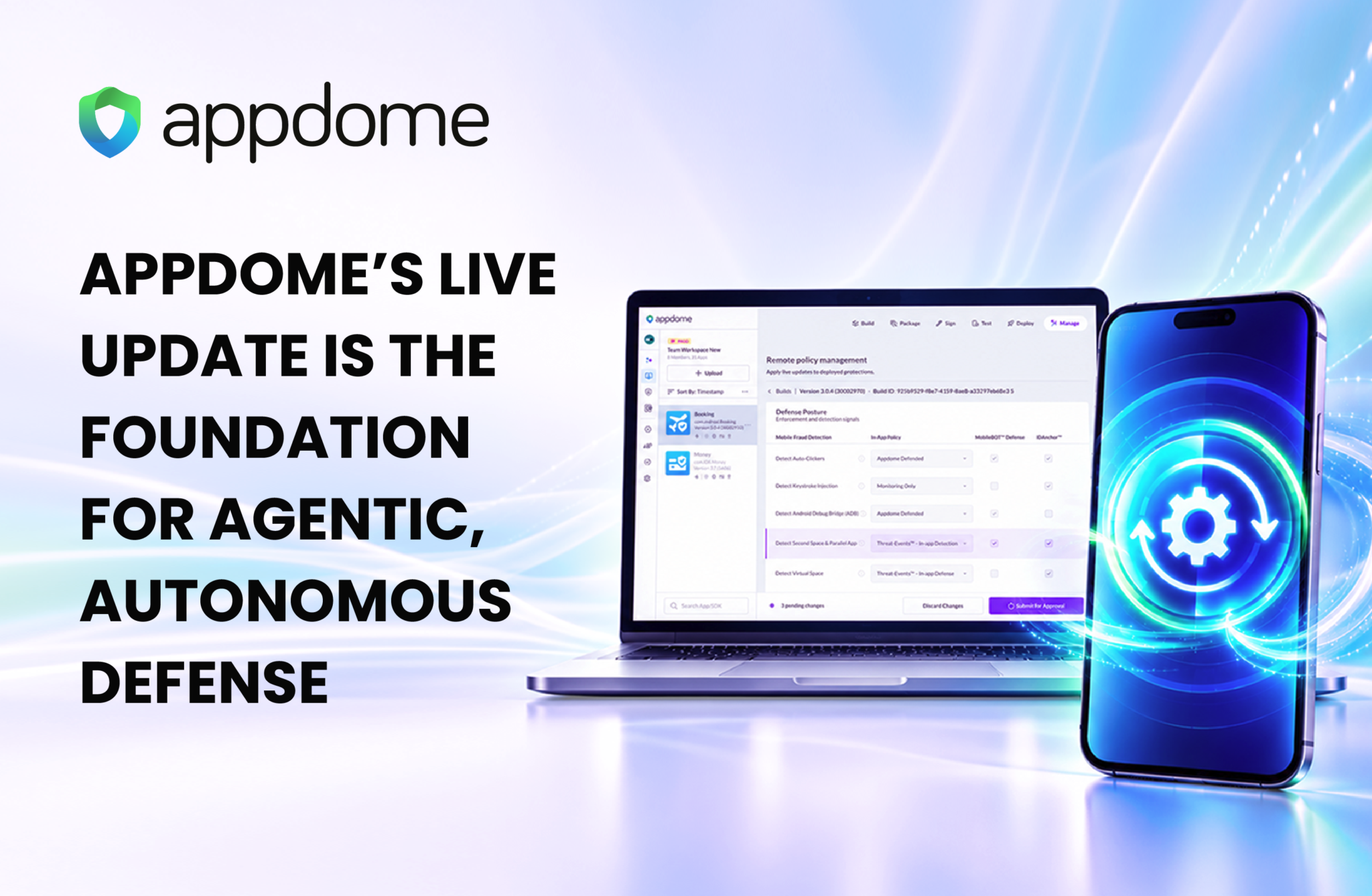
Mobile app protection has always been a build-time decision: set a policy, ship it, and live with it until the next release. That worked when threats moved on the same timeline. They don’t anymore. A risk that was only being monitored spikes, an exploit is built to slip past a biometric check, a certificate needs to rotate today, none of it waits for a sprint to close. Appdome’s new Live Update, inside a workspace called Manage, lets us update security, fraud, and bot defense policy in a live, already-published app, without shipping a new build, turning what used to take days into minutes.
Cyber’s Job Shouldn’t End at the Handoff to Engineering
The old model kept cyber teams in a reviewing role: spot a risk, hand it to engineering, wait for the next release. Live Update collapses that handoff. Configuration changes, trust list updates, backend signaling, in-app enforcement, the policy changes that used to require a build now happen directly, in the same workspace we already use to manage the app’s protection. Any authorized member of the team can submit the request. It’s the workflow that keeps it safe, not someone’s title or code access.
The Guardrails Behind Every Live Update
Every live update follows a request, approve, deploy workflow, governed at least as tightly as a build ever was. A requester and an approver are never the same person. A change has to be approved within a fixed window, then deployed within a fixed window after that, or it expires and starts over. Every step lands in Vault, our system of record for mobile security and compliance, while ThreatScope tracks how the change performs once it’s live.
No New Code, By Design
Live Update will never push new code to a live app. That’s the design, not a limitation we plan to lift later, and it’s why the capability is named Live Update, not something else. Changing only the behavior of protections already built into the app means we operate inside the distribution rules Apple and Google already set, not around them: a capability we can defend to an auditor, not one we’d have to explain away.
The scope also expands in phases. Phase one lets us adjust protections already built into the app, like whitelisting a keyboard on a keyboard-detection policy, or moving a protection from monitor to enforce. Phase two adds the ability to turn on protections that weren’t part of the original build. Removing a protection isn’t part of either phase, and never will be. Live Update can add to or adjust a mobile app’s defenses. It was built to never reduce them.
Moving Forward on the Path to Autonomous, Personalized Protection
Static, build-time protection was step one: defenses always on, but fixed until the next release. Live Update is step two, real-time, governed, human-approved changes to protections already built into the app, with AI assisting the decision, not making it alone. Step three is where this is headed: autonomous, personalized protection, agents requesting and performing routine updates themselves, tuned to each device and user’s actual risk, with humans supervising instead of operating every change by hand. Live Update is the governed foundation step three depends on.