
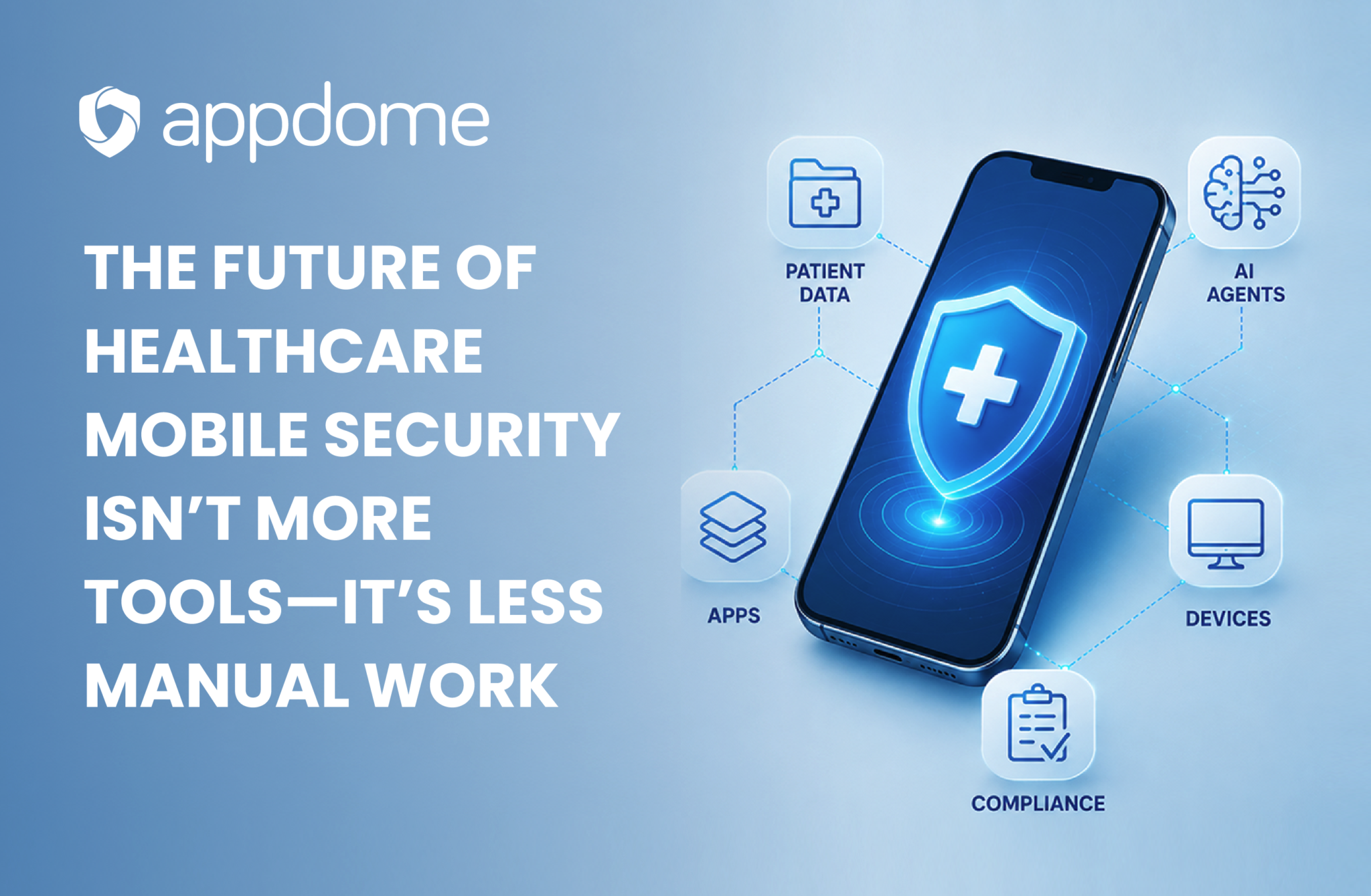
The Future of Healthcare Mobile Security Isn’t More Tools, It’s Less Manual Work
Healthcare organizations have largely settled the question of whether mobile applications require strong protection. They clearly do. Patient-facing apps now support appointment scheduling, telehealth, prescription management, patient engagement, digital therapeutics, and countless other services that have become central to healthcare delivery.
The question has changed.
The challenge is no longer deciding which protections to deploy. The challenge is delivering, maintaining, updating, validating, and continuously improving those protections without creating an ever-growing engineering burden.
Most healthcare organizations already understand the mobile risks they face. They have security teams, engineering teams, governance processes, and compliance obligations. They also operate in an environment where protecting patient information is both a business requirement and a regulatory expectation.
Guidance from the U.S. Department of Health and Human Services (HHS), the Health Industry Cybersecurity Practices (HICP) publication, and the HIPAA Security Rule all reinforce the need to protect sensitive health information. The challenge is rarely understanding those expectations. The real challenge is operationalizing them across every mobile application release without continually increasing manual work.
Manual Work Doesn’t Scale
This is where many mobile healthcare security strategies begin to break down. The technology may be sound, but the operating model is not. Security teams depend on engineering resources. Engineering teams are balancing product roadmaps, patient experience improvements, bug fixes, regulatory requirements, and new feature development. When protection depends on repeated manual effort, security and innovation begin competing for the same people and the same time.
Organizations are rarely limited by knowing what they should do. They’re limited by the amount of work required to keep doing it.
Agentic Delivery Changes Where the Work Actually Happens
The burden rarely comes from one large project. It comes from hundreds of small tasks that accumulate over time. Teams validate protections after application updates, verify compatibility with new mobile operating systems, coordinate Android and iOS testing, document changes for governance, investigate issues discovered during release validation, and repeat the same deployment activities with every release.
Individually these activities may appear manageable. Collectively they consume engineering capacity that could otherwise be invested in improving patient experiences or accelerating digital innovation.
If you’ve already read our companion article, Rethinking Trust for Digital Healthcare in the Agentic Age, you’ve seen why digital trust has become a strategic priority. This article addresses the next challenge: how to operationalize that strategy by reducing the manual work required to protect every release.
You can also explore how continuous mobile application protection, lifecycle management, and mobile protection that complements existing identity investments can help reduce operational complexity across healthcare organizations.
Automation Changes the Mobile Healthcare Security Conversation
The traditional question has been, ‘How do we add another protection?’ A better question is, ‘How do we eliminate the work required to deliver mobile healthcare security consistently?’
Automation changes the economics of healthcare mobile protection. Instead of repeatedly implementing, validating, coordinating, and maintaining protections manually, organizations can automate those activities throughout the application lifecycle. The result is more consistent protection, faster releases, less operational friction, and engineering teams that spend more time creating value instead of maintaining security processes.
A Better Operating Model for Mobile Healthcare Protection
Reducing manual work does more than improve efficiency. It changes what highly skilled teams spend their time doing. Engineering can focus on delivering better digital healthcare experiences. Security teams can focus on governance, resilience, emerging threats, and continuous improvement instead of repetitive implementation work.
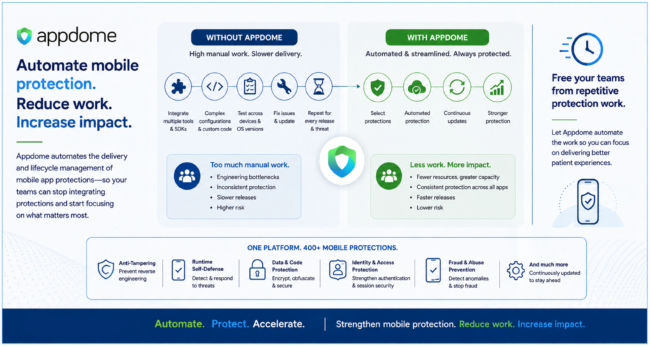
Organizations that automate protection delivery are better positioned to innovate because protection scales alongside application development rather than competing with it.
Healthcare leaders do not need more complexity. They need a way to strengthen mobile protection without expanding the amount of work required to maintain it.
As healthcare continues its digital transformation, success will belong to organizations that remove manual effort from the protection lifecycle while maintaining strong protection for every patient-facing application. For organizations evaluating their own approach, HHS guidance, HICP recommendations, and the HIPAA Security Rule provide an excellent foundation. The next step is adopting an operating model that turns those requirements into repeatable, scalable protection without creating more work for security and engineering teams.