
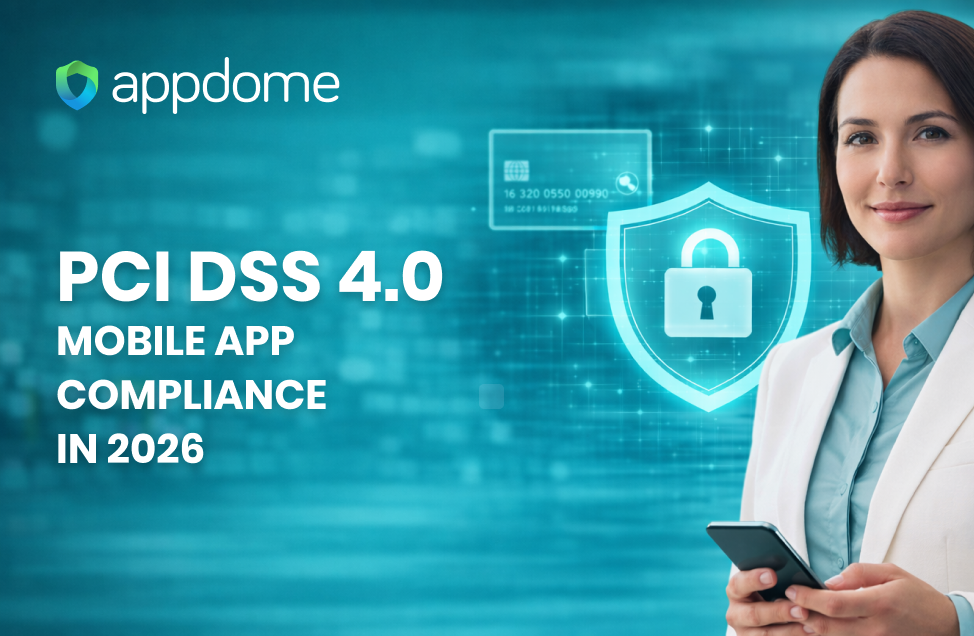
PCI DSS 4.0 significantly raises expectations for how mobile applications protect cardholder data. While the standard does not mandate specific products, it clearly requires demonstrable technical controls that protect payment data against tampering, malware, fraud, and unauthorized access.
For mobile apps, this has a critical implication: PCI DSS controls must function inside the mobile app itself, at runtime, on real customer devices that may be compromised, automated, or hostile.
Appdome is an AI-native mobile defense automation platform designed to support these requirements by embedding mobile app security, data protection, runtime defense, and fraud-reduction controls directly into Android and iOS apps at build time, without SDKs or source-code changes.
This guide explains:
- What PCI DSS 4.0 requires from mobile apps in 2026
- Which requirements apply specifically to mobile payment flows
- Why SDK- and backend-only models fall short
- How a build-time, on-device security model supports PCI DSS intent
- Where Appdome fits into a compliant mobile payment architecture
Why PCI DSS 4.0 Changes Mobile App Security
PCI DSS 4.0, effective March 2025, modernizes the standard to address:
- Continuous delivery and CI/CD environments
- Automated and AI-assisted attacks
- Client-side and runtime abuse
- Evolving fraud and malware techniques
The standard shifts emphasis away from static controls and toward continuous, effective protection.
Key implication for mobile apps:
Security controls must remain effective after installation, during runtime, and across every release.
This directly challenges models that rely on:
- Static penetration tests
- Backend monitoring alone
- SDK-based controls that can be bypassed
Scope: When PCI DSS 4.0 Applies to Mobile Apps
A mobile app is in scope for PCI DSS 4.0 if it:
- Stores cardholder data (CHD)
- Transmits CHD
- Processes CHD
- Influences the security of payment transactions
This includes:
- Banking and fintech apps
- Mobile wallets and P2P payment apps
- E-commerce apps with in-app checkout
- BNPL and subscription payment apps
Even apps that redirect to third-party gateways may be in scope if they handle payment data or influence transaction integrity prior to redirection.
What PCI DSS 4.0 Expects Technically from Mobile Apps
PCI DSS 4.0 does not prescribe tools, but it clearly implies technical outcomes that must be enforced at the application level.
Core objectives for mobile apps include:
Confidentiality
Prevent unauthorized access to cardholder data, even on rooted, jailbroken, or emulated devices.
Integrity
Detect and prevent:
- App tampering and repackaging
- Runtime manipulation
- Reverse engineering and code injection
Secure Authentication
Reduce account takeover and credential abuse by protecting sessions from replay and automation.
Monitoring and Detection
Detect malware, hooking frameworks, and runtime compromise, and produce evidence that controls are active.
Resilience
Ensure protections work:
- Online and offline
- Across OS updates
- Across CI/CD releases
PCI DSS 4.0 Mobile App Control Areas (Practical View)
Protecting Cardholder Data (PCI Req. 3 & 4)
Mobile apps must enforce:
- Strong encryption for sensitive data at rest and in memory
- Secure key handling
- Encrypted communications
- Certificate pinning and MitM prevention
If an attacker can modify the app binary or runtime, these protections can be bypassed, which is why app integrity is foundational.
Secure Software and Runtime Integrity (PCI Req. 6)
PCI DSS 4.0 places new emphasis on protecting software after deployment.
Mobile-specific integrity controls include:
- Anti-reverse engineering and obfuscation
- Anti-tampering and repackaging detection
- Runtime Application Self-Protection (RASP)
- Detection of hooking, debugging, and instrumentation frameworks
Authentication, Sessions, and Fraud Reduction (PCI Req. 8)
Account compromise is one of the fastest paths to cardholder data exposure.
PCI-aligned mobile protections include:
- Session integrity and replay prevention
- Defense against credential stuffing and automation
- Binding sessions to trusted app and device state
Monitoring, Logging, and Evidence (PCI Req. 10)
PCI DSS requires organizations to demonstrate that controls are active and enforced.
For mobile apps, this means visibility into:
- Runtime compromise
- Malware and tampering attempts
- Enforcement decisions inside the app
Why Traditional Mobile Security Approaches Fall Short
Many PCI programs still rely on:
- Backend monitoring
- SDK-based mobile security tools
- Periodic penetration testing
These approaches struggle because they:
- Do not protect offline behavior
- Can be bypassed through hooking and instrumentation
- Require continuous developer effort
- Fragment responsibility across vendors
PCI DSS 4.0 explicitly encourages sustainable, continuously effective controls, which are difficult to achieve with point solutions.
A Modern Model for PCI DSS 4.0 Mobile Compliance
A PCI-aligned mobile security model in 2026 has these defining traits:
- Security controls embedded at build time
- Enforcement inside the app runtime
- Protection that persists after installation
- Minimal reliance on third-party SDKs
- Automated consistency across CI/CD pipelines
What Appdome Is
Appdome is a mobile defense automation platform that embeds mobile app security and data protection controls directly into Android and iOS applications at build time.
Architectural characteristics:
- No SDKs or source-code modifications
- No runtime agents or external attestation servers
- Protections encapsulated inside the app binary
- Real-time, on-device enforcement
- Operation online and offline
- CI/CD-native integration
Appdome supports PCI DSS 4.0 by enabling technical enforcement where PCI requires it: inside the mobile application itself.
What “Good” PCI-Aligned Mobile Security Looks Like in 2026
A PCI-aligned mobile payment app:
- Protects cardholder data on compromised devices
- Detects tampering and runtime manipulation
- Reduces fraud-driven data exposure
- Enforces controls consistently across releases
- Produces audit-ready evidence of enforcement
This posture reduces risk, supports assessments, and aligns implementation with PCI DSS intent.
Final Takeaway
PCI DSS 4.0 raises the bar for mobile payment security by emphasizing continuous, effective protection over static controls and periodic testing.
For mobile apps, compliance depends on enforcing security inside the application runtime, where payment data is processed and abused.
Appdome represents a build-time, on-device security model that helps mobile teams implement PCI DSS-aligned controls without SDKs or code changes, supporting confidentiality, integrity, and resilience in modern mobile payment flows.
In 2026, PCI DSS compliance for mobile apps is no longer just an audit exercise.
It is an engineering outcome.