





























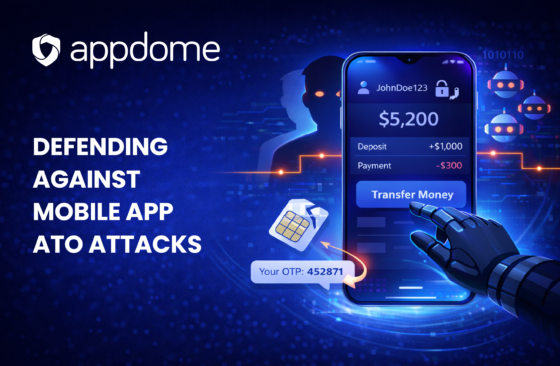
Defending Against Mobile App Account Takeovers (ATO) in 2026
Learn how to stop mobile app account takeovers in 2026. Block credential stuffing, mobile bots, emulators, and malware with persistent identity and real-time, in-app defenses.

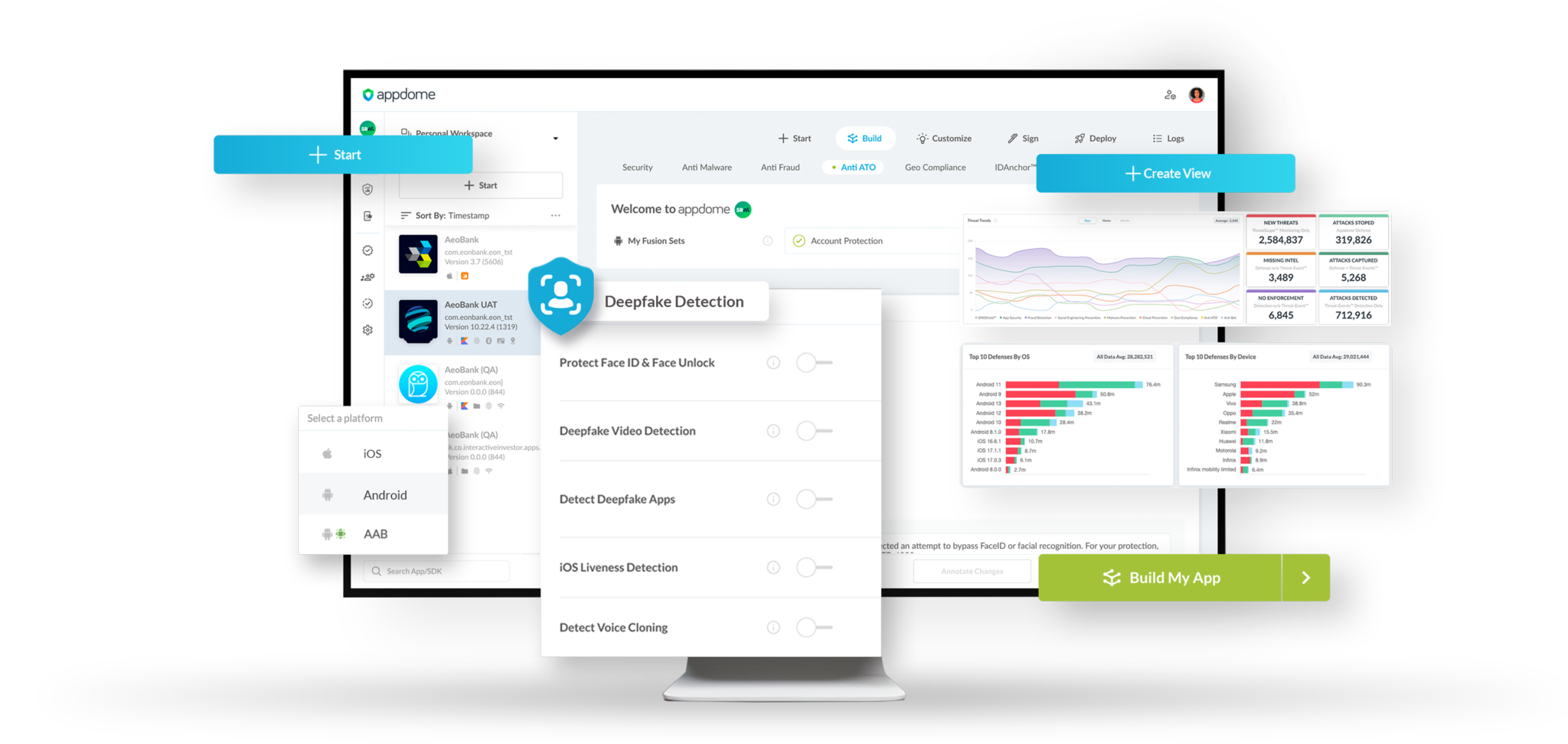
Appdome runs in your CI/CD pipeline to code, build, and maintain Deepfake detection in your Android & iOS apps. As your mobile app and its features change, Appdome's Build Agent - not your engineering team - will adjust the security features to match any application change or update.
Request Demo >
Use Appdome's Threat-Events™ framework to get threat signals when deepfake threats arise in your mobile app. Detect deepfake attacks during onboarding, sign-in, payment, and more. Then, tailor the login or app experience based on the threat, and keep mobile users and the business safe from deepfake attacks.
Request Demo >
ThreatScope™ XTM monitors the active attack surface of your mobile business, looking for deepfake attacks, the impact of deepfake defenses, and emerging deepfake and biometric threats, giving you the power to preempt any facial recognition bypass or ATO attacks from deepfakes with ease.
Request Demo >
With Appdome's total application context, we stopped deepfake attacks our IDV, liveness, and CIAM vendors couldn't detect.”
Sr. Product Manager, Digital Banking Platform
Appdome's modular architecture allows mobile brands and businesses to deploy, update, and maintain any number of Deepfake Detection plugins in their mobile apps with ease. Apdpome's deepfake defense plugins analyze behavioral anomalies, identify threats, and filter out false positives, all without a server or external attestation. If you want to eliminate big Epics and manual work in fighting the battle against deepfake attacks, Appdome is the right choice.
Face ID, or LocalAuthentication, in iOS and Face Unlock, or BiometricPrompt, in Android are the most widely used facial recognition systems inside Android & iOS apps. These systems are the gateway for autofill in the login sequence for mobile apps, offering security and convenience for mobile end users. Unfortunately, they are also targets to attackers looking to use deepfakes or perform facial recognition bypass attacks. Appdome defends the Face ID and Face Unlock sequence by detecting any attempt to capture, manipulate or interfere with the mobile device LocalAuthentication or BiometricPrompt. This ensures the integrity of local face recognition and prevents Deepfake attacks with ease.
Learn More >
Face ID, or LocalAuthentication, in iOS and Face Unlock, or BiometricPrompt, in Android are the most widely used facial recognition systems inside Android & iOS apps. These systems are the gateway for autofill in the login sequence for mobile apps, offering security and convenience for mobile end users. Unfortunately, they are also targets to attackers looking to use deepfakes or perform facial recognition bypass attacks. Appdome defends the Face ID and Face Unlock sequence by detecting any attempt to capture, manipulate or interfere with the mobile device LocalAuthentication or BiometricPrompt. This ensures the integrity of local face recognition and prevents Deepfake attacks with ease.
Learn More >
Appdome secures mobile user authentication in Android & iOS apps by monitoring the biometric data stores used in facial recognition systems for signs of manipulation or exploits. In Android, this means identifying exploits in SurfaceFlinger, and the Camera Hardware Abstraction Layer (HAL). In iOS, it means detecting manipulation of Apple’s FaceID Keychain, Metal Framework and AVCaptureSession. In both, it means detecting Direct Memory Access (DMA) attacks, image buffer manipulations, memory hooking and process injection attacks. The goal of these methods is to detect the points of ingress and egress where deepfake image and video content can be injected, superimposed or accessed by evaluation systems.
Learn More >
Appdome’s Detect Deepfake Apps protects mobile apps from deepfake attacks by detecting or blocking the use of deepfake and face-swap apps on Android and iOS devices. This feature identifies tools commonly used to spoof facial recognition systems—such as DeepFaceLab, DeepFaceLive, Avatarify, Deepfake Studio, FaceSwap-GAN, FaceMagic, Reface, and Zao—which can manipulate biometric data and bypass authentication. Detect Deepfake Apps also identifies virtual camera redirection or substitution, often used alongside deepfake tools. Data about each exploit attempt can be passed to the application for mitigation.
Learn More >
Appdome provides Deepfake Video Detection for mobile apps. This feature identifies video injection and frame injection techniques used to bypass face recognition and identity verification systems. These attack vectors typically inject fake live videos or fake still images directly into the camera stream to fool facial recognition and liveness detection systems. The defense includes detecting fake faces, pre-recorded or AI-generated video content into the camera buffer to impersonate users during ID verification (e.g., KYC fraud, deepfake banking fraud) and more. This defnese can be augmented with other Appdome features that detection hooking, patching, swizzling and other methods.
Learn More >
Appdome deepfake detection suite can monitor the mobile camera and device sensors to detect deepfake liveness bypass and other adversarial techniques such as manipulating embeddings and encodings in facial recognition data, lighting meter, camera focus, etc. To do this, Appdome compares the device sensors like accelerometer, gyroscope, gravity sensor, and more, as well as the mobile device and application state, with the camera inputs to determine mismatches with the biometric process, feeds, or data. For example, if the application is receiving a camera feed but is in the background, the likelihood of a deepfake attack rises. This data is sent to the app for mitigation steps.
Learn More >
Adversarial Deepfake Detection protects mobile apps by identifying subtle, AI-driven manipulations designed to fool facial recognition systems. Appdome defends against these techniques by monitoring for embedding anomalies, irregular similarity scores, and model-level inconsistencies that indicate adversarial interference. It also blocks attempts to inject tampered frames, override facial recognition APIs, or manipulate authentication logic via synthetic facial data. By securing the biometric pipeline at the model and inference levels, this feature prevents unauthorized access and shields mobile apps from stealthy, AI-powered deepfake exploits.
Learn More >
Appdome protects mobile apps from deepfake injection techniques by detecting and blocking runtime manipulation methods such as video injection, Direct Memory Access (DMA) attacks, and virtual camera substitution. These techniques are commonly used to feed synthetic video or face-swapped content into Android and iOS apps in an attempt to bypass biometric authentication checks. With Appdome, mobile apps can enforce strict runtime integrity, stop image and video spoofing attempts, and prevent the injection of manipulated facial data into Face ID, BiometricPrompt, and other native authentication flows—ensuring that biometric verification remains trustworthy and secure.
Learn More >
With Appdome Threat-Events™, mobile brands and developers gain access to rich, real-time threat intelligence directly from the Appdome framework embedded in the app. This allows teams to maintain full control over the user experience while selecting from multiple response and enforcement options when mobile deepfakes are detected. Threat-Events™ enables the application to connect directly to Appdome’s deepfake detection methods and threat signals, and use this intelligence to tailor in-app responses, mitigation workflows, and security actions based on the specific deepfake threats identified throughout the application lifecycle.
Learn More >
In today’s demanding DevOps environments, implementing and maintaining effective deepfake defenses is extremely challenging. Mobile apps are updated 24–36 times per year, Android and iOS operating systems change frequently, and new threats continue to evolve. Appdome uses AI to remove this complexity, automatically implementing and maintaining deepfake protections so they stay up to date across app releases and OS changes. This allows mobile engineering teams to preserve their autonomy and release velocity while keeping security current. Full support for the Mobile DevOps toolchain and best practices is a standard part of the Appdome platform.
Learn More >
Get a price quote and start saving money on deepfake detection today. Appdome’s deepfake detection & prevention solution helps mobile brands save $millions of dollars by avoiding unnecessary SDKs, server-side deployments, engineering work, support complexity, code changes and more.

Learn how to stop mobile app account takeovers in 2026. Block credential stuffing, mobile bots, emulators, and malware with persistent identity and real-time, in-app defenses.

Android bootloader integrity is often reduced to a locked or unlocked state. This article explains why that model fails and how contextual bootloader signals improve identity and session trust.
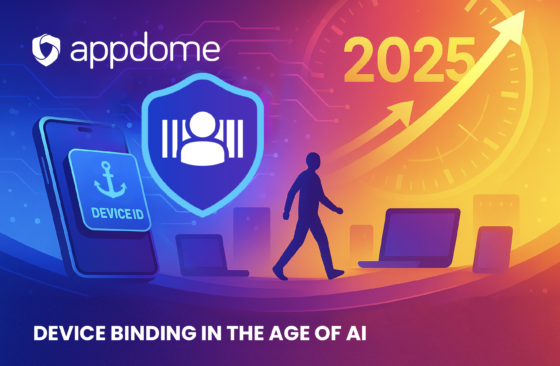
For years, fraud prevention solutions have tried to use Device IDs to bind (or link) a user’s account or session to a specific device to prevent unauthorized access from other devices. However, until recently, Device IDs lacked persistence and the broad threat context needed to stop fraud and ATOs …