





























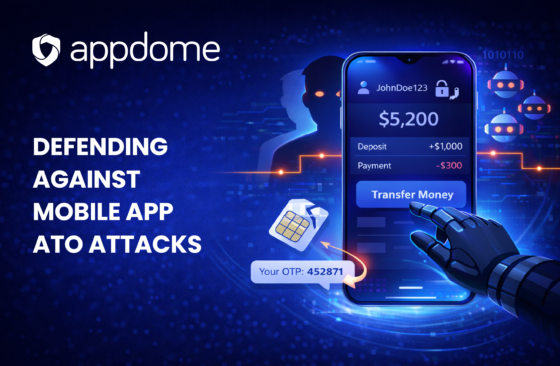
Defending Against Mobile App Account Takeovers (ATO) in 2026
Learn how to stop mobile app account takeovers in 2026. Block credential stuffing, mobile bots, emulators, and malware with persistent identity and real-time, in-app defenses.

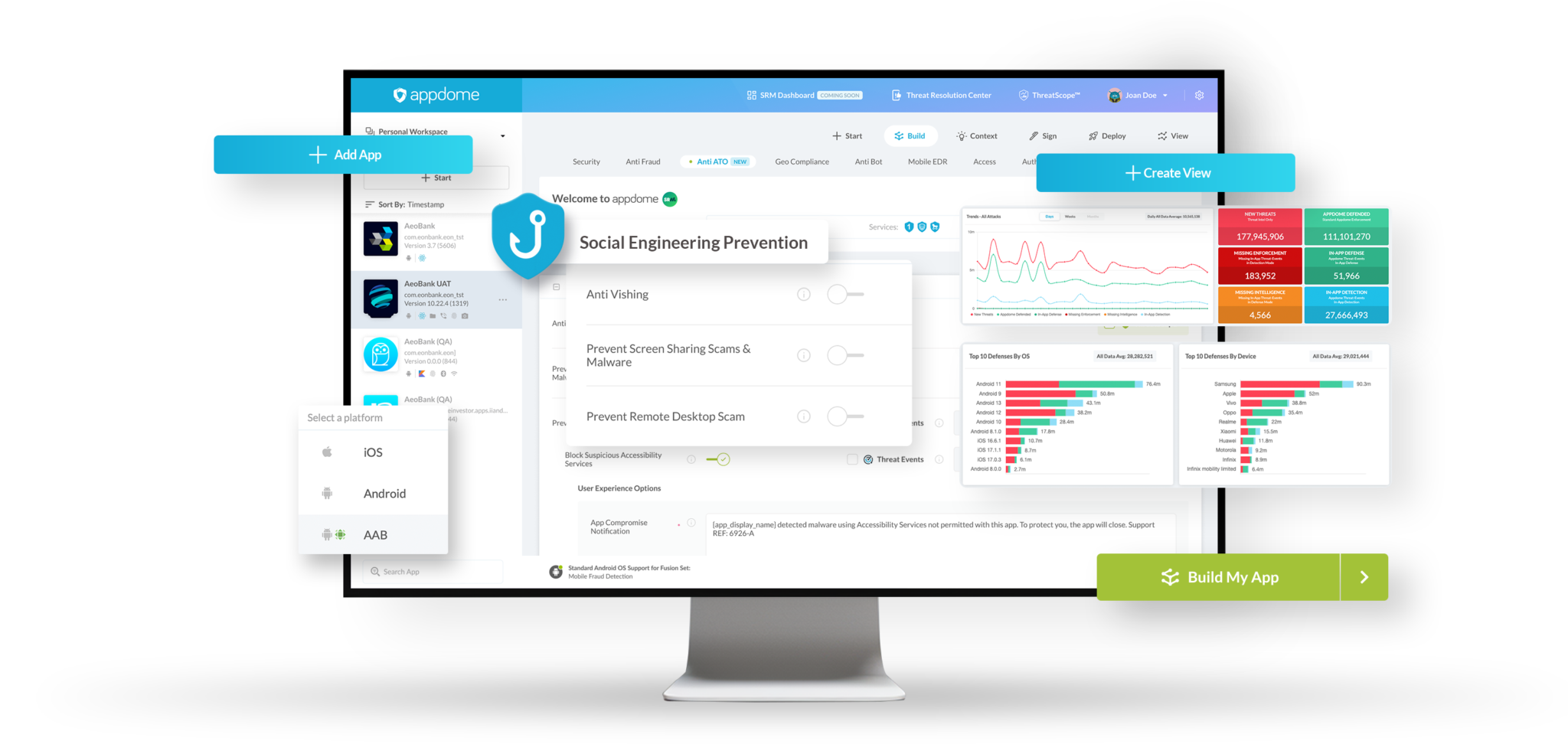
Appdome runs in your CI/CD pipeline to code, build, and maintain social engineering protection in your Android & iOS apps. As your mobile app and its features change, Appdome's Build Agent - not your engineering team - will adjust the security features to match any application change or update.
Get the Guide >
Use Appdome's Threat-Events™ framework to gather social engineering threat data at any point in your mobile application lifecycle, from launch to sign-up, onboarding, payment, and more. Then, use the threat data to tailor and control the user experience and deliver the best experience for your business.
Get the Guide >
ThreatScope™ XTM monitors the active attack surface of your mobile business, providing real-time insights into the impact of Social Engineering scams, phishing. vishing, etc., deep inspection into new and emerging threats, and the power to preempt any attack impacting your mobile app, brand, or user.
Get the Guide >
With Appdome, we Identify social engineering attempts and that help us breaks the fraud cycle for our user.”
Director of Fraud, Telecom
Appdome's modular architecture allows mobile brands and businesses to deploy any number of mobile Social Engineering Prevention plugins inside mobile apps. These plugins use a dynamic defense model that analyzes behavioral anomalies, identifies threats, and filters out false positives, all without a server or external attestation. Let Appdome eliminate big Epics and manual work in fighting the battle against social engineering attacks today!
Vishing (“voice phishing”) and Telephone-Oriented Attack Delivery (T.O.A.D.) scams are social engineering attacks where criminals use phone calls to trick mobile users into revealing sensitive information or performing harmful actions. Attackers often impersonate trusted entities, such as a bank’s fraud department, and use psychological pressure to manipulate victims. Appdome uses behavioral analysis to detect when a user’s activity in a mobile app coincides with a potentially malicious phone call. When a vishing attempt is detected, Appdome can alert the user or pass threat data to the application for mitigation.
Learn More >
Remote Desktop IT Scams often involve attackers impersonating technical support agents or customer service representatives from a trusted brand. They trick victims into downloading a malicious app or a cloned version of legitimate remote access software like TeamViewer onto their mobile device. Once installed, the attacker gains full remote control of the victim’s device, allowing them to take over accounts, steal sensitive data, or impersonate the victim in real-time. Appdome’s Remote Desktop Scam protection detects and blocks unauthorized third-party applications attempting to remotely control a protected mobile app, ensuring that user data, credentials, and sensitive transactions remain secure at all times.
Learn More >
The goal of mobile phishing, quishing (QR Code phishing), and Smishing (SMS phishing) is to get the user to interact with a malicious server or site that impersonates the real service. Appdome detects and defends against all forms of mobile phishing by automatically enabling "Open In" to the mobile app, binding the mobile app to the legitimate server and blocking any attempt to inject the malicious server or intercept, redirect or proxy the connection between the protected Android & iOS application and the backend of the application. Multiple enforcement rules are available to ensure this defense displays a user experience that is informative and userful to the user.
Learn More >
Screen sharing scams are designed to look and feel like real technical support interactions but instead allow the attacker an open window into the system and settings on the victom's mobile device. Via such a screen sharing scam, the attacker can encourage the victim to change settings, download malware and grant permissions to the attacks. Appdome detects all steps in this attack chain, from the initial screen sharing session to subsequent modifications and downloads that benefit the attacker, including malware interactions with the protected app. Multiple enforcement rules are available to ensure users are informed and aware of the risk.
Learn More >
Appdome’s ThreatScope™ XTM brings together real-time social engineering attack data from your mobile apps, AI-driven analytics, and no-code incident response in a single platform. With ThreatScope, security and fraud teams gain clear visibility into what happened, when and where the attack occurred, and how it was carried out. Teams can also see whether existing defenses successfully stopped the attack and identify what additional protections may be needed to further reduce risk. With these insights, organizations can continuously improve their defenses and effectively manage social engineering threats across their mobile business.
Learn More >
With Appdome Threat-Events™, developers and brands can interrupt social engineering scams deep inside the mobile experience, right when the social engineering scam begins. When a social engineering scam is detected, Appdome's Threat-Event in-app framework passes detailed threat data on the social engineering risk to the mobile app. With this data, the mobile app can initiate on-brand, customized threat responses and user notifications that break the cycle of manipulation and abuse used in that specific social engineering scam. Truly, there's no better way to stop social engineering scams in mobile apps.
Learn More >
Get a price quote and start saving money on mobile social engineering prevention today. Appdome’s mobile social engineering prevention solution helps mobile brands save $millions of dollars by avoiding unnecessary SDKs, server-side deployments, engineering work, support complexity, code changes and more.

Learn how to stop mobile app account takeovers in 2026. Block credential stuffing, mobile bots, emulators, and malware with persistent identity and real-time, in-app defenses.


Android bootloader integrity is often reduced to a locked or unlocked state. This article explains why that model fails and how contextual bootloader signals improve identity and session trust.
For years, fraud prevention solutions have tried to use Device IDs to bind (or link) a user’s account or session to a specific device to prevent unauthorized access from other devices. However, until recently, Device IDs lacked persistence and the broad threat context needed to stop fraud and ATOs …