




























HIPAA Compliance for Mobile Health Apps
Learn how HIPAA applies to mobile health apps in 2026, which Security Rule safeguards matter on mobile, and how to enforce them inside the app at runtime.

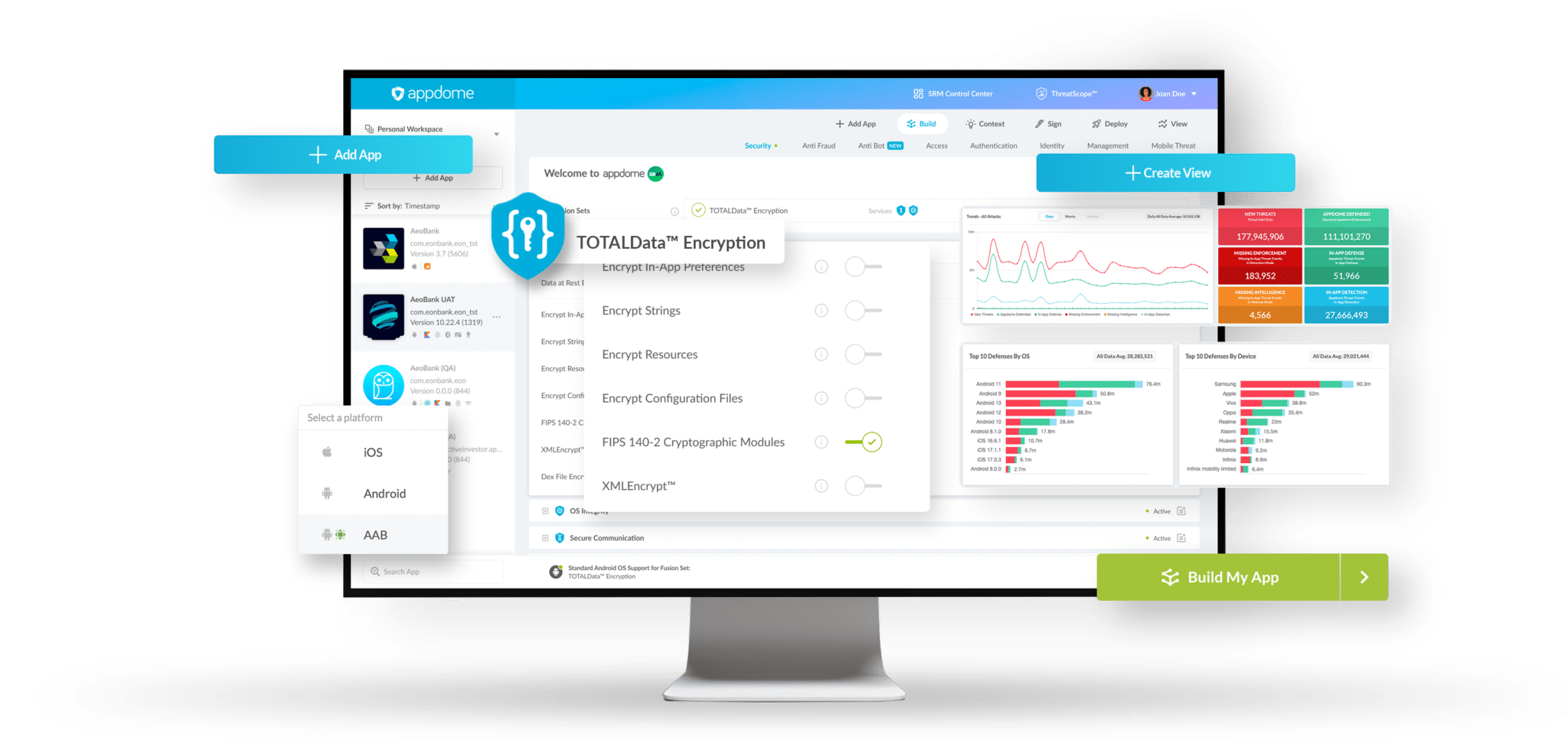
Appdome runs in your CI/CD pipeline to code, build, and maintain FIPS 140-2 Encryption in your Android & iOS apps. As your mobile app and its features change, Appdome's Build Agent - not your engineering team - will adjust the security features to match any application change or update.
Use Appdome to build secure mobile apps that comply with FirstNet and NIST standards, in seconds, no code or coding required.
Use FIPS 140-2 cryptography to protect all the areas of the app, including the app sandbox, file system, secrets, strings, and more.
Getting FIPS 140-2 encryption without rewriting our app was a huge win - Appdome made it effortless.”
AppSec Program Officer, Government Department
Appdome's modular architecture allows mobile brands and businesses to deploy any number of FIPS 140-2 Encryption Detection plugins inside mobile apps. These plugins use a dynamic defense model that analyzes behavioral anomalies, identifies threats, and filters out false positives, all without a server or external attestation. If you want to eliminate big Epics and manual work in fighting the battle against FIPS 140-2 encryption attacks, Appdome is the right choice.
Appdome protects mobile app data with FIPS 140-2 Cryptography. Discrete blocks of data are encrypted and placed in a self-contained and segregated environment to isolate mobile app data from other resources. This prevents non-secure apps on the same device or different devices to decrypt and open this encrypted data. Appdome’s FIPS 140-2 implementation makes use of FIPS 140-2 compliant RNG to generate unique IVs (Initial Vectors), and the AES-256 block-cipher.
Learn More >
Appdome’s MitM Prevention uses FIPS 140-2 compliant certificate and certificate-chain verification (X509_verify_cert) and ensures that only FIPS 140-2 compliant encryption and hashing algorithms are used during the TLS handshake. When Session Hardening is enabled, all outgoing TLS connections are established using FIPS 140-2 compliant cryptographic functions.
Learn More >
Encrypts keys, shared secrets, tokens, and user preferences such as usernames, emails, contact information, and other PII. When FIPS 140-2 mode is enabled, Appdome uses a FIPS 140-2 compliant random number generator (RNG) to create unique initialization vectors (IVs) and applies AES-256 block cipher encryption to protect sensitive data.
Learn More >
Encrypts dynamic shared libraries, which contain native code stored inside an app package. For instance, if an attacker loads an Android app into a reversing tool, such as IDA or Hopper, Appdome ensures the attacker can’t access dynamic libraries even if they are extracted directly from app binary or device. Appdome’s Non-native code obfuscation makes use of FIPS 140-2 compliant RNG to generate unique IVs (Initial Vectors), and the AES-256 block-cipher.
Learn More >
Performs checksum validation to calculate a unique hash or fingerprint of binary data and assets and validates them at runtime. This prevents changes to the app, its resources, code, and configuration. Appdome’s Checksum validation computes and verifies only using FIPS 140-2 approved checksum algorithms (SHA-1, SHA-224, SHA-256, SHA-384, SHA-512, SHA-512/224 and SHA-512/256).
Learn More >
With Appdome's Certified Secure™ mobile app security certification, every mobile app release is certified-protected with the FIPS 140-2 encryption and other protections added to Android and iOS apps on Appdome. Certified Secure™ is the perfect complement to DevSecOps strategies. It can be used in "go, no-go" release meetings, compliance verification and to reduce reliance on code scanning services.
Learn More >

Learn how HIPAA applies to mobile health apps in 2026, which Security Rule safeguards matter on mobile, and how to enforce them inside the app at runtime.


Summary: Quantum computing poses a looming challenge to today’s encryption standards, especially for mobile apps that rely on asymmetric key exchange to secure user data. Threat actors can potentially…
With the recent attention on Signal Gate, we get asked: “How secure are messaging apps?”
As a backdrop, let me say that many messaging apps use “end-to-end” encryption to protect…
Get a price quote and start saving money on FIPS 140-2 encryption today. Appdome’s FIPS 140-2 encryption solution helps mobile brands save $millions of dollars by avoiding unnecessary SDKs, server-side deployments, engineering work, support complexity, code changes and more.