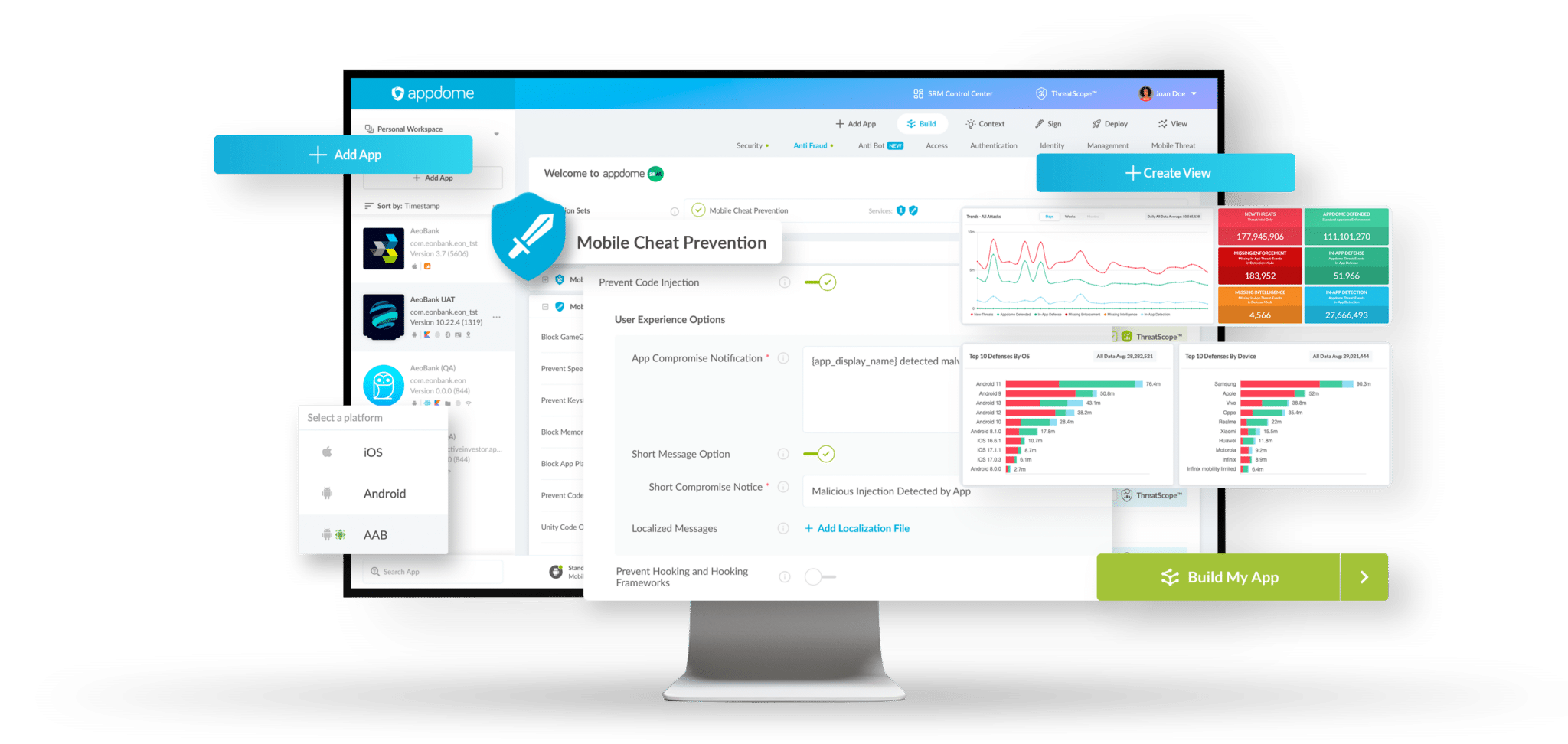































Anti-Injection

One Solution to Prevent
All Injection Attacks

Use AI to build and maintain injection attack prevention in Android & iOS apps. Free your engineering team from the work it takes to secure, test, and support injection attack prevention in your Android & iOS apps.

Anti Injection Persona

Injection Attack Prevention Made Easy
+Best
User Experience in the Industry

Use AI for Anti-Injection
in Android & iOS Apps

Use AI to build and maintain Mobile Injection Prevention in Android & iOS apps. In your CI/CD pipeline, Appdome automatically adapts and builds anti-injection protections to match the language and structure of your mobile app, build by build. You enjoy less work, no coding, no SDKs, and better protection.

Get the Guide >

Use Data From Injection Threats in Your App

Use Appdome's Threat-Events™ framework to get injection attack data at any point in your mobile app lifecycle, from launch to sign-up to onboarding, payment, and more. Then, use the threat data to tailor and control the user experience and deliver the best experience for your business.

Get the Guide >

Monitor & Preempt Injection
Attacks on Your Business

ThreatScope™ XTM monitors the active attack surface of your mobile business, providing real-time insights into the impact of mobile anti-injection defenses, deep inspection into new and emerging threats, and the power to preempt any attack impacting your mobile app, brand, or user.

Get the Guide >

We now have protections against injection attacks at runtime - clean, effective, and no maintenance headaches for our team.”

Injection Attack Prevention Cx

Automate the Work Out of
Injection Attack Prevention

Use Appdome’s AI-Native platform to secure, monitor, & respond with anti-injection attack defense in mobile apps fast. Let A.I. code & build Certified Secure™ injection attack prevention features like shell code prevention, remote code execution, process injection, memory injection and more with ease. Don’t force more work, coding, outdated SDKs, and servers on the engineering team. Automate everything. Save Money.

You need More than One Defense to
Stop Code Injection Attacks

Appdome's modular architecture allows mobile brands and businesses to deploy any number of Code Injection Detection plugins inside mobile apps. These plugins use a dynamic defense model that analyzes behavioral anomalies, identifies threats, and filters out false positives, all without a server or external attestation. If you want to eliminate big Epics and manual work in fighting the battle against code injection attacks, Appdome is the right choice.

Detect Code Injection Attacks

Appdome's Prevent Code Injection feature detects and defends mobile applications from code injection and process injection attacks, such as shared object and dylib injection on iOS and reflective DLL injection on Android. Code injection involves inserting or injecting malicious code into the memory space or context of a running process, typically to modify the app's behavior, bypass restrictions, including purchase and authentication restrictions, access the process memory and resources. ​​

Learn More >

Detect Memory Injection Attacks

Appdome's Block Memory Editing Tools feature detects and defends mobile applications against mobile app memory editing and memory injection attacks. These attacks are used to inject data into a mobile application memory, alter account values, including mobile game or loyalty points and synthetic currencies, bypass restrictions, fake login, reuse or replay sessions or cheat inside mobile games and applications.

Learn More >

Block Hooking Injection Attacks

Appdome's Detect Hooking Frameworks and Anti-Swizzling features detect and defend mobile apps from attacks that intercept function calls within a running process and redirecting them to the attacker's code, including function hooking (intercepting function calls), method swizzling (replacing or augmenting methods in Objective-C), or event hooking (intercepting system events or messages). By hooking into functions that handle dynamic code execution or loading, attackers can inject custom code into the mobile app's execution flow.

Learn More >

Detect Keystroke Injection

Appdome's Prevent Keystroke Injection feature detects and defends mobile applications from keystroke injection attacks. Keystroke injection is used to enter or flood data, taps and other actions in mobile apps to masquerade as real users filling out forms, submitting requests, or performing transactions. Keystroke injection can also be used to deceive users into entering sensitive information, such as triggering password reset or fake login screens, or pop-up dialogs and notifications requesting malicious permissions.

Learn More >

Detect Frida Injection Attacks

Appdome's Anti-Frida toolkit features detect all forms of Frida instrumentation, including Frida-server, inject-mode, gadget-mode, custom Frida modules, Frida with Objection scripts and more. Frida is a dynamic instrumentation toolkit. It's used as an advanced debugging, reverse engineering and hacking framework. It allows an attacker to change a target mobile application behavior, bypass security measures, and extract information. If you need to detect or block Frida toolkit, pass mobile app pen tests or protect your app from Frida, learn what Appdome can do for you!

Learn More >

Detect Tap Injection Attacks

Appdome's Prevent Auto-Clicking feature detects and defends mobile applications against tap injection attacks. Tap injection attacks are used in click fraud, i.e., impersonating user clicks on advertisements or sponsored content in mobile apps to generate fraudulent impressions or clicks. Tap injection attacks are also used in loyalty program and referral program abuse, or to cheat in mobile games, by impersonating real users tapping on buttons, collecting rewards, or performing in-game actions.

Learn More >

Detect Shell Code Injection Attacks

Appdome's Block Shell Code feature detects and defends mobile applications from shell code injection attacks. Shell code is typically a small piece of machine code designed to be executed directly by a system's shell, operating system, or other execution environment. For example, attackers can inject shellcode into mobile apps running on compromised mobile devices, potentially leading to unauthorized access, data theft, or other malicious activities.

Learn More >

Detect Accessibility & ATS Malware

Appdome offers mobile brands and enterprises the only true Accessibility Service Malware and ATS Malware defense for Android applications. Detect and defend against the use of Android AccessibilityService abuse and ATS malware attacks, such as BrasDex, Xenomorph, CraxRat, Octo, and more. Defend against user input and data harvesting, OTP hijacking, transaction hijacking, Remote Access Trojans (RATs) and more from inside the Android application, gather data on the attack, set trusted accessibility services and more with ease.

Learn More >

Better UX, Monetize Injection Attacks

When mobile injection attacks happens in your Android or iOS game, you don't have to block to stop the attack. Instead, mobile game makers and publishers can use Threat-Events™ to transform the cheat into a monetizable moment for your mobile game business. Use Threat-Events to gather data on the cheat method, tool or app used and use that data to make offers, promotions, sponsorships, and create affiliate programs with cheat developers.​

Learn More >

Best Anti-Injection for DevOps

Inside a highly demanding DevOps lifecycle, getting injection prevention right is extremely hard. Mobile apps are updated 24x-36x a year, the Android & iOS OS changes frequently, and threats evolve constantly. Appdome uses AI to eliminate this complexity, implement and maintain each anti-injection defense up to date, and support the mobile engineering team's autonomy and release cycles. Full support for the Mobile DevOps tool chain and best practices is a standard part of using Appdome.

Learn More >

Are you an Android or iOS Developer?

Meet Your Injection Attack Prevention Requirements the Right Way.​

With Appdome, you can meet Injection Attack Prevention requirements without sacrificing your engineering freedom, development choices, other features, or the user experience. 

Appdome works with the way you build your app, using defense plug-ins that are built to support the coding languages used in your Android & iOS apps. 

Appdome uses AI to create and build Injection Attack Prevention that works with the way you’ve built your app, including the coding languages and frameworks used in your Android & iOS apps. Appdome also supports your existing DevOps tech stack, including CI/CD, test automation, release management, and more. 

Need to deliver Injection Attack Prevention features without a lot of work, crashing your app or slowing down your release cycle? We’ve got you covered.

Developer Persona 10 Android Ios E1752433155634

Ready to Save $Millions on Mobile Injection Attack Prevention?

Get a price quote and start saving money on mobile injection protection today. Appdome’s mobile injection attack prevention helps mobile brands save $millions of dollars by avoiding unnecessary SDKs, server-side deployments, engineering work, support complexity, code changes and more. 

Header Image How Hackers Use Nox Emulator To Cheat Mobile Games

How Hackers Use Nox Emulator to Cheat Mobile Games

Nox Emulator is one of the ‘go-to’ methods mobile game cheaters use to gain an unfair advantage in playing mobile games. This blog covers the basics of how cheaters use emulators and App Players to cheat in mobile games…
mobile game modding using dynamic code injection and memory editing

Mobile Game Modding Using Dynamic Code Injection & Memory Editing

There are many ways fraudsters can hack/cheat mobile games. This blog will focus on how experienced hackers can use special purpose or general hacking tools such as memory editing, dynamic code injection, and saved game state editing in order to modify running processes or memory of a mobile game.

Search Appdome Solutions

Search
Image Blog 2 Text

Device Binding in the Age of AI

For years, fraud prevention solutions have tried to use Device IDs to bind (or link) a user’s account or session to a specific device to prevent unauthorized access from other devices. However, until recently, Device IDs lacked persistence and the broad threat context needed to stop fraud and ATOs …