






























Top 5 Reasons Mobile Apps Need Geo Compliance in 2025
Mobile apps may be global, but not all users—or locations—should be treated the same. From regulatory enforcement to fraud control, user geography plays a vital role in mobile risk…

Let AI build and maintain the Know Your Customer (KYC) Checks in your Android & iOS apps – fast. Prevent fake devices and users, login spoofing, location spoofing, synthetic IDs, and more in one DevOps ready platform.
Let AI build and maintain KYC Checks in Android & iOS apps. Ensure the integrity of each device, application, installation, session, IDV, and authentication in the app. Detect fake devices, location, users, and submissions. Enjoy no coding, no SDKs, and better KYC protection.
Appdome's Threat-Events framework provides threat data to the mobile app about KYC risks, including fake location, the use of stolen credentials, bots, and more. Use this threat data to trigger EDD workflows in the app and deliver the best experience for your business.
ThreatScope™ XTM monitors your mobile business' active attack surface, providing real-time insights into mobile KYC Checks, deep inspection into new and emerging KYC risks, and the power to preempt any KYC Fraud impacting your mobile app, brand, or user.
Our mobile KYC workflows are strengthened with Appdome's real-time KYC Checks - huge boost for compliance and trust.”
VP Compliance, Crypto Exchange
Use Appdome’s AI-Native platform to secure, monitor, and respond with mobile KYC checks in Android & iOS apps fast. Let AI code and build Certified Secure™ KYC checks using mobile device intelligence and behavioral biometrics to detect fake users, fake taps, fake gestures, injection attacks, malware, geo-fraud, and more. Don’t force more work, coding, outdated SDKs, and servers on the engineering team. Automate everything. Save Money.
Appdome's modular architecture allows mobile brands and businesses to deploy any number of mobile KYC Detection plugins inside mobile apps. These plugins use a dynamic defense model that analyzes behavioral anomalies, identifies threats, and filters out false positives, all without a server or external attestation. If you want to eliminate big Epics and manual work in fighting the battle against mobile KYC attacks, Appdome is the right choice.
Appdome's Anti-Injection Attack suite defends Android & iOS mobile apps and accounts from fake clicks, fake inputs, memory injection and code injection attacks. Eliminate account creation fraud in KYC onboarding and application fraud, and other fake inputs in your mobile apps and reduce KYC risk everywhere it exists in your operations. Detect all major injection attack vectors including static and dynamic mobile code injection, process injections, DB injection, memory injection, as well as methods & tools used in injection attacks including Magisk, Magisk Hide, Magisk Manager, Frida, hooking frameworks and more. When attacks are present, defend the app or gather data to determine the best response needed.
Learn More >
Appdome detects when mobile applications are run in emulated, virtualized, dual space, Android Player, and other automated environments. These platforms can pose a serious risk to in-app account and transaction integrity. They can also be used to create rebate and referral program abuse, point inflation, as well as fake in-app transactions, fake account set up and more. Appdome will signal if they are run in these emulated or virtualized environments, on virtualized devices, and virtualized operating systems, including via Android Debug Bridge (ADB), and more. When these environments are present, defend the app or gather data, and determine the optimal attack response.
Learn More >
Appdome's Prevent Keystroke Injection feature detects and defends mobile applications from keystroke injection attacks. Keystroke injection is used to enter or flood data, taps and other actions in mobile apps to masquerade as real users filling out forms, submitting requests, or performing transactions. Keystroke injection can also be used to deceive users by triggering workflows from the background that force users to enter sensitive information, such as password reset or fake login screens, or pop-up dialogs and notifications requesting malicious permissions.
Learn More >
Appdome's Prevent Auto-Clicking feature detects & defends mobile apps against tap injection. Tap injection attacks are used in click fraud to impersonate user clicks on ads or sponsored content in mobile apps to generate fraudulent impressions or clicks. Tap injection attacks are also used in loyalty program and referral program abuse, or to cheat in mobile games, by impersonating real users tapping on buttons, collecting rewards or performing game actions. Appdome makes these attacks are a thing of the past.
Learn More >
Appdome's Block Android Debug Bridge (ADB) feature detects and defends mobile apps from all forms of attacks using ADB 'input tap', 'keyevent', 'input swipe' and other commands. With these commands, ADB can be used to simulate or create fake events in mobile apps by sending input events directly to the device, or executing shell commands on connected Android devices or emulators. Detect ADB commands that simulate touch events, key presses, gestures, and other input actions. Gather data and control what, when and how to enforce these defenses.
Learn More >
Appdome's Prevent Android Virtualization detects and defends mobile apps when Android Virtual Machine (AVM) is used to execute synthetic fraud attacks. AVM allows attackers to simulate taps, swipes, and gestures on a virtual screen and trigger actions or interactions within the mobile app. AVM can also be used to emulate device sensors such as accelerometer, gyroscope, GPS, and orientation sensors, allowing attackers to spoof sensor data and events. With Appdome's Prevent Android Virtualization feature, mobile brands can gather data and control what, when and how to enforce these defenses.
Learn More >
If a mobile device containing KYC information from a mobile app is infected with spyware, it could lead to a data breach, exposing customer identity, account information, and other confidential data to an attacker. Spyware can capture keystrokes, login credentials, two-factor authentication (2FA), biometric authentication data and other personal information entered by mobile app users, allowing attackers to carry out fraudulent activities, gain unauthorized access to customer accounts or harvest sensitive information. Appdome offers a comprehensive mobile anti-spyware suite to detect and defend mobile apps from spyware.
Learn More >
Geolocation fraud occurs when fraudsters manipulate or spoof their geographic location to deceive mobile businesses during the KYC process. To do so, fraudsters can use virtual private networks (VPNs), proxy servers, Fake GPS, location spoofing and other techniques. Faking geolocation allows fraudsters impersonate the identity of legitimate mobile customers, bypass KYC controls, and open accounts as though they are a genuine account holder, making it more difficult for businesses to detect fraudulent activity in Android & iOS apps. Appdome offers a comprehensive geo-location compliance suite to detect & defend mobile apps from geo fraud.
Learn More >
Appdome's Threat-Score™ empowers mobile brands with attack-specific fraud risk profiles in their mobile app. Threat-Scores are generated and passed to the mobile application when attacks occur, without any server call out. They can be linked to specific Android & iOS events, and customer userID, sessionID and DeviceID. Threat-Score's fraud risk profiling is used to identify at-risk transactions, reduce or eliminate chargebacks, and customer support expenses. Threat-Scores are also used to prioritize enhanced due diligence procedures in the mobile app itself, to reduce mobile fraud exposure and improve consumer trust.
Learn More >
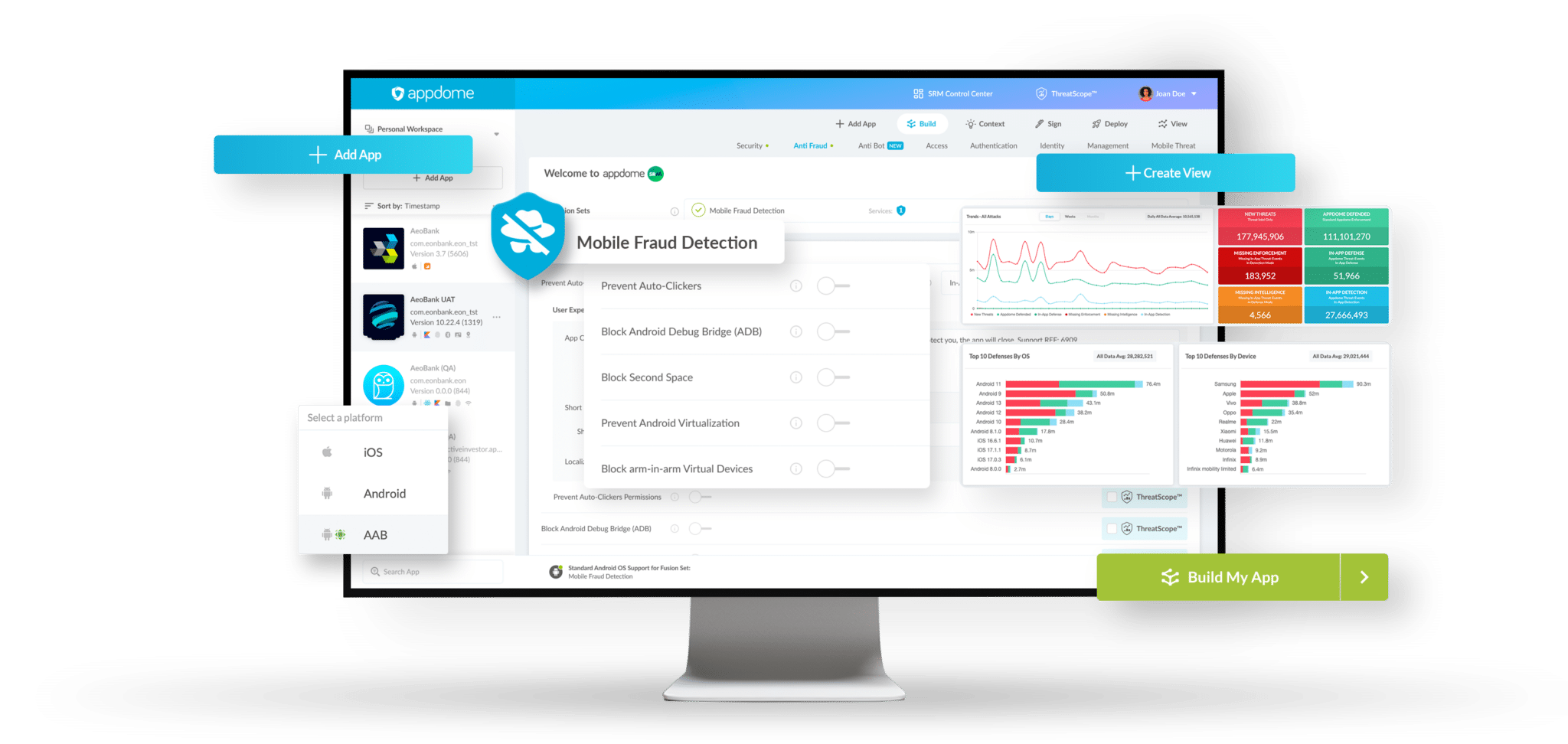
Appdome's ThreatScope™ XTM combines the power of real-time KYC fraud data from your mobile apps, AI-driven analytics, and no-code incident response in one platform. With ThreatScope, you know exactly what, when, where, and how KYC fraud was attempted, whether existing defenses worked to stop the attack, and what new defenses are needed to eliminate KYC fraud in your mobile business. Don't suffer from mobile KYC fraud any longer. Choose ThreatScope and manage mobile KYC fraud out of your business fast.
Learn More >
With Appdome Threat-Events™, mobile brands and developers can get rich threat data directly from the Appdome framework in the app, keep full control over the user experience, and enjoy multiple threat response options when mobile KYC fraud occurs. Threat-Events™ enables the app to plug into and control Appdome's KYC fraud detection methods and threat data, and use the threat data to tailor in-app responses and mitigation workflows based on the specific KYC fraud events present in the application lifecycle.
Learn More >
Inside a highly demanding DevOps lifecycle, getting mobile KYC defense right is extremely hard. Mobile apps are updated 24x-36x a year, the Android & iOS OS changes frequently, and threats evolve constantly. Appdome uses AI to eliminate this complexity, implement and maintain each mobile KYC defense up to date, and support the mobile engineering team's autonomy and release cycles. Full support for the Mobile DevOps tool chain and best practices is a standard part of using Appdome.
Learn More >
With Appdome, you can meet Mobile KYC requirements without sacrificing your engineering freedom, development choices, other features, or the user experience.
Appdome uses AI to create and build Mobile KYC checks that work with the way you’ve built your app, including the coding languages and frameworks used in your Android apps. Appdome also supports your existing DevOps tech stack, including CI/CD, test automation, release management, and more.
Need to deliver Mobile KYC checks without a lot of work, crashing your app or slowing down your release cycle? We’ve got you covered.
Get a price quote and start saving money on mobile KYC compliance and monitoring today. Appdome’s mobile KYC solution helps mobile brands save $millions of dollars by avoiding unnecessary SDKs, server-side deployments, engineering work, support complexity, code changes and more.

Mobile apps may be global, but not all users—or locations—should be treated the same. From regulatory enforcement to fraud control, user geography plays a vital role in mobile risk…


A recent Cybernews investigation revealed that over 71% of iOS apps leak hardcoded secrets, exposing mobile users and businesses to significant security risks. These embedded credentials – API keys,…

In the rapidly growing digital economy of Latin America, mobile banking has become a cornerstone of financial inclusion and convenience. However, with this surge in digital transactions, cybercriminals have…