





























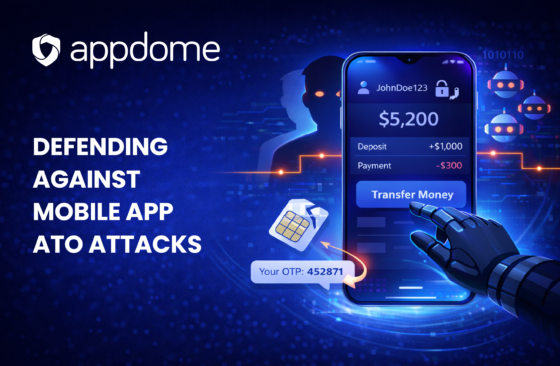
Defending Against Mobile App Account Takeovers (ATO) in 2026
Learn how to stop mobile app account takeovers in 2026. Block credential stuffing, mobile bots, emulators, and malware with persistent identity and real-time, in-app defenses.

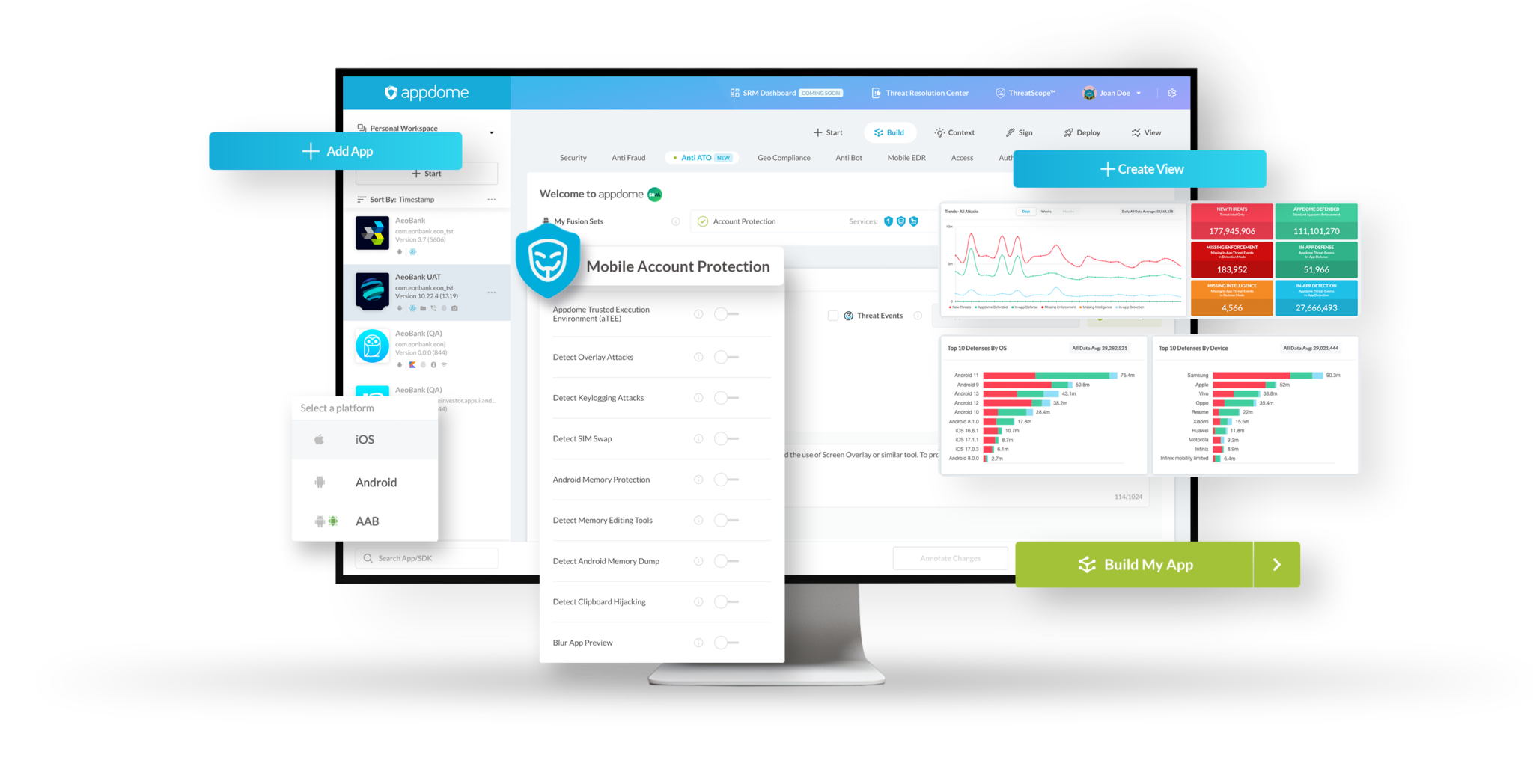
Let AI build and maintain mobile account protection in Android & iOS apps – fast. Stop the use of stolen credentials, spyware, password harvesting, trojan malware and more in one DevOps ready platform.
Let AI build and maintain Mobile Account Protection in Android & iOS apps. Guarantee the integrity of authentication, transactions, and activities in mobile apps. Stop fraudsters from stealing or using stolen credentials in apps. Enjoy less work, no coding, no SDKs, and better protection.
Request Demo >
Appdome's Threat-Events™ framework provides threat data to your mobile apss throughout the mobile account lifecycle, from onboarding, to login, purchase, payment, and more. Use the threat data to tailor the threat response in your app and deliver the best experience for your business.
Request Demo >
ThreatScope™ XTM monitors the active attack surface of your mobile business, providing real-time insights into the impact of mobile account protection defenses, deep inspection into new and emerging ATO threats, and the power to preempt any attack impacting your mobile app, brand, or user.
Request Demo >
Appdome gave us dynamic defense for account integrity - no SDKs, just instant protection against fraud and takeover threats.”
VP Mobile Engineering, Fintech
Use Appdome’s AI-Native platform to secure, monitor, and respond with Mobile Account Protection features in your Android & iOS apps fast. Let AI code and build Certified Secure™ Mobile Account Protection, ATO Prevention, Deepfake Detection, Social Engineering Prevention, and more into mobile apps. Don’t force more work, coding, outdated SDKs, and servers on the engineering team. Automate everything. Save Money.
Appdome uses AI and a modular architecture to build, monitor, and respond with 400+ mobile app security, anti-fraud, anti-ATO and anti-bot defense plugins in Android & iOS apps on demand. Each mobile account protection plugin automatically adjusts to the code of the app and uses a dynamic defense model that analyzes behavioral anomalies, identifies threats, and filters out false positives, all without a server or external attestation. Let Appdome eliminate big Epics and manual work, handoffs, and resolutions in your mobile account protection journey!
Overlay attacks are fake or transparent overlay screens used in spyware and identity theft. In an overlay attack, the fake or transparent user interface (UI) is placed on top of legitimate apps, screens, fields and other elements in a mobile app to trick users into providing sensitive information or performing unintended actions. Overlay attacks have become the go-to method of mobile fraud, Account Take Overs (ATOs), credential theft, and password harvesting. Appdome detects and prevents overlay attacks, eliminating false positives from legitimate overlays, and gives mobile brands choices in enforcing defense options.
Learn More >
Keylogging attacks in mobile apps are a common tool in spyware and identity theft. These attacks secretly capture or record user keystrokes, often through malware or 3rd party keyboards installed on the device. Keyloggers are used to steal sensitive information such as usernames, passwords, credit card numbers, and other personal data entered. Appdome detects and blocks malicious keyloggers, prevents unauthorized keystroke logging in the app, and allows developers to trust approved keyboards, giving mobile brands and developers maximum flexibility in protecting their apps and users.
Learn More >
SIM swapping is a social engineering attack in which an attacker persuades the victim's mobile carrier to transfer a legitimate user's phone number to a SIM card controlled by the attacker. With access to the victim’s number, the attacker can reset passwords, intercept authentication codes (such as MFA passcodes or OTP tokens), and execute Account Takeovers (ATOs) for any app on the device. Appdome identifies when a protected mobile app is accessed using a non-recognized SIM card and either exits the app or passes the attack data back to the app for threat response.
Learn More >
Standard OS functions like screen sharing, screen recording, or screen mirroring can be used to carry our Identity theft, steal confidential data or spy on users in mobile apps. Detect spyware that records the screen, or abuses legitimate screen functions. Coverage includes zero day, unknown threats, and screen capture malware like StrandHogg and other variants. Appdome detects and prevents abuse of screen capture, screen sharing and screen mirroring applications and gives mobile brands choices on what and how to enforce the defenses.
Learn More >
DeepSeek AI and its clones extract and transmit sensitive user data, including financial details and account credentials, to unauthorized parties. Reports confirm DeepSeek acts as spyware, potentially sending unencrypted data abroad without consent. Appdome’s AI Native Detect DeepSeek AI Attacks plugin blocks DeepSeek from infiltrating mobile apps, detecting unauthorized file access, memory scanning, and data exfiltration in real-time. By preventing DeepSeek from accessing sensitive data, mobile brands ensure user privacy, account protection, and regulatory compliance—without SDKs, servers, or developer work.
Learn More >
Attackers use memory editing and dumping tools to extract encryption keys, modify app logic, and bypass security controls. Tools such as Frida, Cheat Engine, and GDB enable attackers to alter variables, intercept tokens, and disable protections at runtime. Appdome’s AI-Native Detect Memory Editing Tools blocks live memory modification, runtime hooking, and code injection, while Detect Memory Dumping prevents data extraction, binary dumps, and key theft. Together, they secure app memory and protect data integrity without SDKs, servers, or developer work.
Learn More >
Use memory protection to safeguard sensitive data in an app’s RAM during runtime, preventing unauthorized access or modification. Attackers use techniques like memory dumping to steal credentials, session tokens, or manipulate app behavior, such as altering game scores. Appdome’s dynamic Android & iOS Memory Protection plugins secure app-specific data like credentials and in-app purchase values, blocking unauthorized access, securing in-app transactions, and ensuring data integrity.
Learn More >
Spyware may intercept and monitor the content of the mobile device clipboard, where copied text or data is temporarily stored. This could include sensitive information such as passwords, credit card numbers, addresses, or other personal data. Spyware using the mobile clipboard can perform PII harvesting, stealing user credentials, crypto tokens and more. Appdome has several defenses that detect and block these actions, giving mobile brands choices on how and when to enforce each defense.
Learn More >
Appdome’s Trusted Execution Environment for Android & iOS protects business-critical data flowing to and from mobile apps, including authentication information, credentials, app secrets, biometric data, and account details. Appdome’s aTEE extends the native trusted execution environments of Android and iOS, adding an additional layer of protection even if other parts of the device or app environment are compromised. By isolating sensitive processes and data, aTEE ensures stronger integrity, privacy, and runtime protection for mobile apps.
Learn More >
Protect the app’s runtime state and user data, including Activities, Services, Content Providers, IPCs, Imports, Variables, Temporary Buffers, Notifications, Background Threads and Workers. Android/iOS Memory Protection segregates app-specific data stored in memory. Encrypt the memory allocated and used by the app. Use Secure Session Management to protect sensitive info sent between the app and the backed, such as session IDs, user IDs, authentication tokens, and OTPs.
Learn More >
With Appdome Threat-Events™, mobile brands and developers can get rich threat data directly from the Appdome framework in the app, keep full control over the user experience, and enjoy multiple threat response options when mobile account attacks are detected. Threat-Events™ enables the app to plug into and control Appdome's mobile account protection methods and threat data, and use the threat data to tailor in-app responses and mitigation workflows based on the specific mobile account threat present in the application lifecycle.
Learn More >
Inside a highly demanding DevOps lifecycle, getting mobile account protection right is extremely hard. Mobile apps are updated 24x-36x a year, the Android & iOS OS changes frequently, and threats evolve constantly. Appdome uses AI to eliminate this complexity, implement and maintain each mobile account protection defense up to date, and support the mobile engineering team's autonomy and release cycles. Full support for the Mobile DevOps tool chain and best practices is a standard part of using Appdome.
Learn More >
With Appdome, you can meet Mobile Account Protection requirements without sacrificing your engineering freedom, development choices, other features, or the user experience.
Appdome uses AI to create and build Mobile Account Protection that works with the way you’ve built your app, including the coding languages and frameworks used in your Android apps. Appdome also supports your existing DevOps tech stack, including CI/CD, test automation, release management, and more.
Need to deliver Mobile Account Protection without a lot of work, crashing your app or slowing down your release cycle? We’ve got you covered.
Get a price quote and start saving money on mobile account protection today. Appdome’s Mobile Account Protection solution helps mobile brands save $millions of dollars by avoiding unnecessary SDKs, server-side deployments, engineering work, support complexity, code changes and more.

Learn how to stop mobile app account takeovers in 2026. Block credential stuffing, mobile bots, emulators, and malware with persistent identity and real-time, in-app defenses.


Android bootloader integrity is often reduced to a locked or unlocked state. This article explains why that model fails and how contextual bootloader signals improve identity and session trust.

For years, fraud prevention solutions have tried to use Device IDs to bind (or link) a user’s account or session to a specific device to prevent unauthorized access from other devices. However, until recently, Device IDs lacked persistence and the broad threat context needed to stop fraud and ATOs …