
Implementing Threat-Memory™ in iOS Apps
Overview
Threat-Memory™ allows the iOS application to retrieve security detection data on demand. Using in-app API calls, the application can access the current threat state, including which threats have been detected, when they occurred, and their current status.
All data is returned as an NSDictionary and can be queried at any point during runtime.
Beyond on-demand access to threat data, Threat-Memory™ keeps the application continuously informed as the threat posture evolves. Protected applications can track both threat-state changes and newly detected threats in real time, without the complexity of managing separate listeners for each event.
For a detailed explanation of what Threat-Memory™ is and how it fits into the threat intelligence management framework, see [Threat-Memory™ Overview].
Prerequisites
- Configure each defense to use Threat-Memory™ mode within In-App Control on the Appdome platform.
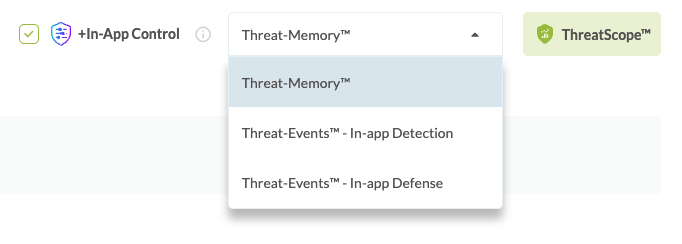
- When a defense is configured in Threat-Memory™ mode, any detected threats are stored locally on the device without any enforcement actions.
- Defenses configured with other intelligence modes (such as In-App Detection, In-App Defense, Failsafe, etc.) are not tracked by Threat-Memory™.
- The application must be built through the Appdome platform. Threat-Memory™ data is only available at runtime in a protected build.
Integration
Threat-Memory™ offers two ways to access threat-state information in your iOS application:
State getter APIs: Allow the application to retrieve the current or historical security state on demand, including session-level, installation-level, and threat-specific data.
Threat-state callbacks: Threat-Memory™ callbacks that keep the application informed of threat activity. One callback notifies the application when the state of a Threat-Memory™-enabled threat changes, while the other notifies the application when a new threat is detected.
Together, these capabilities enable the application to respond to threat-state changes in real time and to query the device risk level whenever additional context is needed.
Follow these steps to integrate and use Threat-Memory™ in the iOS application.
Step 1: Add the Threat-Memory™ Callback Class File
Add the AppdomeThreatCallbacks file to the app project.
The onThreatStateChange(threatName) callback is invoked when the state of a Threat-Memory™-enabled threat changes during the app session. The callback receives the name of the threat whose state changed.
The onThreatDetected(threatName) callback is invoked each time a threat is recorded for a Threat-Memory™-enabled defense during the app session. Unlike onThreatStateChange, which is triggered only when the threat risk state transitions, such as from safe to compromised or from compromised to safe, onThreatDetected is triggered for every detection occurrence, including repeated detections of the same threat. The callback receives the name of the detected threat.
Update the onThreatStateChange(threatName) and onThreatDetected(threatName) implementations with the app’s business logic for handling threat-state changes and individual detection events. For example, the app may query the updated threat state, log detections for telemetry, trigger an immediate in-app response, or send threat data to the backend.
Swift Projects
In Xcode:
- Right-click your project in the Project Navigator.
- Select New File.
- Choose Empty File.
- Name the file
AppdomeThreatCallbacks.swift. - Paste the following code into the new file:
import Foundation @objc(AppdomeThreatCallbacks) class AppdomeThreatCallbacks: NSObject { @objc class func onThreatStateChange(_ threatName: NSString) { // Handle threat state changes here // Use the threatName to query updated state using AppdomeThreatApi. // let sessionState: NSDictionary = AppdomeThreatApi.getSessionState() // print("Session state: \(sessionState)") } @objc class func onThreatDetected(_ threatName: NSString) { // Called every time a new threat detection occurs for a ThreatMemory-enabled defense. // Use the threatName to query the updated threat state using AppdomeThreatApi. // let threatState: NSDictionary = AppdomeThreatApi.getThreatSessionState(threatName: threatName) // print("Threat detected: \(threatName)") // print("Updated threat state: \(threatState)") } } - Update the
onThreatStateChange(_ threatName: NSString)implementation with the app’s business logic to handle threat-state changes.
Objective-C Projects
In Xcode:
- Right-click your project in the Project Navigator.
- Select New File.
- Choose Empty File.
- Name the file
AppdomeThreatCallbacks.h. - Paste the following code into the new file:
#import <Foundation/Foundation.h> @interface AppdomeThreatCallbacks : NSObject + (void)onThreatStateChange:(NSString *)threatName; + (void)onThreatDetected:(NSString *)threatName; @end @implementation AppdomeThreatCallbacks + (void)onThreatStateChange:(NSString *)threatName { // Handle threat state changes here. // Use the threatName to query updated state using AppdomeThreatApi. //NSDictionary *sessionState = [AppdomeThreatApi getSessionState]; //NSDictionary *threatSessionState = [AppdomeThreatApi getThreatSessionState:threatName]; //NSLog(@"Threat state changed: %@", threatName); //NSLog(@"Session state: %@", sessionState); //NSLog(@"Threat session state: %@", threatSessionState); // Add the app's business logic here. } + (void)onThreatDetected:(NSString *)threatName { // Called every time a new threat detection occurs for a ThreatMemory-enabled defense. // Use the threatName to query the updated threat state using AppdomeThreatApi. //NSDictionary *threatState = [AppdomeThreatApi getThreatSessionState:threatName]; //NSLog(@"Threat detected: %@", threatName); //NSLog(@"Updated threat state: %@", threatState); // Add the app's business logic here. } @end -
Update the
onThreatStateChange:(NSString *)threatNameimplementation with the app’s business logic to handle threat state changes.
Step 2: Add the Threat-Memory™ API Placeholder Class
Add the AppdomeThreatApi class file to the app project.
This file contains placeholder implementations of the Threat-Memory™ API methods.
The implementations in the placeholder class allow the unprotected app to be tested using developer-controlled responses prior to protecting the app on Appdome.
The AppdomeThreatApi methods are replaced in the protected app to return responses from Threat-Memory™ at runtime.
Swift Projects
In Xcode:
- Right-click your project in the Project Navigator.
- Select New File.
- Choose Empty File.
- Name the file
AppdomeThreatApi.swift. - Paste the following code into the new file:
import Foundation

@objc(AppdomeThreatApi)
class AppdomeThreatApi: NSObject {

	@objc dynamic class func getThreatSessionState(threatName: NSString) -> NSDictionary {
		return placeholderResponse("getThreatSessionState")
	}

	@objc dynamic class func getThreatSessionState(threatName: NSString, sessionID: NSString) -> NSDictionary {
		return placeholderResponse("getThreatSessionState")
	}

	@objc dynamic class func getThreatInstallationState(threatName: NSString) -> NSDictionary {
		return placeholderResponse("getThreatInstallationState")
	}

	@objc dynamic class func getSessionState() -> NSDictionary {
		return placeholderResponse("getSessionState")
	}

	@objc dynamic class func getSessionState(sessionID: NSString) -> NSDictionary {
		return placeholderResponse("getSessionState")
	}

	@objc dynamic class func getInstallationState() -> NSDictionary {
		return placeholderResponse("getInstallationState")
	}

	private class func placeholderResponse(_ method: String) -> NSDictionary {
		return [
			"status": "not_available",
			"message": "Return stub response",
			"method": method
		]
	}
}
Objective-C Projects
In Xcode:
- Right-click your project in the Project Navigator.
- Select New File.
- Choose Empty File.
- Name the file
AppdomeThreatApi.h. - Paste the following code into the new file:
#import <Foundation/Foundation.h>

@interface AppdomeThreatApi : NSObject

+ (NSDictionary *)getThreatSessionState:(NSString *)threatName;
+ (NSDictionary *)getThreatSessionState:(NSString *)threatName sessionID:(NSString *)sessionID;
+ (NSDictionary *)getThreatInstallationState:(NSString *)threatName;
+ (NSDictionary *)getSessionState;
+ (NSDictionary *)getSessionState:(NSString *)sessionID;
+ (NSDictionary *)getInstallationState;

@end

@implementation AppdomeThreatApi

+ (NSDictionary *)getThreatSessionState:(NSString *)threatName {
	return [self placeholderResponse:@"getThreatSessionState"];
}

+ (NSDictionary *)getThreatSessionState:(NSString *)threatName sessionID:(NSString *)sessionID {
	return [self placeholderResponse:@"getThreatSessionState"];
}

+ (NSDictionary *)getThreatInstallationState:(NSString *)threatName {
	return [self placeholderResponse:@"getThreatInstallationState"];
}

+ (NSDictionary *)getSessionState {
	return [self placeholderResponse:@"getSessionState"];
}

+ (NSDictionary *)getSessionState:(NSString *)sessionID {
	return [self placeholderResponse:@"getSessionState"];
}

+ (NSDictionary *)getInstallationState {
	return [self placeholderResponse:@"getInstallationState"];
}

+ (NSDictionary *)placeholderResponse:(NSString *)method {
	return @{
		@"status": @"not_available",
		@"message": @"Return stub response",
		@"method": method
	};
}

@end
Step 3: Call the Threat-Memory™ API
After adding the AppdomeThreatApi placeholder API file, the Threat-Memory™ getter APIs can be called from any Swift or Objective-C file in the application.
Swift
let sessionState: NSDictionary = AppdomeThreatApi.getSessionState()
print("Session state: \(sessionState)")
Objective-C
NSDictionary *sessionState = [AppdomeThreatApi getSessionState];
NSLog(@"Session state: %@", sessionState);
-
All methods are exposed as static methods on
AppdomeThreatApi -
Each method returns a
NSDictionary -
Calls are synchronous, rely on on-device storage, and return immediately without waiting for network requests.
Step 4: Test and Validate the Integration
1. Build the Application and Test Without Appdome
At this stage, Threat-Memory™ is not present in the application because the application is not protected by Appdome.
All calls to AppdomeThreatApi return placeholder responses. These responses can be modified during development to invoke and validate different threat scenarios in the application. This expedites testing of the unprotected version prior to protecting the application. For example, you can test an end-to-end flow that collects data in-app using Threat-Memory™ and sends threat telemetry to the backend.
2. Protect the Application with Appdome
Build the protected application on the Appdome platform with Threat-Memory™ enabled for the selected defenses in the defense policy.
Once the application is protected:
- The placeholder implementations are replaced automatically at runtime.
- All
AppdomeThreatApimethods return threat data collected on the device from defenses monitored by Threat-Memory™. - No code changes are required between testing and production builds. The integration implementation also does not require changes when the defense policy changes (for example, when adding a new Threat-Memory™-enabled defense to the defense policy).
API Reference
Glossary
Session
A session represents a single app launch until it is closed by the user or the operating system (OS), identified by a sessionID.
Installation
An installation represents the lifetime of a given app version on the device across sessions, identified by an installationID.
Threat State
Threat State represents the current risk status of a specific threat or the overall security posture of an application session or installation.
Session State
Session State represents the security status of a single application process lifetime, from launch to termination. It is identified by a unique sessionID and includes an overall status of either safe (no active critical threats), compromised (at least one active threat), or evaluating (the defense has not completed the verification logic required to detect the threat).
Installation-Level Data
Installation-level data resets on application upgrades or reinstalls.
Class: AppdomeThreatApi
AppdomeThreatApi exposes class methods for querying Threat-Memory™ data at runtime.
All methods:
- Return an
NSDictionary - Execute synchronously using on-device data
- Do not require delegates, callbacks, or network requests
Session-Level Methods
getSessionState()
Method signature
Swift
class func getSessionState() -> NSDictionary
Objective-C
+ (NSDictionary *)getSessionState;
Description
Returns the full Threat-Memory™ state for the current application session.
Parameters
None.
Returns
An NSDictionary containing the full threat state for the current session. See the Returned Data section for the expected fields and example response.
Usage Example
Swift
let sessionState: NSDictionary = AppdomeThreatApi.getSessionState()

// Print the entire dictionary
print("Full session state: \(sessionState)")

// Access a specific field
if let threats = sessionState["threats"] as? NSDictionary {
    print("Threats: \(threats)")
}
Objective-C
NSDictionary *sessionState = [AppdomeThreatApi getSessionState];

// Print the entire dictionary
NSLog(@"Full session state: %@", sessionState);

// Access a specific field
NSDictionary *threats = sessionState[@"threats"];
if (threats) {
  NSLog(@"Threats: %@", threats);
}
getSessionState(sessionID:)
Method signature
Swift
class func getSessionState(sessionID: NSString) -> NSDictionary
Objective-C
+ (NSDictionary *)getSessionState:(NSString *)sessionID;
Description
Returns the full Threat-Memory™ state for a specific session.
Use this method with a session identifier returned from a previous Threat-Memory™ API call. For example, the current session ID can be retrieved from the sessionID field returned by getSessionState().
Note that calling getSessionState(currentSessionID) with the current sessionID is equivalent to calling getSessionState().
Parameters
|
Name |
Type |
Description |
|---|---|---|
sessionID |
NSString * |
The session identifier to query. You can obtain this value from the sessionID field returned by getSessionState(). |
Returns
NSDictionary containing the full threat state for the specified session. See Returned Data for the expected fields and example response.
Usage Example
Swift
// Query ThreatMemory for a specific session using a known sessionID.
// You can store sessionIDs from previous ThreatMemory responses and use them later.
let sessionState: NSDictionary = AppdomeThreatApi.getSessionState(sessionID: "")

// Print the entire dictionary
print("Full session state: \(sessionState)")

// Access a specific field
if let threats = sessionState["threats"] as? NSDictionary {
    print("Threats: \(threats)")
}
Objective-C
// Query ThreatMemory for a specific session using a known sessionID.
// You can store sessionIDs from previous ThreatMemory responses and use them later.
NSDictionary *sessionState = [AppdomeThreatApi getSessionState:@""];

// Print the entire dictionary
NSLog(@"Full session state: %@", sessionState);

// Access a specific field
NSDictionary *threats = sessionState[@"threats"];
if (threats) {
    NSLog(@"Threats: %@", threats);
}
getThreatSessionState(threatName:)
Method signature
Swift
class func getThreatSessionState(threatName: NSString) -> NSDictionary
Objective-C
+ (NSDictionary *)getThreatSessionState:(NSString *)threatName;
Description
Returns the Threat-Memory™ state for a single threat in the current session.
Use threatName to specify the Threat-Event identifier for the defense being queried. Refer to the Appdome Threat Knowledge Base to find the correct threat name for the specific protection you enabled.
Parameters
|
Name |
Type |
Description |
|---|---|---|
threatName |
NSString * |
The identifier of the threat to query. Use the same value returned in the “threatName” field from ThreatMemory responses (for example, “JailbrokenDevice”). |
Returns
An NSDictionary containing the state of the specified threat for the current session. See Returned Data for the expected fields and example response.
Usage Example
Swift
// Query ThreatMemory for a specific threat in the current session
let threatState: NSDictionary = AppdomeThreatApi.getThreatSessionState(threatName: "JailbrokenDevice")

// Print the entire dictionary
print("Full threat state: \(threatState)")

// Access a specific field
if let state = threatState["state"] as? String {
    print("Threat state: \(state)")
}
Objective-C
// Query ThreatMemory for a specific threat in the current session
NSDictionary *threatState = [AppdomeThreatApi getThreatSessionState:@"JailbrokenDevice"];

// Print the entire dictionary
NSLog(@"Full threat state: %@", threatState);

// Access a specific field
NSString *state = threatState[@"state"];
if (state) {
    NSLog(@"Threat state: %@", state);
}
getThreatSessionState(threatName:sessionID:)
Method signature
Swift
class func getThreatSessionState(threatName: NSString, sessionID: NSString) -> NSDictionary
Objective-C
+ (NSDictionary *)getThreatSessionState:(NSString *)threatName sessionID:(NSString *)sessionID;
Description
Returns the Threat-Memory™ state for a single threat in a specific session.
Use threatName to specify the identifier of the threat you want to query. This value should match the threatName field returned in Threat-Memory™ responses. Refer to the Appdome Threat Knowledge Base to find the correct threat name for the specific protection you enabled.
Use sessionID to specify the session to query. You can obtain this value from the sessionID field returned by getSessionState() and store it if you want to inspect a specific session later.
Note that calling getThreatSessionState(threatName, currentSessionID) with the current sessionID is equivalent to calling getThreatSessionState(threatName).
Parameters
|
Name |
Type |
Description |
|---|---|---|
|
|
|
The threat identifier to query. |
|
|
|
The session identifier to query. |
Returns
NSDictionary containing the state of the specified threat for the specified session. See Returned Data for the expected fields and example response.
Usage Example
Swift
let threatState: NSDictionary = AppdomeThreatApi.getThreatSessionState(
    threatName: "JailbrokenDevice",
    sessionID: ""
)

// Print the entire dictionary
print("Full threat state: \(threatState)")

// Access a specific field
if let state = threatState["state"] as? String {
    print("Threat state: \(state)")
}
Objective-C
NSDictionary *threatState =
    [AppdomeThreatApi getThreatSessionState:@"JailbrokenDevice"
                            sessionID:@""];

// Print the entire dictionary
NSLog(@"Full threat state: %@", threatState);

// Access a specific field
NSString *state = threatState[@"state"];
if (state) {
    NSLog(@"Threat state: %@", state);
}
Session-Level Methods
getInstallationState()
Method signature
Swift
class func getInstallationState() -> NSDictionary
Objective-C
+ (NSDictionary *)getInstallationState;
Description
Returns the full Threat-Memory™ state for the current application installation.
Parameters
None.
Returns
An NSDictionary containing the aggregated threat state across all sessions in the current installation. See Returned Data for the expected fields and example response.
Usage Example
Swift
let installationState: NSDictionary = AppdomeThreatApi.getInstallationState()

// Print the entire dictionary
print("Full installation state: \(installationState)")

// Access a specific field
if let threats = installationState["threats"] as? NSDictionary {
    print("Threats: \(threats)")
}
Objective-C
NSDictionary *installationState = [AppdomeThreatApi getInstallationState];

// Print the entire dictionary
NSLog(@"Full installation state: %@", installationState);

// Access a specific field
NSDictionary *threats = installationState[@"threats"];
if (threats) {
    NSLog(@"Threats: %@", threats);
}
getThreatInstallationState(threatName:)
Method signature
Swift
class func getThreatInstallationState(threatName: NSString) -> NSDictionary
Objective-C
+ (NSDictionary *)getThreatInstallationState:(NSString *)threatName;
Description
Returns the aggregated Threat-Memory™ state for a single threat across all sessions in the current installation.
Use threatName to specify the identifier of the threat you want to query. This value should match the threatName field returned in Threat-Memory™ responses. Refer to the Appdome Threat Knowledge Base to find the correct threat name for the specific protection you enabled.
Parameters
|
Name |
Type |
Description |
|---|---|---|
threatName |
NSString * |
The threat identifier to query. |
Returns
An NSDictionary containing the installation-level state of the specified threat. See Returned Data for the expected fields and example response.
Usage Example
Swift
let threatState: NSDictionary = AppdomeThreatApi.getThreatInstallationState(threatName: "JailbrokenDevice")

// Print the entire dictionary
print("Full installation-level threat state: \(threatState)")

// Access a specific field
if let state = threatState["state"] as? String {
    print("Threat state: \(state)")
}
Objective-C
NSDictionary *threatState = [AppdomeThreatApi getThreatInstallationState:@"JailbrokenDevice"];

// Print the entire dictionary
NSLog(@"Full installation-level threat state: %@", threatState);

// Access a specific field
NSString *state = threatState[@"state"];
if (state) {
    NSLog(@"Threat state: %@", state);
}
Returned Data
All Threat-Memory™ API methods return an NSDictionary containing Threat-Memory™ data.
Note
All timestamp fields are formatted as:
YYYY-MM-DD HH:MM:SS.mmm
Example: 2026-04-12 14:32:07.412
Session State Response
Returned by:
getSessionState()

getSessionState(sessionID:)
|
Field |
Type |
Description |
Expected Values |
|---|---|---|---|
|
|
|
Unique identifier for the session |
UUID string |
|
|
|
Unique protected app identifier |
Build token string |
|
|
|
Overall security state of the session |
|
|
|
Number |
Total number of defenses tracked by ThreatMemory |
Integer ≥ 0 |
|
|
Number |
Total number of detected threats, where each distinct threat is counted once. |
Integer ≥ 0 |
|
|
NSDictionary |
Device attributes and environment metadata captured at session start. Each field is an array containing a single value. |
See Device Metadata Object. |
|
|
NSDictionary |
Mapping of threat names to their threat state objects |
Object of threat state objects |
Device Metadata Object
Returned inside session and installation responses under the deviceMetadata key.
Every field is an array of strings. In a session response, each array contains exactly one value (the value at session start). In an installation response, hardware-constant fields still contain one value, while environment fields that can change between sessions (for example, after an iOS update) contain all distinct values observed across sessions, ordered from most recent to oldest.
|
Field |
Type |
Description |
Expected Values |
|---|---|---|---|
|
deviceManufacturer |
|
Device hardware manufacturer |
[“Apple”] |
|
deviceModel |
|
Device model identifier |
Array of strings |
|
osVersion |
|
iOS version |
Array of strings |
|
kernelInfo |
|
Darwin kernel version |
Array of strings |
Device Metadata Object
Represents the state of a single threat.
Returned by:
threats object in Session State Response
getThreatSessionState(...)
getThreatInstallationState(...)
|
Field |
Type |
Description |
Expected Values |
|---|---|---|---|
|
|
|
Unique threat identifier |
Example: |
|
|
|
Defines whether the threat persists or returns to a safe state. |
|
|
|
|
Unique protected app identifier |
Build token String |
|
|
|
Threat lifecycle state |
|
|
|
|
Current threat risk state.
|
|
|
|
Number |
Number of recorded threat occurrences |
Integer ≥ 0 |
|
|
|
Last time the threat state changed. Empty string indicates that the threat was not detected. |
Timestamp or Empty string |
|
|
|
Time of first detection. Empty string indicates that the threat was not detected. |
Timestamp or Empty string |
|
|
|
Time of most recent detection. Empty string indicates that the threat was not detected. |
Timestamp or Empty string |
|
|
NSArray |
Detection data for each unique detection event. Includes fields such as reason code, reason data, and additional parameters. |
Array of objects or empty array if no threats where detected |
Detection Data Object
Represents detailed information about a specific detection event.
|
Field |
Type |
Description |
Expected Values |
|---|---|---|---|
|
|
|
Code representing the detection type |
String |
|
|
|
Appdome-specific threat identifier |
String |
|
|
|
Description of the detection |
String – Free text |
|
occurrenceCount |
Integer |
Count how many this specific detection has been detected |
Integer >=0 |
|
|
|
Reference code to provide to the Appdome Support agent for remediation or inquiries about this detection. |
String |
|
params |
NSDictionary |
Additional detection data, which may include more metadata regarding the detection. |
|
Detection data params may include additional fields depending on the specific threat and detection context.
Detection Data Example
When a threat is detected:
[
  {
    "reasonCode": "9999",
    "threatCode": "AAAAA",
    "reasonData": "X was detected by Y...",
    "occurrenceCount": 1,
    "detectionReference": "9999:1234:AAAAA",
    "params" : {...}
  }
]
When a threat is not detected:
[]
Installation State Response
Returned by:
getInstallationState()
|
Field |
Type |
Description |
Expected Values |
|---|---|---|---|
|
|
|
Unique identifier for the app installation |
UUID string |
|
|
Number |
Total number of threats registered as ThreatMemory features |
Integer ≥ 0 |
|
|
Number |
Total number of detected threats, where each distinct threat is counted once. |
Integer ≥ 0 |
|
|
|
Aggregated threat state across all sessions |
|
|
|
NSArray |
List of session IDs for this installation, ordered from most recent to oldest. |
Array of session IDs |
|
|
NSDictionary |
Device attributes and environment metadata. Each field is an array. Hardware-constant fields contain a single value. Environment fields that can change between sessions contain all distinct values observed across sessions, ordered from most recent to oldest. |
See Device Metadata Object. |
|
|
NSDictionary |
Mapping of threat names to aggregated threat state objects |
Object of threat state objects |
Example output
getSessionState() and getSessionState(sessionID)
{
  "sessionID": "",
  "buildID": "",
  "sessionState": "compromised",
  "registeredThreatCount": 2,
  "detectedThreatCount": 1,
  "deviceMetadata": {
    "deviceManufacturer": ["Apple"],
    "deviceModel": ["iPhone15,2"],
    "osVersion": ["17.4"],
    "kernelInfo": ["..."]
  },
  "threats": {
    "JailbrokenDevice": {
      "threatName": "JailbrokenDevice",
      "transitionType": "persistentThreat",
      "buildID": ""
      "threatState": "active",
      "state": "compromised",
      "detectionCount": 1,
      "lastStateChangeTime": "2026-04-12 14:32:05.100",
      "firstDetectionTimestamp": "2026-04-12 14:32:01.230",
      "lastDetectionTimestamp": "2026-04-12 14:32:05.100",
      "detectionData": [
        {
          "reasonCode": "9999",
          "threatCode": "AAAAA",
          "reasonData": "...info..",
          "occurrenceCount": 1,
          "detectionReference": "9999:1234:AAAAA"
          "params" : {...}
        }
      ]
    },
    "FridaDetected": {
      "threatName": "FridaDetected",
      "transitionType": "resolvable",
      "buildID": ""
      "threatState": "notDetected",
      "state": "safe",
      "detectionCount": 0,
      "lastStateChangeTime": "",
      "firstDetectionTimestamp": "",
      "lastDetectionTimestamp": "",
      "detectionData": []
    }
  }
}
getThreatSessionState(threatName) and getThreatSessionState(threatName, sessionId)
Returns the state of a single threat within the current session.
{
  "threatName": "JailbrokenDevice",
  "transitionType": "persistentThreat",
  "buildID": "",
  "threatState": "active",
  "state": "compromised",
  "detectionCount": 2,
  "lastStateChangeTime": "2026-04-12 14:32:05.100",
  "firstDetectionTimestamp": "2026-04-12 14:32:01.230",
  "lastDetectionTimestamp": "2026-04-12 14:32:05.100",
  "detectionData": [
    {
      "reasonCode": "AAAA",
      "threatCode": "5ABCDE",
      "reasonData": "...info..",
      "occurrenceCount": 1,
      "detectionReference": "AAAA:1234:5ABCDE"
      "params" : { ... }
    }
  ]
}
getInstallationState()
Returns the aggregated threat state across all sessions for the current app installation.
{
  "installationID": "",
  "registeredThreatCount": 2,
  "detectedThreatCount": 2,
  "installationState": "compromised",
  "sessionList": [
    "",
    ""
  ],
  "deviceMetadata": {
    "deviceManufacturer": ["Apple"],
    "deviceModel": ["iPhone15,2"],
    "osVersion": ["17.4", "17.3"],
    "kernelInfo": ["...", "..."]
  },
  "threats": {
    "JailbrokenDevice": {
      "threatName": "JailbrokenDevice",
      "transitionType": "persistentThreat",
      "buildID": "",
      "threatState": "active",
      "state": "compromised",
      "detectionCount": 5,
      "lastStateChangeTime": "2026-04-12 14:32:05.100",
      "firstDetectionTimestamp": "2026-04-10 09:15:22.800",
      "lastDetectionTimestamp": "2026-04-12 14:32:05.100",
      "detectionData": [
        {
          "reasonCode": "AAAA",
          "threatCode": "5ABCDE",
          "reasonData": "...info...",
          "occurrenceCount": 5,
          "detectionReference": "AAAA:1234:5ABCDE"
          "params" : {...}
        }
      ],
      "detectedSessions": {
        "": 2,
        "": 3
      }
    },
    "FridaDetected": {
      "threatName": "FridaDetected",
      "transitionType": "resolvable",
      "buildID": "",
      "threatState": "notDetected",
      "state": "safe",
      "detectionCount": 0,
      "lastStateChangeTime": "",
      "firstDetectionTimestamp": "",
      "lastDetectionTimestamp": "",
      "detectionData": []
    }
}
getThreatInstallationState(threatName)
Returns the aggregated state of a single threat across all sessions.
{
  "threatName": "JailbrokenDevice",
  "transitionType": "persistentThreat",
  "buildID": "",
  "threatState": "active",
  "state": "compromised",
  "detectionCount": 5,
  "lastStateChangeTime": "2026-04-12 14:32:05.100",
  "firstDetectionTimestamp": "2026-04-10 09:15:22.800",
  "lastDetectionTimestamp": "2026-04-12 14:32:05.100",
  "detectionData": [
    {
      "reasonCode": "AAAA",
      "threatCode": "BBBBBB",
      "reasonData": "...",
      "occurrenceCount": 5,
      "detectionReference": "AAAA:1234:BBBBBB"
      "params" : {...}
    }
  ],
  "detectedSessions": {
    "": 2,
    "": 3
  }
}
Retention Policy
Threat-Memory™ stores threat detection data locally on the device to enable both real-time and historical analysis.
Session data remains available during app runtime and is cleared when the application closes.
Historical data (cross-session threat data) is preserved in persistent storage on the device.
Installation-level data is reset when the application is updated or reinstalled.
Threat-Memory™ retains threat data using a rolling history of sessions and detections, discarding older entries as new data arrives once the number of sessions containing threat data exceeds the configured window size. Both the rolling session window size and the volume of unique threat data retained are governed by the retention policy defined in the defense policy.
How to Interpret the Response
Threat-Memory™ responses provide an overall risk state as well as detailed per-threat information.
Overall State vs. Per-Threat State
sessionState / installationState
Represents the overall risk status of the session or installation.
|
Value |
Meaning |
|---|---|
|
|
No active threats detected |
|
|
No active threats with at least one threat has not yet completed its initial evaluation. |
|
|
At least one threat is currently active |
state per threat
Indicates whether a specific threat is currently active.
|
Value |
Meaning |
|---|---|
|
|
The defense hasn’t not yet completed the initial threat evaluation. |
|
|
No threat is currently impacting the app |
|
|
Active threat is actively impacting the app |
Threat Lifecycle: threatState
The threatState field describes the lifecycle state of a threat.
|
Value |
Meaning |
|---|---|
|
|
Threat is currently active and affecting the app |
|
|
Threat was detected earlier in the current session, but is not currently active |
|
|
Threat was detected in a previous session |
|
|
Threat has never been detected |
|
|
The defense has not completed the initial threat evaluation. |
Persistent vs. Resolvable Threats
The transitionType field indicates how a threat behaves over time.
|
Value |
Meaning |
|---|---|
|
|
The threat is considered active once detected, such as a rooted or jailbroken device |
|
|
The threat can be resolved and return to a safe state, such as vpn or proxy |
Detection Count and History
These fields provide insight into threat frequency and timing base on the scope of the query – session vs installation.
|
Field |
Meaning |
|---|---|
|
|
Total number of threat detection occurrences |
|
|
First time the threat was detected |
|
|
Most recent detection |
|
|
Last time the threat state changed |
Detection Data
The detectionData field provides additional context about a detected threat.
When a threat is detected, detectionData is an array of objects with these fields:
reasonCode

threatCode

reasonData

occurrenceCount

detectionReference

params
When a threat is not detected, detectionData is an empty array.
Session and Installation Scope
A session represents a single app launch.
An installation aggregates threat data across multiple sessions for the current app installation.
Installation-level data:
- Is tied to the current app installation.
- Does not persist between application reinstalls.
Use installation-level data to evaluate long-term risk patterns, such as fraud or staged attacks carried out across multiple sessions.
Example Interpretation
The following examples show how to check whether the current session is compromised and identify which threats are active.
Swift
import Foundation

let sessionState: NSDictionary = AppdomeThreatApi.getSessionState()

let overallState = sessionState["sessionState"] as? String ?? ""

if overallState == "compromised" {
    print("The session is compromised")

    if let threats = sessionState["threats"] as? NSDictionary {
        for (key, value) in threats {
            if let threatName = key as? String,
               let threat = value as? NSDictionary,
               let state = threat["state"] as? String,
               state == "compromised" {

                print("Active threat: \(threatName)")
            }
        }
    }
}
Objective-C
#import <Foundation/Foundation.h>

NSDictionary *sessionState = [AppdomeThreatApi getSessionState];

NSString *overallState = sessionState[@"sessionState"];

if ([overallState isEqualToString:@"compromised"]) {
    NSLog(@"The session is compromised");

    NSDictionary *threats = sessionState[@"threats"];
    if (threats != nil) {
        for (NSString *threatName in threats) {
            NSDictionary *threat = threats[threatName];

            if (threat != nil &&
                [[threat[@"state"] description] isEqualToString:@"compromised"]) {

                NSLog(@"Active threat: %@", threatName);
            }
        }
    }
}
This example:
- Checks whether the session is compromised.
- Iterates over all threats in the
threatsobject. - Identifies which threats are currently active.
Related Articles
- Implementing Threat-Memory™ in Android Apps
- Understanding Appdome Threat-Memory™
- Understanding Appdome +In-App Control
How Do I Learn More?
If you have any questions, please send them our way at support.appdome.com or via the chat window on the Appdome platform.
Thank you!
Thanks for visiting Appdome! Our mission is to secure every app on the planet by making mobile app security easy. We hope we’re living up to the mission with your project.